Crétacé

Intervalle géologique

121 image(s) · 33 Actualités

Voir la fiche

Galerie d'images

Saltasaurus (which means "lizard from Salta") was a sauropod dinosaur of the Late Cretaceous Period. Relatively small among sauropods, though still massive by human standards, it was characterized by a diplodocid-like head
Taxons Saltasaurus

Saltasaurus (which means "lizard from Salta") was a sauropod dinosaur of the Late Cretaceous Period. Relatively small among sauropods, though still massive by human standards, it was characterized by a diplodocid-like head

Crétacé Crétacé supérieur Balochisauridae Dinosauria +7
Saltasaurus (which means "lizard from Salta") was a sauropod dinosaur of the Late Cretaceous Period. Relatively small among sauropods, though still massive by human standards, it was characterized by a diplodocid-like head
Taxons Lithostrotia

Saltasaurus (which means "lizard from Salta") was a sauropod dinosaur of the Late Cretaceous Period. Relatively small among sauropods, though still massive by human standards, it was characterized by a diplodocid-like head

Crétacé Crétacé supérieur Balochisauridae Dinosauria +7
Saltasaurus (which means "lizard from Salta") was a sauropod dinosaur of the Late Cretaceous Period. Relatively small among sauropods, though still massive by human standards, it was characterized by a diplodocid-like head
Taxons Titanosauridae

Saltasaurus (which means "lizard from Salta") was a sauropod dinosaur of the Late Cretaceous Period. Relatively small among sauropods, though still massive by human standards, it was characterized by a diplodocid-like head

Crétacé Crétacé supérieur Balochisauridae Dinosauria +7
Saltasaurus (which means "lizard from Salta") was a sauropod dinosaur of the Late Cretaceous Period. Relatively small among sauropods, though still massive by human standards, it was characterized by a diplodocid-like head
Taxons Saltasauridae

Saltasaurus (which means "lizard from Salta") was a sauropod dinosaur of the Late Cretaceous Period. Relatively small among sauropods, though still massive by human standards, it was characterized by a diplodocid-like head

Crétacé Crétacé supérieur Balochisauridae Dinosauria +7
Saltasaurus (which means "lizard from Salta") was a sauropod dinosaur of the Late Cretaceous Period. Relatively small among sauropods, though still massive by human standards, it was characterized by a diplodocid-like head
Taxons Saltasaurinae

Saltasaurus (which means "lizard from Salta") was a sauropod dinosaur of the Late Cretaceous Period. Relatively small among sauropods, though still massive by human standards, it was characterized by a diplodocid-like head

Crétacé Crétacé supérieur Balochisauridae Dinosauria +7
Saltasaurus (which means "lizard from Salta") was a sauropod dinosaur of the Late Cretaceous Period. Relatively small among sauropods, though still massive by human standards, it was characterized by a diplodocid-like head
Taxons Balochisauridae

Saltasaurus (which means "lizard from Salta") was a sauropod dinosaur of the Late Cretaceous Period. Relatively small among sauropods, though still massive by human standards, it was characterized by a diplodocid-like head

Crétacé Crétacé supérieur Balochisauridae Dinosauria +7
Saltasaurus (which means "lizard from Salta") was a sauropod dinosaur of the Late Cretaceous Period. Relatively small among sauropods, though still massive by human standards, it was characterized by a diplodocid-like head
Taxons Saltasaurini

Saltasaurus (which means "lizard from Salta") was a sauropod dinosaur of the Late Cretaceous Period. Relatively small among sauropods, though still massive by human standards, it was characterized by a diplodocid-like head

Crétacé Crétacé supérieur Balochisauridae Dinosauria +7
Reconstruction of the holotype skull (PIN 3906/2) of the Late Cretaceous sauropod Quaesitosaurus orientalis. Based on Kurzanov & Bannikov 1983,[1] missing elements restored after Nemegtosaurus.[2]
Color Key
  Preserved
  Missing
References

↑ (1983). "A new sauropod from the Upper Cretaceous of Mongolia". Paleontological Journal 2: 90−96.

↑ (2005). "Redescription of the mongolian sauropod Nemegtosaurus mongoliensis nowinski (dinosauria: Saurischia) and comments on late cretaceous sauropod diversity". Journal of Systematic Palaeontology 3 (3): 283−318. DOI:10.1017/S1477201905001628.
Taxons Quaesitosaurus

Reconstruction of the holotype skull (PIN 3906/2) of the Late Cretaceous sauropod Quaesitosaurus orientalis. Based on Kurzanov & Bannikov 1983,[1] missing elements restored after Nemegtosaurus.[2] Color Key   Preserved   Missing References ↑ (1983). "A new sauropod from the Upper Cretaceous of Mongolia". Paleontological Journal 2: 90−96. ↑ (2005). "Redescription of the mongolian sauropod Nemegtosaurus mongoliensis nowinski (dinosauria: Saurischia) and comments on late cretaceous sauropod diversity". Journal of Systematic Palaeontology 3 (3): 283−318. DOI:10.1017/S1477201905001628.

Mongolie Crétacé Crétacé supérieur holotype +5
Restoration of Borealosaurus a potentially titanosaur dinosaur from the Cretaceous of China
Taxons Borealosaurus

Restoration of Borealosaurus a potentially titanosaur dinosaur from the Cretaceous of China

Chine Crétacé Borealosaurus Dinosauria +1
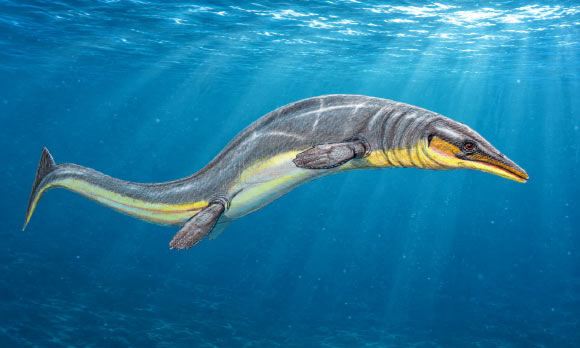
Globidens aegyptiacus Zdansky, 1934 - Ouled Abdoun, Khouribgha Province, Chaouia-Ouardigha Region, Morocco - Maastrichtian, Cretaceous (≈ -70,6 MA ± ≈ 0,6 MA)

Globidens aegyptiacus Zdansky, 1934 - Ouled Abdoun, Khouribgha Province, Chaouia-Ouardigha Region, Morocco - Maastrichtian, Cretaceous (≈ -70,6 MA ± ≈ 0,6 MA)

Maroc Crétacé Maastrichtien Globidens +1
Globidens aegyptiacus Zdansky, 1934 - Ouled Abdoun, Khouribgha Province, Chaouia-Ouardigha Region, Morocco - Maastrichtian, Cretaceous (≈ -70,6 MA ± ≈ 0,6 MA)

Globidens aegyptiacus Zdansky, 1934 - Ouled Abdoun, Khouribgha Province, Chaouia-Ouardigha Region, Morocco - Maastrichtian, Cretaceous (≈ -70,6 MA ± ≈ 0,6 MA)

Maroc Crétacé Maastrichtien Globidens +1
The Maastrichtian, Transylvanian giant azhdarchid pterosaur Hatzegopteryx sp. preys on the rhabdodontid iguanodontian Zalmoxes. Because large predatory theropods are unknown on Late Cretaceous Haţeg Island, giant azhdarchids may have played a key role as terrestrial predators in this community.

The Maastrichtian, Transylvanian giant azhdarchid pterosaur Hatzegopteryx sp. preys on the rhabdodontid iguanodontian Zalmoxes. Because large predatory theropods are unknown on Late Cretaceous Haţeg Island, giant azhdarchids may have played a key role as terrestrial predators in this community.

prédateur proie Crétacé Crétacé supérieur +8
Reconstruction of Mochlodon suessi from the Late Cretaceous of Austria. Based on Zalmoxes by Scott Hartman
Taxons Mochlodon

Reconstruction of Mochlodon suessi from the Late Cretaceous of Austria. Based on Zalmoxes by Scott Hartman

Autriche Crétacé Crétacé supérieur Mochlodon +1
Palaeogeographic distribution of late Early and early Late Cretaceous pterosaur assemblages. Taxonomic composition of assemblages shown on Fig. 1. Palaeogeography based on Smith et al. 1994. Abbreviations: 1. Cambridge Greensand, England: 2. Lower Chalk, England: 3. Züümbayan Svita, Khuren-Dukh, Mongolia: 4. Lysaya Gora, Saratov, Russia: 5. Kem Kem red beds, Morocco: 6. Paw Paw Formation, Texas, USA: 7. Lagarcito Formation, San Luis, Argentina: 8. Santana and Crato Formations, Ceara, Brazil: 9. Toolebuc Formation, Queensland, Australia.

Palaeogeographic distribution of late Early and early Late Cretaceous pterosaur assemblages. Taxonomic composition of assemblages shown on Fig. 1. Palaeogeography based on Smith et al. 1994. Abbreviations: 1. Cambridge Greensand, England: 2. Lower Chalk, England: 3. Züümbayan Svita, Khuren-Dukh, Mongolia: 4. Lysaya Gora, Saratov, Russia: 5. Kem Kem red beds, Morocco: 6. Paw Paw Formation, Texas, USA: 7. Lagarcito Formation, San Luis, Argentina: 8. Santana and Crato Formations, Ceara, Brazil: 9. Toolebuc Formation, Queensland, Australia.

Argentine Australie Brésil Mongolie +8
Locality map: Grand Staircase-Escalante National Monument, southern Utah.
Map showing the Nipple Butte area (indicated by yellow star) of Grand Staircase-Escalante National Monument (GSENM). GSENM is bounded by the red rectangle and silhouetted in dark gray on the inset of Utah and surrounding states (modified from [1]).

The original map has been modified to show the Nipple Butte area instead of the Machairoceratops fossil locality as in the original source. New location based on map in A New Macrovertebrate Assemblage from the Late Cretaceous (Campanian) of Southern Utah, page 601.

Locality map: Grand Staircase-Escalante National Monument, southern Utah. Map showing the Nipple Butte area (indicated by yellow star) of Grand Staircase-Escalante National Monument (GSENM). GSENM is bounded by the red rectangle and silhouetted in dark gray on the inset of Utah and surrounding states (modified from [1]). The original map has been modified to show the Nipple Butte area instead of the Machairoceratops fossil locality as in the original source. New location based on map in A New Macrovertebrate Assemblage from the Late Cretaceous (Campanian) of Southern Utah, page 601.

Campanien Crétacé Crétacé supérieur fossile +1
Kaiparowits Formation (Campanian; Upper Cretaceous) at The Blues, near Powell Point (peak to the left) composed of the Claron Formation.

Kaiparowits Formation (Campanian; Upper Cretaceous) at The Blues, near Powell Point (peak to the left) composed of the Claron Formation.

Kaiparowits Campanien Crétacé formation
1 2 3 4 5 6 7 8

Actualités

Un nouveau dinosaure Unenlagiid de Patagonie (Argentine)
Argentine Japon Crétacé Crétacé supérieur fossile Dinosauria Kank Unenlagiidae découverte formation nouvelle espèce
Une équipe de scientifiques argentins et japonais a décrit une nouvelle espèce de dinosaure unenlagiidé du sud de la Patagonie. Nommé Kank australis, ce petit dinosaure théropode vivait il y a environ 70 millions d'années à la fin du Crétacé. Les restes fossiles ont été découverts dans la formation Chorrillo de la province de Santa Cruz, en Argentine. La découverte aide mieux les paléontologues
02/06/2026 everythingdinosaur ⚙ Traduction automatique
Cet oiseau fossile arborait un étonnant plumage sur la queue
plume Crétacé fossile oiseau
Une espèce d'oiseau du Crétacé nouvellement décrite possédait d'étonnamment longues plumes sur la queue. Les chercheurs supposent qu'elles aidaient les mâles à séduire les femelles.
01/06/2026 sciencesetavenir
New Dinosaur Species from Argentina May Have Specialized in Catching Fish
De nouvelles espèces de dinosaures d'Argentine pourraient s'être spécialisées dans la capture de poissons
Argentine Crétacé Crétacé supérieur Dinosauria Kank Unenlagiidae
Des paléontologues argentins ont identifié une espèce jusqu'alors inconnue de dinosaures unenlagiidés qui parcouraient les zones humides d'eau douce à la fin du Crétacé, ajoutant ainsi la preuve que certains dinosaures se spécialisaient dans la capture de poissons. L'article De nouvelles espèces de dinosaures d'Argentine pourraient s'être spécialisées dans la capture de poissons est apparu en premier sur Sci.News : Breaking Science News.
29/05/2026 sci-news ⚙ Traduction automatique
Fungi Bloomed Twice around End-Cretaceous Mass Extinction
Les champignons ont fleuri deux fois autour de l'extinction massive de la fin du Crétacé
bassin Denver Crétacé Dinosauria extinction
En étudiant les microfossiles fongiques dans des échantillons de roches vieilles de 66 millions d'années du bassin de Denver, au Colorado, les microbiologistes de l'Université Johns Hopkins ont confirmé que l'impact de l'astéroïde tueur de dinosaures a déclenché une invasion fongique mondiale et a découvert une deuxième crise écologique, jusqu'alors inconnue, juste avant elle. L'article Les champignons ont fleuri deux fois autour de l'extinction massive de la fin du Crétacé est apparu en premier sur Sci.News : Breaking Science News.
28/05/2026 sci-news ⚙ Traduction automatique
Cretaceous Bird from China Had Pair of Tail Feathers Twice as Long as Its Body
Un oiseau du Crétacé de Chine avait une paire de plumes de queue deux fois plus longues que son corps
plume Chine Crétacé oiseau
Nommée Plumadraco bankoorum, l'espèce d'oiseau énantiornithine nouvellement décrite vivait dans ce qui est aujourd'hui le nord-est de la Chine pendant la période du Crétacé, il y a environ 121 millions d'années. L'article Un oiseau du Crétacé de Chine avait une paire de plumes de queue deux fois plus longues que son corps est apparu en premier sur Sci.News : Breaking Science News.
28/05/2026 sci-news ⚙ Traduction automatique
1 2 3 4 5 6 7