←

Crétacé

Intervalle géologique

163 image(s) · 59 Actualités

Voir la fiche

Galerie d'images

landscape of Montmorélien (Cretaceous Campanian), Charente, SW France

landscape of Montmorélien (Cretaceous Campanian), Charente, SW France

France Campanien Crétacé
A fossil tree from the Coal Creek region, Fruitland Formation, latest Cretaceous (Late Campanian), San Juan Basin, New Mexico

A fossil tree from the Coal Creek region, Fruitland Formation, latest Cretaceous (Late Campanian), San Juan Basin, New Mexico

Mexique Fruitland Campanien Crétacé +2
Holotype skull of the centrosaurine ceratopsian dinosaur Diabloceratops eatoni from the Late Cretaceous (Campanian) of the Wahweap Formation, Grand Staircase-Escalante National Monument, Utah. Photograph by Nick Longrich, 2023.

Holotype skull of the centrosaurine ceratopsian dinosaur Diabloceratops eatoni from the Late Cretaceous (Campanian) of the Wahweap Formation, Grand Staircase-Escalante National Monument, Utah. Photograph by Nick Longrich, 2023.

Campanien Crétacé Crétacé supérieur holotype +5
Outcrops of the Late Cretaceous (Campanian) aged Aguja Formation, Big Bend National Park, Texas, USA
Formations Aguja

Outcrops of the Late Cretaceous (Campanian) aged Aguja Formation, Big Bend National Park, Texas, USA

États-Unis Aguja Campanien Crétacé +2
Mawsonia , giant coelocanth from the Cretaceous period (Albian and Cenomanian stages) of South America and North Africa

Mawsonia , giant coelocanth from the Cretaceous period (Albian and Cenomanian stages) of South America and North Africa

Albien Cénomanien Crétacé
Life restoration of Cearadactylus atrox.
Based on figure 2 of "On the systematic relationships of Cearadactylus atrox, an enigmatic Early Cretaceous pterosaur from the Santana Formation of Brazil" by D. M. Unwin Mitteilungen Museum für Naturkunde Berlin, Geowissenschaftlichen Reihe 5: 239-263

Life restoration of Cearadactylus atrox. Based on figure 2 of "On the systematic relationships of Cearadactylus atrox, an enigmatic Early Cretaceous pterosaur from the Santana Formation of Brazil" by D. M. Unwin Mitteilungen Museum für Naturkunde Berlin, Geowissenschaftlichen Reihe 5: 239-263

musée Brésil Crétacé Crétacé inférieur +4
A map showing the distribution of paraves in Late Cretaceous with the respective paleogeographic setting.

A map showing the distribution of paraves in Late Cretaceous with the respective paleogeographic setting.

Crétacé Crétacé supérieur Paraves
A map showing the distribution of paraves in Early Cretaceous with respective paleogeographic setting.

A map showing the distribution of paraves in Early Cretaceous with respective paleogeographic setting.

Crétacé Crétacé inférieur Paraves
Diuqin is an unenlagiine dinosaur from the Late Cretaceous of what is now Argentina. Unenlagiines, known exclusively from South America, are usually classified as dromaeosaurs though this is sometimes debated. Like dromaeosaurs, they were covered in feathers, carnivorous, and had the large sickle-like claw on the inner toe of each foot. Unique to unenlagiines is their elongated snout, suggesting a piscivorous diet. Diuqin was a medium-sized unenlagiine, at about 4 m in length.

Diuqin is an unenlagiine dinosaur from the Late Cretaceous of what is now Argentina. Unenlagiines, known exclusively from South America, are usually classified as dromaeosaurs though this is sometimes debated. Like dromaeosaurs, they were covered in feathers, carnivorous, and had the large sickle-like claw on the inner toe of each foot. Unique to unenlagiines is their elongated snout, suggesting a piscivorous diet. Diuqin was a medium-sized unenlagiine, at about 4 m in length.

griffe plume Argentine Crétacé +5
Figure 1. Evolution of macroecological traits in Dinosauria. Large scale event in dinosaur evolution (a); the origin of dinosaurs (star), hyperthermals (volcano), the earliest fossil Avialae (bird), the earliest fossil angiosperm (flower), the Cretaceous/Palaeogene mass extinction (asteroid). Phylogeny of dinosaurs (b) redrawn from Sereno and adapted to the current consensus and upon which an ancestral state reconstruction of temperature niche (mean annual temperature) after Chiarenza et al. is plotted; Mesozoic palaeogeographies (c) for Triassic (T), Jurassic (J) and Cretaceous (K). Silhouette colours symbolize body mass for each of the taxa represented; information on dietary habits are plotted after Barrett and Zanno & Makovicky; numbers represent clades discussed through this study: 1, Ornithischia; 2, Thyreophora; 3, Ornithopoda; 4, Hadrosauroidea; 5, Marginocephalia; 6, Ceratopsia; 7, Saurischia; 8, Sauropodomorpha; 9, Sauropoda; 10, Theropoda; 11, Ceratosauria; 12, Tetanurae; 13, Coelurosauria; 14, Maniraptoriformes; 15, Maniraptora; 16, Deinonychosauria; 17, Avialae; 18, Ornithothoraces. Palaeogeographies modified from original plots via R package ‘mapast’ using plate models by Scotese.

Figure 1. Evolution of macroecological traits in Dinosauria. Large scale event in dinosaur evolution (a); the origin of dinosaurs (star), hyperthermals (volcano), the earliest fossil Avialae (bird), the earliest fossil angiosperm (flower), the Cretaceous/Palaeogene mass extinction (asteroid). Phylogeny of dinosaurs (b) redrawn from Sereno and adapted to the current consensus and upon which an ancestral state reconstruction of temperature niche (mean annual temperature) after Chiarenza et al. is plotted; Mesozoic palaeogeographies (c) for Triassic (T), Jurassic (J) and Cretaceous (K). Silhouette colours symbolize body mass for each of the taxa represented; information on dietary habits are plotted after Barrett and Zanno & Makovicky; numbers represent clades discussed through this study: 1, Ornithischia; 2, Thyreophora; 3, Ornithopoda; 4, Hadrosauroidea; 5, Marginocephalia; 6, Ceratopsia; 7, Saurischia; 8, Sauropodomorpha; 9, Sauropoda; 10, Theropoda; 11, Ceratosauria; 12, Tetanurae; 13, Coelurosauria; 14, Maniraptoriformes; 15, Maniraptora; 16, Deinonychosauria; 17, Avialae; 18, Ornithothoraces. Palaeogeographies modified from original plots via R package ‘mapast’ using plate models by Scotese.

écaille Crétacé Jurassique Mésozoïque +23
A photograph of partial specimen American Museum of Natural History (AMNH) 22555, skull without mandible, of Anhanguera sp. (formerly often assigned to Anhanguera santanae),[1] from the Early Cretaceous Romualdo Formation (former Romualdo Member of the Santana Formation) of NE Brazil in right lateral view.

A photograph of partial specimen American Museum of Natural History (AMNH) 22555, skull without mandible, of Anhanguera sp. (formerly often assigned to Anhanguera santanae),[1] from the Early Cretaceous Romualdo Formation (former Romualdo Member of the Santana Formation) of NE Brazil in right lateral view.

musée Brésil Conway Romualdo +7
A photograph of partial specimen American Museum of Natural History (AMNH) 22555, anterior dorsal vertebrae, dorsal ribs and partial shoulder girdle (at least right scapula) of Anhanguera sp. (formerly often assigned to Anhanguera santanae),[1] from the Early Cretaceous Romualdo Formation (former Romualdo Member of the Santana Formation) of NE Brazil in dorsal view.

A photograph of partial specimen American Museum of Natural History (AMNH) 22555, anterior dorsal vertebrae, dorsal ribs and partial shoulder girdle (at least right scapula) of Anhanguera sp. (formerly often assigned to Anhanguera santanae),[1] from the Early Cretaceous Romualdo Formation (former Romualdo Member of the Santana Formation) of NE Brazil in dorsal view.

musée Brésil Conway Romualdo +6
A photograph of partial specimen American Museum of Natural History (AMNH) 22555, posterior dorsal vertebrae, and the sacrum and pelvis (both iliae, and right ischium and pubis) of Anhanguera sp. (formerly often assigned to Anhanguera santanae),[1] from the Early Cretaceous Romualdo Formation (former Romualdo Member of the Santana Formation) of NE Brazil in dorsal view.

A photograph of partial specimen American Museum of Natural History (AMNH) 22555, posterior dorsal vertebrae, and the sacrum and pelvis (both iliae, and right ischium and pubis) of Anhanguera sp. (formerly often assigned to Anhanguera santanae),[1] from the Early Cretaceous Romualdo Formation (former Romualdo Member of the Santana Formation) of NE Brazil in dorsal view.

bassin musée Brésil Conway +7
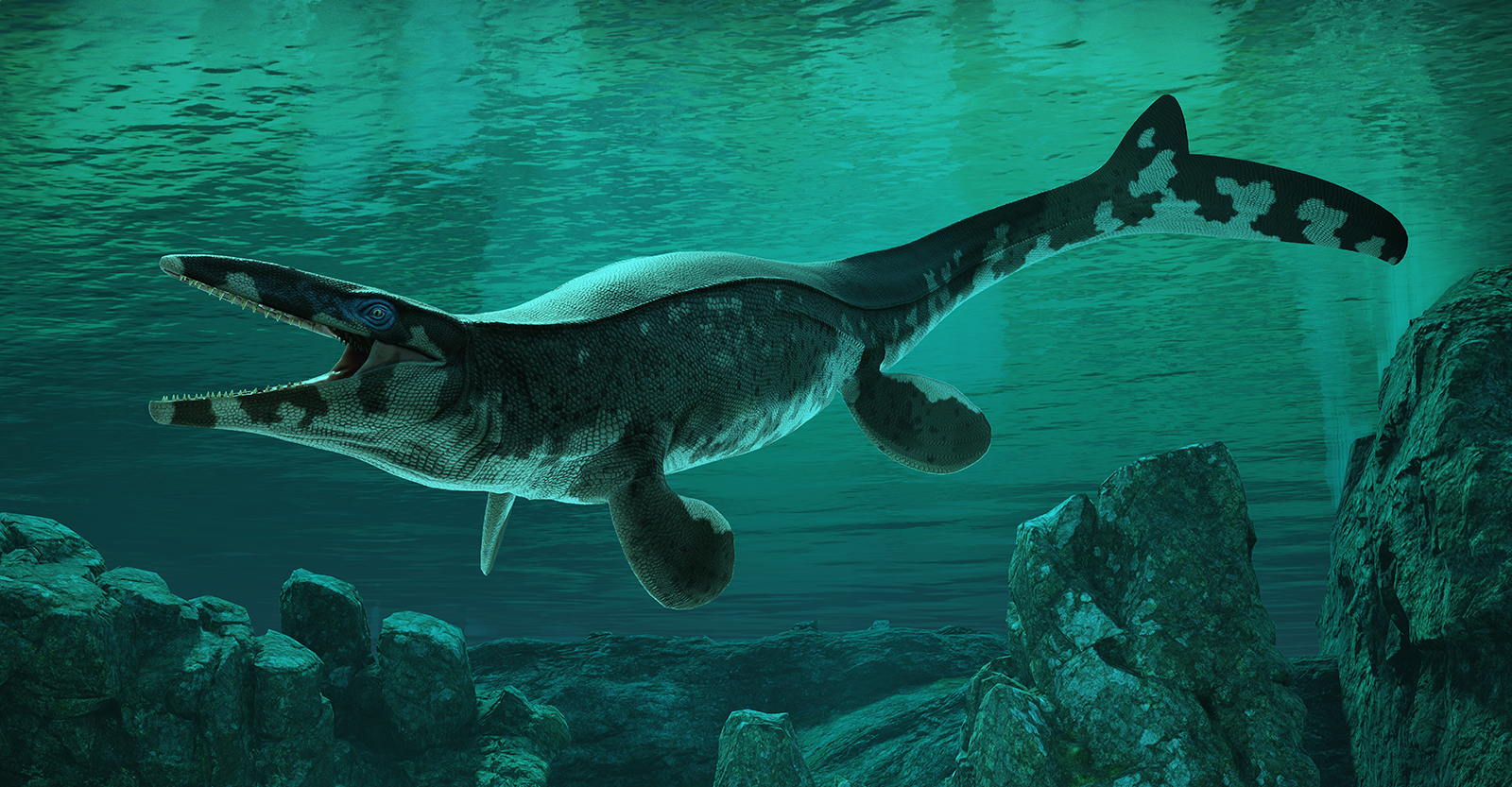
Reconstitution d'un Tylosaurus rex dans la voie maritime intérieure occidentale de l'Amérique du Nord, datant de l'époque du Crétacé.

Reconstitution d'un Tylosaurus rex dans la voie maritime intérieure occidentale de l'Amérique du Nord, datant de l'époque du Crétacé.

jeu reconstitution Crétacé Tylosaurus
Elasmosaurus platyurus, plesiosaurian from Late Cretaceous (Campanian) of North America

Elasmosaurus platyurus, plesiosaurian from Late Cretaceous (Campanian) of North America

Campanien Crétacé Crétacé supérieur Elasmosaurus +1
Elasmosaurus platyurus, plesiosaurian from Late Cretaceous (Campanian) of North America

Elasmosaurus platyurus, plesiosaurian from Late Cretaceous (Campanian) of North America

Campanien Crétacé Crétacé supérieur Elasmosaurus +1
1 2 3 4 5 6 7 8 9 10 11

Actualités

Elasmosaurus: Beast of the Week
Élasmosaure : la bête de la semaine
États-Unis Crétacé Crétacé supérieur Elasmosaurus
 Cette semaine, nous allons observer une bête marine dont les proportions étaient si scandaleuses qu'elles ont même dérouté les scientifiques ! Découvrez Elasmosaurus platyurus. L'Elasmosaurus était un grand reptile qui vivait dans la mer qui couvrait ce qui est aujourd'hui la partie centrale des États-Unis à la fin du Crétacé, il y a entre 80 et 77 millions d'années.  Du museau à la queue, il aurait mesuré environ 7,1 m et aurait mangé de la viande de son vivant.  Son nom de genre se traduit par « reptile en plaques », en référence à la façon dont
29/03/2026 prehistoricbeastoftheweek ⚙ Traduction automatique
Haolong: Beast of the Week
Haolong : Bête de la semaine
Chine Crétacé Crétacé inférieur juvénile spécimen Dinosauria Haolong
 Cette semaine, nous allons découvrir un dinosaure nouvellement décrit qui est si unique qu'il change complètement ce que nous pensions savoir sur la peau des dinosaures !  Entrez Haolong Dongi ! Haolong était un dinosaure herbivore qui vivait dans ce qui est aujourd'hui le Liaoning, en Chine, au début du Crétacé, il y a environ 112,5 millions d'années.  Le seul spécimen enregistré mesure environ 8 pieds (2,45 m) du bec à la queue, mais il était juvénile lorsqu'il est mort, l'espèce a donc probablement grandi.  Le nom du genre se traduit du chinois par "S
08/03/2026 prehistoricbeastoftheweek ⚙ Traduction automatique
Spinosaurus: Beast of the Week
Spinosaure : la bête de la semaine
Égypte Maroc Niger Crétacé Crétacé supérieur Dinosauria Spinosauria
Faites place (beaucoup d'espace... sauvegardez davantage... continuez... continuez... backbackbackback) pour le puissant Spinosaurus Aegyptiacus ! Le Spinosaurus était un dinosaure carnivore qui vivait dans ce qui est aujourd'hui l'Afrique, notamment en Égypte, au Maroc et au Niger, à la fin du Crétacé, il y a environ 97 à 95 millions d'années.  C'était un animal massif, le plus gros individu connu mesurant peut-être 49 pieds (environ 15 m) de long du museau à la queue à l'âge adulte, ce qui en fait le plus long dinosaure carnivore connu de la science.  La génération
22/02/2026 prehistoricbeastoftheweek ⚙ Traduction automatique
Ajkaceratops: Beast of the Week
Ajkaceratops : la bête de la semaine
Hongrie Crétacé Crétacé supérieur fossile Ajkaceratops Dinosauria
Cette semaine, nous allons découvrir un dinosaure unique qui vivait dans un environnement encore plus unique.  Parlons d'Ajkaceratops kozmai ! Ajkaceratops était un petit dinosaure herbivore qui vivait dans ce qui est aujourd'hui la Hongrie à la fin du Crétacé, il y a environ 85 millions d'années.  Du bec à la queue, il mesurait probablement un peu plus de 1 m de long.  Le nom du genre se traduit par « Ajka Horned Face », faisant référence à la ville de Hongrie près de l'endroit où ses fossiles ont été trouvés.  Aquarelle d'Ajkaceratops par C
18/01/2026 prehistoricbeastoftheweek ⚙ Traduction automatique
Parasaurolophus: Beast of the Week
Parasaurolophus : Bête de la semaine
crête Crétacé Crétacé supérieur spécimen Canardia Dinosauria Parasaurolophus
Cette semaine, nous allons nous intéresser à un dinosaure à bec de canard très populaire.  Dites bonjour à Parasaurolophus !  Le parasaurolophus était un herbivore qui vivait dans ce qui est aujourd'hui l'Amérique du Nord à la fin du Crétacé, il y a environ 77 à 73 millions d'années.  Le parasaurolophus mesurait environ 9,1 mètres de long du bec à la queue, mais certains spécimens incomplets montrent qu'ils étaient un peu plus grands.  Parasaurolophus est surtout connu pour sa longue crête incurvée qui s'est développée à l'arrière de sa tête, givi
21/12/2025 prehistoricbeastoftheweek ⚙ Traduction automatique
1 2 3 4 5 6 7 8 9 10 11 12