Crétacé

Intervalle géologique

121 image(s) · 33 Actualités

Voir la fiche

Galerie d'images

Kaikaifilu pectorals, done on inkscape.
Based on pictures and diagrams from "Kaikaifilu hervei  gen. et sp. nov., a new large mosasaur (Squamata, Mosasauridae) from the upper Maastrichtian of Antarctica. Cretaceous Research".
Taxons Kaikaifilu

Kaikaifilu pectorals, done on inkscape. Based on pictures and diagrams from "Kaikaifilu hervei gen. et sp. nov., a new large mosasaur (Squamata, Mosasauridae) from the upper Maastrichtian of Antarctica. Cretaceous Research".

Antarctique Crétacé Maastrichtien Kaikaifilu +1
Muzquizopteryx coahuilensis (Familyː Nyctosauridae) is a species of nyctosaurid pterodactyloid pterosaur from the Late Cretaceous period (early Coniacian stage) of what is now Coahuila, Mexico.
Taxons Muzquizopteryx

Muzquizopteryx coahuilensis (Familyː Nyctosauridae) is a species of nyctosaurid pterodactyloid pterosaur from the Late Cretaceous period (early Coniacian stage) of what is now Coahuila, Mexico.

Mexique Coniacien Crétacé Crétacé supérieur +3
Alvarezsauroid theropod Linhenykus monodactylus Xu, Sullivan, Pittman, Choiniere, Hone, Upchurch, Tan, Xiao, Tan, and Han, 2011a,

Bayan Mandahu (“Gate Locality”), Late Cretaceous (Campanian), holo−type (IVPP V17608). Skeletal silhouette showing preserved bones (missing portions shown in grey).
Taxons Linhenykus

Alvarezsauroid theropod Linhenykus monodactylus Xu, Sullivan, Pittman, Choiniere, Hone, Upchurch, Tan, Xiao, Tan, and Han, 2011a, Bayan Mandahu (“Gate Locality”), Late Cretaceous (Campanian), holo−type (IVPP V17608). Skeletal silhouette showing preserved bones (missing portions shown in grey).

os Campanien Crétacé Crétacé supérieur +1
Line diagram of the holotype specimen (ZPAL MgD-I/117) of the protoceratopsid Breviceratops kozlowskii. Based on Maryańska & Osmólska 1975,[1] and Czepiński 2019.[2]
References

↑ (1975). "Protoceratopsidae (Dinosauria) of Asia". Palaeontologia Polonica 33: 134−143. Archived from the original on 2018-09-21. Retrieved on 2021-07-25.

↑ (2019). "Ontogeny and variation of a protoceratopsid dinosaur Bagaceratops rozhdestvenskyi from the Late Cretaceous of the Gobi Desert". Historical Biology: 1−28. DOI:10.1080/08912963.2019.1593404. Archived from the original on 2021-07-08. Retrieved on 2021-07-25.
Taxons Breviceratops

Line diagram of the holotype specimen (ZPAL MgD-I/117) of the protoceratopsid Breviceratops kozlowskii. Based on Maryańska & Osmólska 1975,[1] and Czepiński 2019.[2] References ↑ (1975). "Protoceratopsidae (Dinosauria) of Asia". Palaeontologia Polonica 33: 134−143. Archived from the original on 2018-09-21. Retrieved on 2021-07-25. ↑ (2019). "Ontogeny and variation of a protoceratopsid dinosaur Bagaceratops rozhdestvenskyi from the Late Cretaceous of the Gobi Desert". Historical Biology: 1−28. DOI:10.1080/08912963.2019.1593404. Archived from the original on 2021-07-08. Retrieved on 2021-07-25.

ontogenèse Crétacé Crétacé supérieur holotype +5
Fossil specimen of early Cretaceous pterosaur Sinopterus dongi, which is collected from Chaoyang, Liaoning, China. The specimen (BMNHC Ph773) is a collection of Beijing Museum of Natural History and was on display in the National Museum of Natural Science (Taichung, Taiwan) during a special exhibition.
Taxons Sinopterus

Fossil specimen of early Cretaceous pterosaur Sinopterus dongi, which is collected from Chaoyang, Liaoning, China. The specimen (BMNHC Ph773) is a collection of Beijing Museum of Natural History and was on display in the National Museum of Natural Science (Taichung, Taiwan) during a special exhibition.

musée Chine Taïwan Crétacé +6
Fossil specimen of early Cretaceous pterosaur Sinopterus dongi, which is collected from Chaoyang, Liaoning, China. The specimen (BMNHC Ph773) is a collection of Beijing Museum of Natural History and was on display in the National Museum of Natural Science (Taichung, Taiwan) during a special exhibition.
Taxons Huaxiapterus

Fossil specimen of early Cretaceous pterosaur Sinopterus dongi, which is collected from Chaoyang, Liaoning, China. The specimen (BMNHC Ph773) is a collection of Beijing Museum of Natural History and was on display in the National Museum of Natural Science (Taichung, Taiwan) during a special exhibition.

musée Chine Taïwan Crétacé +6
Montanoceratops cerorhynchus (Brown & Schlaikjer, 1942) - fossil ceratopsian dinosaur skeleton from the Cretaceous of Montana, USA. (MOR 542, Museum of the Rockies, Bozeman, Montana, USA)
The species name is sometimes incorrectly spelled "cerorhynchos".  The original publication spells it "cerorhynchus".  The genus name is sometimes incorrectly spelled "Montanaceratops".
Ceratopsians are the "horned dinosaurs".  They were large, quadrupedal, herbivorous dinosaurs having a beaked skull and a frill - an extension of bone behind the skull that partially covered the neck.  Ceratopsian dinosaurs are known from the Jurassic and Cretaceous.  The last members of the group died out at the Cretaceous-Tertiary boundary, 65 million years ago.
This is a partial skeleton of a juvenile Montanoceratops, a ceratopsian from the near-latest Cretaceous of western North America.  This type of ceratopsian lacked facial horns.


From exhibit signage:
Sixty-eight million years ago, when the horned dinosaurs Triceratops and Torosaurus inhabited the coastal plain near the inland ocean, primitive "horned" dinosaurs named Montanoceratops lived in uplands near the young Rocky Mountains.  These little protoceratopsians fed on plants with slicing teeth and narrow beaks similar to their giant three-horned relatives.


Classification: Animalia, Chordata, Vertebrata, Reptilia, Archosauria, Dinosauria, Ornithischia, Marginocephalia, Ceratopsia, Leptoceratopsidae
Stratigraphy: St. Mary River Formation, Maastrichtian Stage, Upper Cretaceous
Locality: Little Rocky Coulee, north of the town of Cut Bank, eastern Glacier County, northwestern Montana, USA


Info. at:

en.wikipedia.org/wiki/Montanoceratops
Taxons Montanoceratops

Montanoceratops cerorhynchus (Brown & Schlaikjer, 1942) - fossil ceratopsian dinosaur skeleton from the Cretaceous of Montana, USA. (MOR 542, Museum of the Rockies, Bozeman, Montana, USA) The species name is sometimes incorrectly spelled "cerorhynchos". The original publication spells it "cerorhynchus". The genus name is sometimes incorrectly spelled "Montanaceratops". Ceratopsians are the "horned dinosaurs". They were large, quadrupedal, herbivorous dinosaurs having a beaked skull and a frill - an extension of bone behind the skull that partially covered the neck. Ceratopsian dinosaurs are known from the Jurassic and Cretaceous. The last members of the group died out at the Cretaceous-Tertiary boundary, 65 million years ago. This is a partial skeleton of a juvenile Montanoceratops, a ceratopsian from the near-latest Cretaceous of western North America. This type of ceratopsian lacked facial horns. From exhibit signage: Sixty-eight million years ago, when the horned dinosaurs Triceratops and Torosaurus inhabited the coastal plain near the inland ocean, primitive "horned" dinosaurs named Montanoceratops lived in uplands near the young Rocky Mountains. These little protoceratopsians fed on plants with slicing teeth and narrow beaks similar to their giant three-horned relatives. Classification: Animalia, Chordata, Vertebrata, Reptilia, Archosauria, Dinosauria, Ornithischia, Marginocephalia, Ceratopsia, Leptoceratopsidae Stratigraphy: St. Mary River Formation, Maastrichtian Stage, Upper Cretaceous Locality: Little Rocky Coulee, north of the town of Cut Bank, eastern Glacier County, northwestern Montana, USA Info. at: en.wikipedia.org/wiki/Montanoceratops

os musée États-Unis Crétacé +10
Muttaburrasaurus
The plants, animals and climate of the Australian continent have changed dramatically over long periods of time. Imagine this giant creature roaming the luxuriant wet forests that covered parts of the continent in the Cretaceous period, about 100-110 million years ago. The Muttaburrasaurus ambled along on all four legs or stood on its hind legs. Its large teeth were well adapted to eat tough vegetation such as the leathery foliage of the evergreen forests of Araucaria trees, ancient relatives of the bunya pine of south-eastern Queensland.
In 1963, grazier Doug Langdon discovered the fossilised bones of a dinosaur on his property near Muttaburra in central-west Queensland. It was one of the most complete dinosaur skeletons found in Australia. The bones belonged to a new species of ornithopod and palaeontologists named it Muttaburrasaurus langdoni.

Cast of Muttaburresaurus langdoni 1987 made by Queensland Museum, Brisbane National Museum of Australia
Taxons Muttaburrasaurus

Muttaburrasaurus The plants, animals and climate of the Australian continent have changed dramatically over long periods of time. Imagine this giant creature roaming the luxuriant wet forests that covered parts of the continent in the Cretaceous period, about 100-110 million years ago. The Muttaburrasaurus ambled along on all four legs or stood on its hind legs. Its large teeth were well adapted to eat tough vegetation such as the leathery foliage of the evergreen forests of Araucaria trees, ancient relatives of the bunya pine of south-eastern Queensland. In 1963, grazier Doug Langdon discovered the fossilised bones of a dinosaur on his property near Muttaburra in central-west Queensland. It was one of the most complete dinosaur skeletons found in Australia. The bones belonged to a new species of ornithopod and palaeontologists named it Muttaburrasaurus langdoni. Cast of Muttaburresaurus langdoni 1987 made by Queensland Museum, Brisbane National Museum of Australia

os musée Australie Crétacé +5
Azhdarcho sp., ZIN PH 56/43, distal fragment of a right ulna in proximal (a), ventral (b), posterior (c), dorsal (d), anterior (e), and distal (f, stereopair) views. This specimen is from the Tyulkili locality in the northeastern Aral Sea region of Kazakhstan; Zhirkindek Formation, Upper Cretaceous (upper Turonian – Coniacian). Abbreviations: das, dorsal articulation surface; ft, groove for flexor tendon; tub, tuberculum; vf, ventral fovea. Scale bar is 10 mm.
Taxons Azhdarcho

Azhdarcho sp., ZIN PH 56/43, distal fragment of a right ulna in proximal (a), ventral (b), posterior (c), dorsal (d), anterior (e), and distal (f, stereopair) views. This specimen is from the Tyulkili locality in the northeastern Aral Sea region of Kazakhstan; Zhirkindek Formation, Upper Cretaceous (upper Turonian – Coniacian). Abbreviations: das, dorsal articulation surface; ft, groove for flexor tendon; tub, tuberculum; vf, ventral fovea. Scale bar is 10 mm.

écaille Kazakhstan Coniacien Crétacé +4
Dentary of Echinodon becklesii from the Lower Cretaceous Purbeck Formation of England. Left dentary (NHMUK 48215b) in lateral (A), medial (B), and dorsal (C) views.
Taxons Echinodon

Dentary of Echinodon becklesii from the Lower Cretaceous Purbeck Formation of England. Left dentary (NHMUK 48215b) in lateral (A), medial (B), and dorsal (C) views.

Crétacé Echinodon Sauraechmodon formation
Dentary of Echinodon becklesii from the Lower Cretaceous Purbeck Formation of England. Left dentary (NHMUK 48215b) in lateral (A), medial (B), and dorsal (C) views.
Taxons Sauraechmodon

Dentary of Echinodon becklesii from the Lower Cretaceous Purbeck Formation of England. Left dentary (NHMUK 48215b) in lateral (A), medial (B), and dorsal (C) views.

Crétacé Echinodon Sauraechmodon formation
Comparison of cranial features between closely related southern Laramidian taxa; (A), Akainacephalus johnsoni (UMNH VP 20202) from the Late Cretaceous Kaiparowits Formation of Utah; and (B), Nodocephalosaurus kirtlandensis (SMP VP-900) from the Late Cretaceous Kirtland Formation of New Mexico, in left lateral views. Various synapomorphies are shared with N. kirtlandensis (highlighted in black and white arrows) and includes “flaring nostrils”; enlarged, laterally projecting, loreal osteoderms that are situated directly dorsal to the external nares. Other synapomorphies include pyramid-shaped nasal and frontal osteoderms positioned on the dorsal regions of the skull. A number of significant differences have been observed between both specimens; in A. johnsoni, the anterior, and posterior supraorbital bosses form an enlarged element that is somewhat backswept, whereas in N. kirtlandensis, the posterior and anterior supraorbital bosses are clearly defined as individual osteoderms, and are much smaller in size. Additionally, the squamosal horn in Akainacephalus is very small but is prominent and tetrahedrally shaped in Nodocephalosaurus. The quadratojugal horn in Akainacephalus is massive, has a subtriangular morphology in lateral view and projects almost entirely ventral, whereas in Nodocephalosaurus, the quadratojugal horn is smaller and has a typical fin-shaped morphology. Study sites: asob, anterior supraorbital boss; ext naris, external naris; laca, lacrimal caputegulum; loca, loreal caputegulum; naca, nasal caputegulae; orb, orbit; psob, posterior supraorbital boss; qjh, quadratojugal horn; sqh, squamosal horn.
Taxons Nodocephalosaurus

Comparison of cranial features between closely related southern Laramidian taxa; (A), Akainacephalus johnsoni (UMNH VP 20202) from the Late Cretaceous Kaiparowits Formation of Utah; and (B), Nodocephalosaurus kirtlandensis (SMP VP-900) from the Late Cretaceous Kirtland Formation of New Mexico, in left lateral views. Various synapomorphies are shared with N. kirtlandensis (highlighted in black and white arrows) and includes “flaring nostrils”; enlarged, laterally projecting, loreal osteoderms that are situated directly dorsal to the external nares. Other synapomorphies include pyramid-shaped nasal and frontal osteoderms positioned on the dorsal regions of the skull. A number of significant differences have been observed between both specimens; in A. johnsoni, the anterior, and posterior supraorbital bosses form an enlarged element that is somewhat backswept, whereas in N. kirtlandensis, the posterior and anterior supraorbital bosses are clearly defined as individual osteoderms, and are much smaller in size. Additionally, the squamosal horn in Akainacephalus is very small but is prominent and tetrahedrally shaped in Nodocephalosaurus. The quadratojugal horn in Akainacephalus is massive, has a subtriangular morphology in lateral view and projects almost entirely ventral, whereas in Nodocephalosaurus, the quadratojugal horn is smaller and has a typical fin-shaped morphology. Study sites: asob, anterior supraorbital boss; ext naris, external naris; laca, lacrimal caputegulum; loca, loreal caputegulum; naca, nasal caputegulae; orb, orbit; psob, posterior supraorbital boss; qjh, quadratojugal horn; sqh, squamosal horn.

Mexique Kaiparowits Kirtland Crétacé +6
Digital illustration of the Sauropod Dinosaur Isisaurus colberti from the Late Cretaceous (Maastrichtian) of India (72.2-66 MYA). References include Jain & Bandyopadhyay (1997), several papers from Wilson et al. and skeletal reconstruction by Scott Hartman.
Illustrated by Ansh Saxena.
About Isisaurus–

Isisaurus colberti (=Titanosaurus colberti) was a species of Titanosaurian Sauropod Dinosaur from the Late Cretaceous (Maastrichtian) age in the Indian Subcontinent. Isisaurus lived sympatrically with another Titanosaurian Sauropod Jainosaurus. It also lived alongside Theropods like Rajasaurus, Rahiolisaurus, Indosuchus etc. Remains of Isisaurus come from the Lameta formation of Central India.
Taxons Isisaurus

Digital illustration of the Sauropod Dinosaur Isisaurus colberti from the Late Cretaceous (Maastrichtian) of India (72.2-66 MYA). References include Jain & Bandyopadhyay (1997), several papers from Wilson et al. and skeletal reconstruction by Scott Hartman. Illustrated by Ansh Saxena. About Isisaurus– Isisaurus colberti (=Titanosaurus colberti) was a species of Titanosaurian Sauropod Dinosaur from the Late Cretaceous (Maastrichtian) age in the Indian Subcontinent. Isisaurus lived sympatrically with another Titanosaurian Sauropod Jainosaurus. It also lived alongside Theropods like Rajasaurus, Rahiolisaurus, Indosuchus etc. Remains of Isisaurus come from the Lameta formation of Central India.

Inde Lameta Crétacé Crétacé supérieur +9
Restoration of Asiaceratops salsopaludalis a ceratopsian dinosaur from the Late Cretaceous of Uzbekistan
Taxons Asiaceratops

Restoration of Asiaceratops salsopaludalis a ceratopsian dinosaur from the Late Cretaceous of Uzbekistan

Ouzbékistan Crétacé Crétacé supérieur Asiaceratops +2
The titanosaurian sauropod Lirainosaurus astibiae Sanz, Powell, Le Loeuff, Martínez, and Pereda Suberbiola, 1999 from the Late Cretaceous of Laño (northern Spain), paratypic braincase (MCNA 7439). Right lateral, left lateral, posterior, and anterior views.
Taxons Lirainosaurus

The titanosaurian sauropod Lirainosaurus astibiae Sanz, Powell, Le Loeuff, Martínez, and Pereda Suberbiola, 1999 from the Late Cretaceous of Laño (northern Spain), paratypic braincase (MCNA 7439). Right lateral, left lateral, posterior, and anterior views.

Espagne Crétacé Crétacé supérieur Lirainosaurus +1
The nodosaurid dinosaur, Glyptodontopelta is mostly known from isolated osteoderms ("armor plates"). The specimen SMP VP-1580 (State Museum of Pennysylvania) is however, the most complete known specimen, comprising parts of the skull, hundreds of osteoderms and fragments. This specimen was discovered in 2003 by Warwick Fowler, in the Naashoibito Member of the Ojo Alamo Formation (Maatrichtian, Late Cretaceous) of the San Juan Basin, New Mexico, during an expedition led by Dr. Robert Sullivan.
Taxons Glyptodontopelta

The nodosaurid dinosaur, Glyptodontopelta is mostly known from isolated osteoderms ("armor plates"). The specimen SMP VP-1580 (State Museum of Pennysylvania) is however, the most complete known specimen, comprising parts of the skull, hundreds of osteoderms and fragments. This specimen was discovered in 2003 by Warwick Fowler, in the Naashoibito Member of the Ojo Alamo Formation (Maatrichtian, Late Cretaceous) of the San Juan Basin, New Mexico, during an expedition led by Dr. Robert Sullivan.

armure musée Mexique Denver +9
1 2 3 4 5 6 7 8

Actualités

Mexidracon: Beast of the Week
Mexidracon : Bête de la semaine
Mexique Crétacé Crétacé supérieur Dinosauria
 Cette semaine, nous allons nous intéresser à un théropode inhabituel.  Découvrez Mexidracon longimanus !Mexidracon était un dinosaure théropode qui vivait dans ce qui est aujourd'hui Coahuila, au Mexique, à la fin du Crétacé, il y a environ 72 millions d'années.  Du bec à la queue, il mesurait environ 3 mètres de long.  Son nom de genre se traduit par « Dragon mexicain » et son nom d'espèce par « longue main ».  Il se peut qu'il ait mangé des plantes de son vivant ou qu'il ait peut-être mangé un mélange de plantes et de viande.  Reconstruction de la vie du Mexidracon dans
03/05/2026 prehistoricbeastoftheweek ⚙ Traduction automatique
In Cretaceous Oceans, Giant ‘Kraken-Like’ Octopuses May Have Been Top Predators
Dans les océans du Crétacé, les poulpes géants « ressemblant à un Kraken » pourraient avoir été les principaux prédateurs
prédateur Crétacé
D'énormes céphalopodes au corps mou, mesurant jusqu'à 19 m de long, rivalisaient - et peut-être chassaient - avec les reptiles les plus féroces de l'océan au Crétacé, selon une nouvelle recherche menée par des paléontologues de l'Université d'Hokkaido. L'article Dans les océans du Crétacé, les poulpes géants « ressemblant à un Kraken » pourraient avoir été les principaux prédateurs est apparu en premier sur Sci.News : Breaking Science News.
27/04/2026 sci-news ⚙ Traduction automatique
Peloroplites: Beast of the Week
Péloroplites : la bête de la semaine
États-Unis Cedar Mountain Lance Crétacé Dinosauria Peloroplites
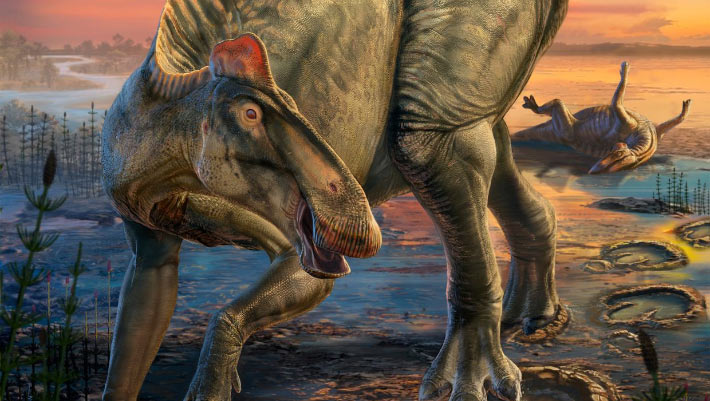
 Cette semaine, nous allons découvrir un grand dinosaure tank.  Entrez Peloroplites cedrimontanus ! Le Peloroplites était un dinosaure herbivore qui vivait dans ce qui est aujourd'hui l'Utah, aux États-Unis, pendant la période du Crétacé, il y a entre 98 et 93 millions d'années.  Du museau à la queue, il mesurait environ 6 m de long.  Son nom de genre se traduit par « Hoplite géant » en référence aux hoplites, les anciens soldats grecs qui portaient des lances et de grands boucliers.  Le nom de l'espèce se traduit par « Cedar Mountain ».
19/04/2026 prehistoricbeastoftheweek ⚙ Traduction automatique
Diamantinasaurus: Beast of the Week
Diamantinasaurus : Bête de la semaine
Australie Crétacé Diamantinasauria Dinosauria
Cette semaine, nous allons découvrir une bête qui nous aide grandement à comprendre à quoi ressemblaient et vivaient les dinosaures sauropodes (« à long cou »).  Découvrez Diamantinasaurus matildae ! Le Diamantinasaurus vivait dans ce qui est aujourd'hui le Queensland, en Australie, au cours du Crétacé moyen, il y a entre 95 et 92 millions d'années.  Il est considéré comme de taille moyenne pour un sauropode et aurait mesuré environ 16 m de long du museau à la queue. (Oui. 52 pieds n'est qu'une taille moyenne pour les sauropodes !) Comme tous les sauropodes, il aurait mangé
12/04/2026 prehistoricbeastoftheweek ⚙ Traduction automatique
Elasmosaurus: Beast of the Week
Élasmosaure : la bête de la semaine
États-Unis Crétacé Crétacé supérieur Elasmosaurus
 Cette semaine, nous allons observer une bête marine dont les proportions étaient si scandaleuses qu'elles ont même dérouté les scientifiques ! Découvrez Elasmosaurus platyurus. L'Elasmosaurus était un grand reptile qui vivait dans la mer qui couvrait ce qui est aujourd'hui la partie centrale des États-Unis à la fin du Crétacé, il y a entre 80 et 77 millions d'années.  Du museau à la queue, il aurait mesuré environ 7,1 m et aurait mangé de la viande de son vivant.  Son nom de genre se traduit par « reptile en plaques », en référence à la façon dont
29/03/2026 prehistoricbeastoftheweek ⚙ Traduction automatique
1 2 3 4 5 6 7