←

Crétacé

Intervalle géologique

163 image(s) · 59 Actualités

Voir la fiche

Galerie d'images

landscape of Montmorélien (Cretaceous Campanian), Charente, SW France

landscape of Montmorélien (Cretaceous Campanian), Charente, SW France

France Campanien Crétacé
A fossil tree from the Coal Creek region, Fruitland Formation, latest Cretaceous (Late Campanian), San Juan Basin, New Mexico

A fossil tree from the Coal Creek region, Fruitland Formation, latest Cretaceous (Late Campanian), San Juan Basin, New Mexico

Mexique Fruitland Campanien Crétacé +2
Holotype skull of the centrosaurine ceratopsian dinosaur Diabloceratops eatoni from the Late Cretaceous (Campanian) of the Wahweap Formation, Grand Staircase-Escalante National Monument, Utah. Photograph by Nick Longrich, 2023.

Holotype skull of the centrosaurine ceratopsian dinosaur Diabloceratops eatoni from the Late Cretaceous (Campanian) of the Wahweap Formation, Grand Staircase-Escalante National Monument, Utah. Photograph by Nick Longrich, 2023.

Campanien Crétacé Crétacé supérieur holotype +5
Outcrops of the Late Cretaceous (Campanian) aged Aguja Formation, Big Bend National Park, Texas, USA
Formations Aguja

Outcrops of the Late Cretaceous (Campanian) aged Aguja Formation, Big Bend National Park, Texas, USA

États-Unis Aguja Campanien Crétacé +2
Mawsonia , giant coelocanth from the Cretaceous period (Albian and Cenomanian stages) of South America and North Africa

Mawsonia , giant coelocanth from the Cretaceous period (Albian and Cenomanian stages) of South America and North Africa

Albien Cénomanien Crétacé
Life restoration of Cearadactylus atrox.
Based on figure 2 of "On the systematic relationships of Cearadactylus atrox, an enigmatic Early Cretaceous pterosaur from the Santana Formation of Brazil" by D. M. Unwin Mitteilungen Museum für Naturkunde Berlin, Geowissenschaftlichen Reihe 5: 239-263

Life restoration of Cearadactylus atrox. Based on figure 2 of "On the systematic relationships of Cearadactylus atrox, an enigmatic Early Cretaceous pterosaur from the Santana Formation of Brazil" by D. M. Unwin Mitteilungen Museum für Naturkunde Berlin, Geowissenschaftlichen Reihe 5: 239-263

musée Brésil Crétacé Crétacé inférieur +4
A map showing the distribution of paraves in Late Cretaceous with the respective paleogeographic setting.

A map showing the distribution of paraves in Late Cretaceous with the respective paleogeographic setting.

Crétacé Crétacé supérieur Paraves
A map showing the distribution of paraves in Early Cretaceous with respective paleogeographic setting.

A map showing the distribution of paraves in Early Cretaceous with respective paleogeographic setting.

Crétacé Crétacé inférieur Paraves
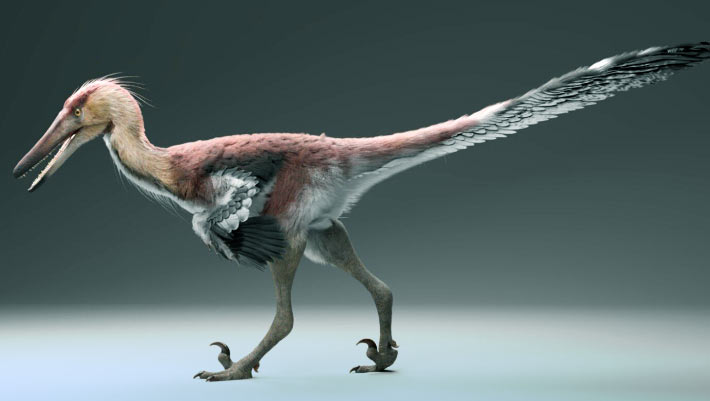
Diuqin is an unenlagiine dinosaur from the Late Cretaceous of what is now Argentina. Unenlagiines, known exclusively from South America, are usually classified as dromaeosaurs though this is sometimes debated. Like dromaeosaurs, they were covered in feathers, carnivorous, and had the large sickle-like claw on the inner toe of each foot. Unique to unenlagiines is their elongated snout, suggesting a piscivorous diet. Diuqin was a medium-sized unenlagiine, at about 4 m in length.

Diuqin is an unenlagiine dinosaur from the Late Cretaceous of what is now Argentina. Unenlagiines, known exclusively from South America, are usually classified as dromaeosaurs though this is sometimes debated. Like dromaeosaurs, they were covered in feathers, carnivorous, and had the large sickle-like claw on the inner toe of each foot. Unique to unenlagiines is their elongated snout, suggesting a piscivorous diet. Diuqin was a medium-sized unenlagiine, at about 4 m in length.

griffe plume Argentine Crétacé +5
Figure 1. Evolution of macroecological traits in Dinosauria. Large scale event in dinosaur evolution (a); the origin of dinosaurs (star), hyperthermals (volcano), the earliest fossil Avialae (bird), the earliest fossil angiosperm (flower), the Cretaceous/Palaeogene mass extinction (asteroid). Phylogeny of dinosaurs (b) redrawn from Sereno and adapted to the current consensus and upon which an ancestral state reconstruction of temperature niche (mean annual temperature) after Chiarenza et al. is plotted; Mesozoic palaeogeographies (c) for Triassic (T), Jurassic (J) and Cretaceous (K). Silhouette colours symbolize body mass for each of the taxa represented; information on dietary habits are plotted after Barrett and Zanno & Makovicky; numbers represent clades discussed through this study: 1, Ornithischia; 2, Thyreophora; 3, Ornithopoda; 4, Hadrosauroidea; 5, Marginocephalia; 6, Ceratopsia; 7, Saurischia; 8, Sauropodomorpha; 9, Sauropoda; 10, Theropoda; 11, Ceratosauria; 12, Tetanurae; 13, Coelurosauria; 14, Maniraptoriformes; 15, Maniraptora; 16, Deinonychosauria; 17, Avialae; 18, Ornithothoraces. Palaeogeographies modified from original plots via R package ‘mapast’ using plate models by Scotese.

Figure 1. Evolution of macroecological traits in Dinosauria. Large scale event in dinosaur evolution (a); the origin of dinosaurs (star), hyperthermals (volcano), the earliest fossil Avialae (bird), the earliest fossil angiosperm (flower), the Cretaceous/Palaeogene mass extinction (asteroid). Phylogeny of dinosaurs (b) redrawn from Sereno and adapted to the current consensus and upon which an ancestral state reconstruction of temperature niche (mean annual temperature) after Chiarenza et al. is plotted; Mesozoic palaeogeographies (c) for Triassic (T), Jurassic (J) and Cretaceous (K). Silhouette colours symbolize body mass for each of the taxa represented; information on dietary habits are plotted after Barrett and Zanno & Makovicky; numbers represent clades discussed through this study: 1, Ornithischia; 2, Thyreophora; 3, Ornithopoda; 4, Hadrosauroidea; 5, Marginocephalia; 6, Ceratopsia; 7, Saurischia; 8, Sauropodomorpha; 9, Sauropoda; 10, Theropoda; 11, Ceratosauria; 12, Tetanurae; 13, Coelurosauria; 14, Maniraptoriformes; 15, Maniraptora; 16, Deinonychosauria; 17, Avialae; 18, Ornithothoraces. Palaeogeographies modified from original plots via R package ‘mapast’ using plate models by Scotese.

écaille Crétacé Jurassique Mésozoïque +23
A photograph of partial specimen American Museum of Natural History (AMNH) 22555, skull without mandible, of Anhanguera sp. (formerly often assigned to Anhanguera santanae),[1] from the Early Cretaceous Romualdo Formation (former Romualdo Member of the Santana Formation) of NE Brazil in right lateral view.

A photograph of partial specimen American Museum of Natural History (AMNH) 22555, skull without mandible, of Anhanguera sp. (formerly often assigned to Anhanguera santanae),[1] from the Early Cretaceous Romualdo Formation (former Romualdo Member of the Santana Formation) of NE Brazil in right lateral view.

musée Brésil Conway Romualdo +7
A photograph of partial specimen American Museum of Natural History (AMNH) 22555, anterior dorsal vertebrae, dorsal ribs and partial shoulder girdle (at least right scapula) of Anhanguera sp. (formerly often assigned to Anhanguera santanae),[1] from the Early Cretaceous Romualdo Formation (former Romualdo Member of the Santana Formation) of NE Brazil in dorsal view.

A photograph of partial specimen American Museum of Natural History (AMNH) 22555, anterior dorsal vertebrae, dorsal ribs and partial shoulder girdle (at least right scapula) of Anhanguera sp. (formerly often assigned to Anhanguera santanae),[1] from the Early Cretaceous Romualdo Formation (former Romualdo Member of the Santana Formation) of NE Brazil in dorsal view.

musée Brésil Conway Romualdo +6
A photograph of partial specimen American Museum of Natural History (AMNH) 22555, posterior dorsal vertebrae, and the sacrum and pelvis (both iliae, and right ischium and pubis) of Anhanguera sp. (formerly often assigned to Anhanguera santanae),[1] from the Early Cretaceous Romualdo Formation (former Romualdo Member of the Santana Formation) of NE Brazil in dorsal view.

A photograph of partial specimen American Museum of Natural History (AMNH) 22555, posterior dorsal vertebrae, and the sacrum and pelvis (both iliae, and right ischium and pubis) of Anhanguera sp. (formerly often assigned to Anhanguera santanae),[1] from the Early Cretaceous Romualdo Formation (former Romualdo Member of the Santana Formation) of NE Brazil in dorsal view.

bassin musée Brésil Conway +7
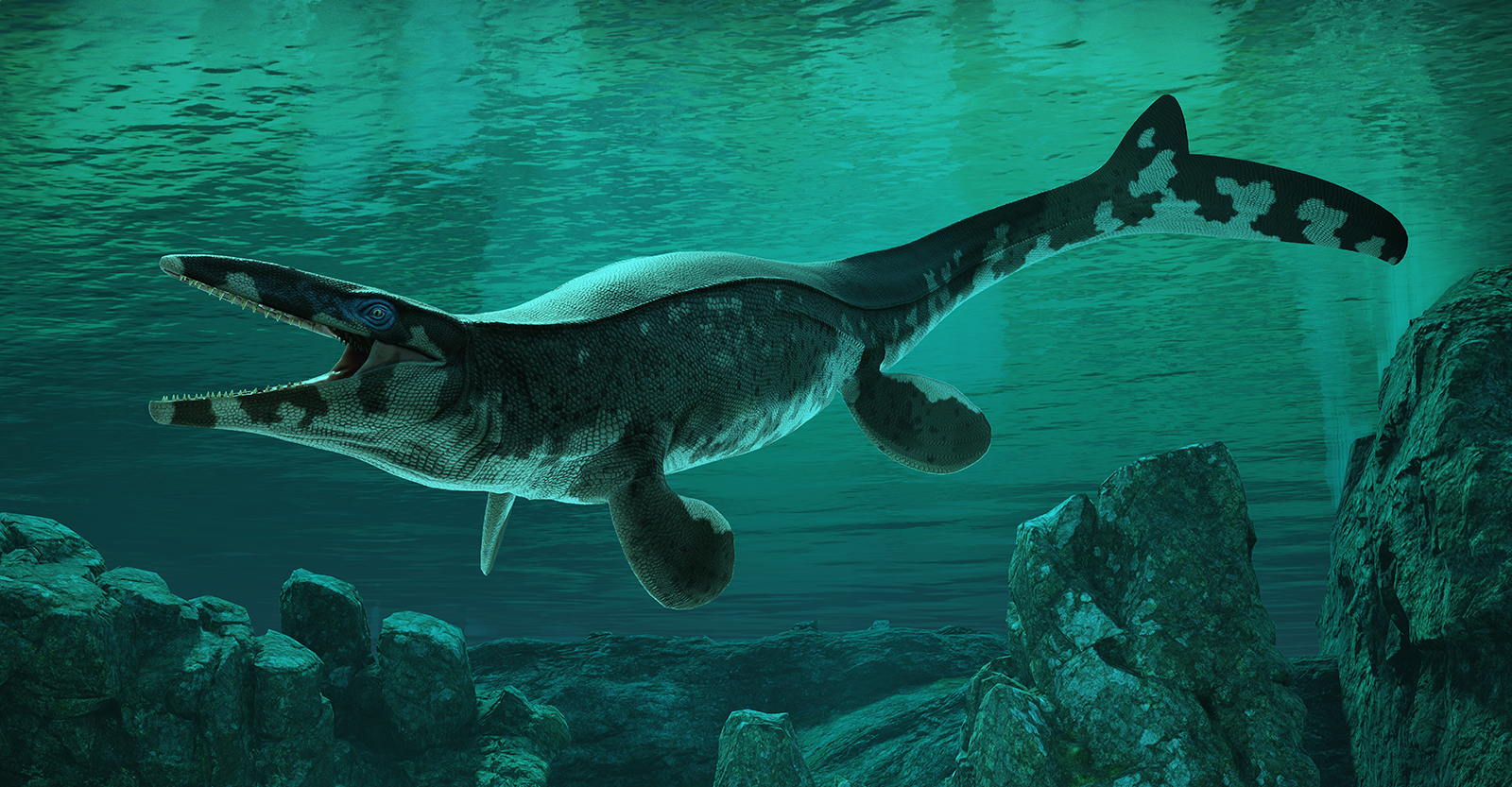
Reconstitution d'un Tylosaurus rex dans la voie maritime intérieure occidentale de l'Amérique du Nord, datant de l'époque du Crétacé.

Reconstitution d'un Tylosaurus rex dans la voie maritime intérieure occidentale de l'Amérique du Nord, datant de l'époque du Crétacé.

jeu reconstitution Crétacé Tylosaurus
Elasmosaurus platyurus, plesiosaurian from Late Cretaceous (Campanian) of North America

Elasmosaurus platyurus, plesiosaurian from Late Cretaceous (Campanian) of North America

Campanien Crétacé Crétacé supérieur Elasmosaurus +1
Elasmosaurus platyurus, plesiosaurian from Late Cretaceous (Campanian) of North America

Elasmosaurus platyurus, plesiosaurian from Late Cretaceous (Campanian) of North America

Campanien Crétacé Crétacé supérieur Elasmosaurus +1
1 2 3 4 5 6 7 8 9 10 11

Actualités

New Microraptorine Dinosaur Discovered in China
Un nouveau dinosaure microraptorine découvert en Chine
Chine Crétacé Crétacé inférieur spécimen Dinosauria Jian Microraptorinae oiseau
Jian changmaensis est le premier dinosaure non aviaire découvert sur un site paléontologique ayant livré plus de 100 spécimens d'oiseaux du Crétacé inférieur. L'article Un nouveau dinosaure microraptorine découvert en Chine est apparu en premier sur Sci.News : Breaking Science News.
04/06/2026 sci-news ⚙ Traduction automatique
Un nouveau dinosaure Unenlagiid de Patagonie (Argentine)
Argentine Japon Crétacé Crétacé supérieur fossile Dinosauria Kank Unenlagiidae découverte formation nouvelle espèce
Une équipe de scientifiques argentins et japonais a décrit une nouvelle espèce de dinosaure unenlagiidé du sud de la Patagonie. Nommé Kank australis, ce petit dinosaure théropode vivait il y a environ 70 millions d'années à la fin du Crétacé. Les restes fossiles ont été découverts dans la formation Chorrillo de la province de Santa Cruz, en Argentine. La découverte aide mieux les paléontologues
02/06/2026 everythingdinosaur ⚙ Traduction automatique
Cet oiseau fossile arborait un étonnant plumage sur la queue
plume Crétacé fossile oiseau
Une espèce d'oiseau du Crétacé nouvellement décrite possédait d'étonnamment longues plumes sur la queue. Les chercheurs supposent qu'elles aidaient les mâles à séduire les femelles.
01/06/2026 sciencesetavenir
New Dinosaur Species from Argentina May Have Specialized in Catching Fish
De nouvelles espèces de dinosaures d'Argentine pourraient s'être spécialisées dans la capture de poissons
Argentine Crétacé Crétacé supérieur Dinosauria Kank Unenlagiidae
Des paléontologues argentins ont identifié une espèce jusqu'alors inconnue de dinosaures unenlagiidés qui parcouraient les zones humides d'eau douce à la fin du Crétacé, ajoutant ainsi la preuve que certains dinosaures se spécialisaient dans la capture de poissons. L'article De nouvelles espèces de dinosaures d'Argentine pourraient s'être spécialisées dans la capture de poissons est apparu en premier sur Sci.News : Breaking Science News.
29/05/2026 sci-news ⚙ Traduction automatique
Fungi Bloomed Twice around End-Cretaceous Mass Extinction
Les champignons ont fleuri deux fois autour de l'extinction massive de la fin du Crétacé
bassin Denver Crétacé Dinosauria extinction
En étudiant les microfossiles fongiques dans des échantillons de roches vieilles de 66 millions d'années du bassin de Denver, au Colorado, les microbiologistes de l'Université Johns Hopkins ont confirmé que l'impact de l'astéroïde tueur de dinosaures a déclenché une invasion fongique mondiale et a découvert une deuxième crise écologique, jusqu'alors inconnue, juste avant elle. L'article Les champignons ont fleuri deux fois autour de l'extinction massive de la fin du Crétacé est apparu en premier sur Sci.News : Breaking Science News.
28/05/2026 sci-news ⚙ Traduction automatique
1 2 3 4 5 6 7 8 9 10 11 12