dent

Partie anatomique

49 image(s) · 22 Actualités

Galerie d'images

Fig. 2. Side view of crown of tooth of Cardiodon rugulosus.
Fig. 3. Fore end of the same tooth.
Fig. 4. Hind end of the crown of another tooth of Cardiodon rugulosus.
Fig. 5. Magnified view of markings on the surface of the enamel of the same tooth.
All the figures are of the natural size.

2-5 are from the Forest Marble of Bradford, Wilts. In the Collection of Channing Pearce, Esq., of that town.
Taxons Cardiodon

Fig. 2. Side view of crown of tooth of Cardiodon rugulosus. Fig. 3. Fore end of the same tooth. Fig. 4. Hind end of the crown of another tooth of Cardiodon rugulosus. Fig. 5. Magnified view of markings on the surface of the enamel of the same tooth. All the figures are of the natural size. 2-5 are from the Forest Marble of Bradford, Wilts. In the Collection of Channing Pearce, Esq., of that town.

dent Cardiodon
Fig. 1. Type material of Amygdalodon patagonicus Cabrera. 1947. A. B. Tooth, MLP 46-VIII-21-1/13, in lingual (A) and labial (B) view. C. D, E. Cervical vertebra, MLP 46-VIII-21-1/8. in right lateral (C, stereopair), ventral (D) and left lateral (E) view. F, G. Right cervical prezygapophysis, MLP 46-VIII-21-117. in dorsal (F) and medial (G) view. H. Anterior dorsal neural spine, MLP 46-VIII-21-116. in posterior view. I, J, K. Posterior dorsal vertebra, MLP 46-VIII-21-112, lectotype, in right lateral view (I, stereopair), right lateral view, with right wall of neural canal remived (J), and posterior (K) view. L, M. Caudal vertebra, MLP 46-VIII-21-1/3, in left lateral (L) and posterior (M) view. N. Caudal vertebra, MLP 46-VIII-21-1/4, in right lateral view. (O). Proximal fragment of a dorsal rib, MLP 46-VIII-21-1/9, in anterolateral view. Abbreviations: acdl, anterior centrodiapophyseal lamina; cprl, centroprezygapophyseal lamina; g, groove; k, ventral keel; pcdl, posterior centrodiapophyseal lamina; pod, postzygodiapophyseal lamina; poz, postzygapophysis; pp, parapophysis; prdl, prezygodiapophyseal lamina; spol, spinopostzgapophyseal lamina; sprl, spinoprezygapophyseal lamina; tprl, intraprezygapophyseal lamina. Scale bars 1 cm (A, B) and 10 cm (C-0).
Taxons Amygdalodon

Fig. 1. Type material of Amygdalodon patagonicus Cabrera. 1947. A. B. Tooth, MLP 46-VIII-21-1/13, in lingual (A) and labial (B) view. C. D, E. Cervical vertebra, MLP 46-VIII-21-1/8. in right lateral (C, stereopair), ventral (D) and left lateral (E) view. F, G. Right cervical prezygapophysis, MLP 46-VIII-21-117. in dorsal (F) and medial (G) view. H. Anterior dorsal neural spine, MLP 46-VIII-21-116. in posterior view. I, J, K. Posterior dorsal vertebra, MLP 46-VIII-21-112, lectotype, in right lateral view (I, stereopair), right lateral view, with right wall of neural canal remived (J), and posterior (K) view. L, M. Caudal vertebra, MLP 46-VIII-21-1/3, in left lateral (L) and posterior (M) view. N. Caudal vertebra, MLP 46-VIII-21-1/4, in right lateral view. (O). Proximal fragment of a dorsal rib, MLP 46-VIII-21-1/9, in anterolateral view. Abbreviations: acdl, anterior centrodiapophyseal lamina; cprl, centroprezygapophyseal lamina; g, groove; k, ventral keel; pcdl, posterior centrodiapophyseal lamina; pod, postzygodiapophyseal lamina; poz, postzygapophysis; pp, parapophysis; prdl, prezygodiapophyseal lamina; spol, spinopostzgapophyseal lamina; sprl, spinoprezygapophyseal lamina; tprl, intraprezygapophyseal lamina. Scale bars 1 cm (A, B) and 10 cm (C-0).

dent vertèbre Amygdalodon
Right dentary in (A), medial; (B), dorsal; and (C) lateral views. Dashed black lines represent approximate contours of the missing areas. Dashed red lines indicate the distinctive banding pattern in the opal used to estimate the extent of the missing area. (D–F) Three-dimensional renders of the posterior dentary fragment in (D) lingual view showing erupted (blue) and developing germ teeth (pink); (E) Same as (D) but with dentary removed; (F) dorsal (occlusal) view of tooth row. (G-J) Three-dimensional render of the best-preserved tooth in (G) mesial, (H) lingual, (I) distal, and (J) labial views. (K) MicroCT scan of the posterior dentary fragment in axial view showing preservation of cancellous bone. Abbreviations: cab, cancellous bone; cr, tooth crown. Photo credit: Phil Bell.
Taxons Weewarrasaurus

Right dentary in (A), medial; (B), dorsal; and (C) lateral views. Dashed black lines represent approximate contours of the missing areas. Dashed red lines indicate the distinctive banding pattern in the opal used to estimate the extent of the missing area. (D–F) Three-dimensional renders of the posterior dentary fragment in (D) lingual view showing erupted (blue) and developing germ teeth (pink); (E) Same as (D) but with dentary removed; (F) dorsal (occlusal) view of tooth row. (G-J) Three-dimensional render of the best-preserved tooth in (G) mesial, (H) lingual, (I) distal, and (J) labial views. (K) MicroCT scan of the posterior dentary fragment in axial view showing preservation of cancellous bone. Abbreviations: cab, cancellous bone; cr, tooth crown. Photo credit: Phil Bell.

os dent Weewarrasaurus
Skeletal elements of Lophorhothon atopus. (A, B and C) Partial skull roof and braincase (holotype FMNH 27383) in dorsal, ventral, and left lateral views. (D) Partial left nasal of FMNH 27383 in lateral view. (E) Left prefrontal of FMNH 27383 in lateral view. (F) Partial left jugal of FMNH 27383 in medial view. (G) Detail of marginal denticles of the dentary tooth in (H). (H) Apical half of a dentary tooth crown AUMP 2295 in lingual view. (I) Maxillary tooth crown of FMNH 27383 in labial view. (J) Left pubis of AUMP 2295 in lateral view. (K) Iliac process of the left ilium of FMNH 27383 in lateral view.
Taxons Lophorhothon

Skeletal elements of Lophorhothon atopus. (A, B and C) Partial skull roof and braincase (holotype FMNH 27383) in dorsal, ventral, and left lateral views. (D) Partial left nasal of FMNH 27383 in lateral view. (E) Left prefrontal of FMNH 27383 in lateral view. (F) Partial left jugal of FMNH 27383 in medial view. (G) Detail of marginal denticles of the dentary tooth in (H). (H) Apical half of a dentary tooth crown AUMP 2295 in lingual view. (I) Maxillary tooth crown of FMNH 27383 in labial view. (J) Left pubis of AUMP 2295 in lateral view. (K) Iliac process of the left ilium of FMNH 27383 in lateral view.

dent holotype Lophorhothon partiel +1
Partial skull of Manidens condorensis from the Middle Jurassic Cañadón Asfalto Formation of Argentina. Skull reconstructions in lateral view. Dashed lines indicate estimated edges. Abbreviations: a angular antfo antorbital fossa asaf anterior surangular foramen be buccal emargination bo basioccipital bt basal tubera d dentary d1, 2, 11 dentary tooth 1, 2, 11 emfo external mandibular fossa f frontal gl glenoid gr groove j jugal jfl jugal flange jh jugal horn m maxilla m1, 11 maxillary tooth 1, 11 n nasal pd predentary pm premaxilla po postorbital pof postorbital fossa popr paroccipital process q quadrate qj quadratojugal ri ridge sa surangular sq squamosal.
Taxons Manidens

Partial skull of Manidens condorensis from the Middle Jurassic Cañadón Asfalto Formation of Argentina. Skull reconstructions in lateral view. Dashed lines indicate estimated edges. Abbreviations: a angular antfo antorbital fossa asaf anterior surangular foramen be buccal emargination bo basioccipital bt basal tubera d dentary d1, 2, 11 dentary tooth 1, 2, 11 emfo external mandibular fossa f frontal gl glenoid gr groove j jugal jfl jugal flange jh jugal horn m maxilla m1, 11 maxillary tooth 1, 11 n nasal pd predentary pm premaxilla po postorbital pof postorbital fossa popr paroccipital process q quadrate qj quadratojugal ri ridge sa surangular sq squamosal.

dent Argentine Jurassique Jurassique moyen +4
Figure 1, 1a. Outer and oral aspects of the imperfect dentary bone of Sarcolestes Leedsi, from the Oxford Clay of Peterborough. 2/3 nat size. s = symphysis. Figure 1b. A single tooth of the former. 3/1 nat size. Figure 2, 2a. Outer aspect and quadratic cavity of the hinder region of the same jaw. 2/3 nat size. Figure 3. A single tooth of Priodontognathus Phillipsi, 3/1 nat size, shown for purposes of comparison. Specimen in the Woodwardian Museum, Cambridge.
Taxons Sarcolestes

Figure 1, 1a. Outer and oral aspects of the imperfect dentary bone of Sarcolestes Leedsi, from the Oxford Clay of Peterborough. 2/3 nat size. s = symphysis. Figure 1b. A single tooth of the former. 3/1 nat size. Figure 2, 2a. Outer aspect and quadratic cavity of the hinder region of the same jaw. 2/3 nat size. Figure 3. A single tooth of Priodontognathus Phillipsi, 3/1 nat size, shown for purposes of comparison. Specimen in the Woodwardian Museum, Cambridge.

os dent musée Oxford Clay +3
Photographs and interpretive drawings of the titanosauroid Bonitasaura salgadoi Apesteguía, 2004 from the Upper Neuquén Group of Río Negro
province, Patagonia, MPCA 460. A–D. Right dentary in dorsal (A), medial (B), ventral (C), and lateral (D) views. E. Isolated tooth in labial (E1) and lateral

(E2) views; lingual view detail and schematic cross section showing hexagonal faceting (E3).
Taxons Bonitasaura

Photographs and interpretive drawings of the titanosauroid Bonitasaura salgadoi Apesteguía, 2004 from the Upper Neuquén Group of Río Negro province, Patagonia, MPCA 460. A–D. Right dentary in dorsal (A), medial (B), ventral (C), and lateral (D) views. E. Isolated tooth in labial (E1) and lateral (E2) views; lingual view detail and schematic cross section showing hexagonal faceting (E3).

dent dessin Bonitasaura
Cranial and postcranial sauropod remains from sediments of the Praia da Amoreira-Porto Novo Fm. of the coastal sector of Praia da Consolação-Lourinhã-Torres Vedras: 1-2, ?Turiasauria indet., heart-shaped tooth (SHN (JJS) 142, Praia da Corva) in lingual (1) and labial (2) views; 3-4, ?Macronaria indet., spatulate tooth (SHN 513, Porto Novo) in labial (3) and lingual (4) views; 5-6, Macronaria indet., compressed cone-chisel-shaped tooth (SHN 578, Valmitão) in lingual (5) and labial (6) views; 7-8, Eusauropoda indet., partial left maxilla (SHN 582, Praia dos Frades) in lateral (7) and posterior (8) views; 9, Titanosauriformes indet., posterior caudal vertebra (SHN 523, Praia da Corva) in right view; 10-12, Diplodocinae indet., partial skeleton (SHN (JJS) 177, Valmitão), anterior caudal neural spine in posterior view (10), anterior caudal centrum in right view (11) and left ischium in medial view (12); 13-16, holotype material of Zby atlanticus (ML 368, Vale de Pombas), right ungueal I in lateral view (13), right humerus in anterior view (14), right radius in posterior view (15), right ulna in lateral view (16); 17, Eusauropoda indet., partial distal forked-chevron (SHN 587, Praia da Corva) in medial view; 18, Sauropoda indet., pedal ungueal I (SHN 524, Praia de Pedrogãos) in lateral view; 19-22, Macronarian indet., partial skeleton (SHN 181, Valmitão), right astragalus in proximal view (19), anterior caudal vertebra in anterior view (20), right tibia in lateral view (21) and right fibula in medial view (22); 23-24, Eusauropoda indet., partial skeleton (SHN 530, Praia da Corva), anterior chevron in anterior view (23) and anterior caudal vertebra in posterior view (24); 25, cf. Duriatitan humerocristatus, humerus (MG 4976, Praia dos Frades) in anterior view; 26, Sauropoda indet., partial skeleton (SHN 534, Santa Rita), middle chevron in posterior view; 27, Diplodocidae indet., partial skeleton (SHN (JJS) 179, Praia Vermelha), dorsal/caudal (?) neural spine in posterior view; 28-30, holotype material of Dinheirosaurus lourinhanensis (ML 414, Porto Dinheiro), proximal end of a dorsal rib in anterior view (28), anterior caudal neural spine in posterior view (29) and articulated dorsal vertebrae in right view (30). Black scale bar: 10 cm; Grey scale bar: 5 cm; Brown scale bar: 1 cm. See Anatomical abbreviations for abbreviations.
Taxons Zby

Cranial and postcranial sauropod remains from sediments of the Praia da Amoreira-Porto Novo Fm. of the coastal sector of Praia da Consolação-Lourinhã-Torres Vedras: 1-2, ?Turiasauria indet., heart-shaped tooth (SHN (JJS) 142, Praia da Corva) in lingual (1) and labial (2) views; 3-4, ?Macronaria indet., spatulate tooth (SHN 513, Porto Novo) in labial (3) and lingual (4) views; 5-6, Macronaria indet., compressed cone-chisel-shaped tooth (SHN 578, Valmitão) in lingual (5) and labial (6) views; 7-8, Eusauropoda indet., partial left maxilla (SHN 582, Praia dos Frades) in lateral (7) and posterior (8) views; 9, Titanosauriformes indet., posterior caudal vertebra (SHN 523, Praia da Corva) in right view; 10-12, Diplodocinae indet., partial skeleton (SHN (JJS) 177, Valmitão), anterior caudal neural spine in posterior view (10), anterior caudal centrum in right view (11) and left ischium in medial view (12); 13-16, holotype material of Zby atlanticus (ML 368, Vale de Pombas), right ungueal I in lateral view (13), right humerus in anterior view (14), right radius in posterior view (15), right ulna in lateral view (16); 17, Eusauropoda indet., partial distal forked-chevron (SHN 587, Praia da Corva) in medial view; 18, Sauropoda indet., pedal ungueal I (SHN 524, Praia de Pedrogãos) in lateral view; 19-22, Macronarian indet., partial skeleton (SHN 181, Valmitão), right astragalus in proximal view (19), anterior caudal vertebra in anterior view (20), right tibia in lateral view (21) and right fibula in medial view (22); 23-24, Eusauropoda indet., partial skeleton (SHN 530, Praia da Corva), anterior chevron in anterior view (23) and anterior caudal vertebra in posterior view (24); 25, cf. Duriatitan humerocristatus, humerus (MG 4976, Praia dos Frades) in anterior view; 26, Sauropoda indet., partial skeleton (SHN 534, Santa Rita), middle chevron in posterior view; 27, Diplodocidae indet., partial skeleton (SHN (JJS) 179, Praia Vermelha), dorsal/caudal (?) neural spine in posterior view; 28-30, holotype material of Dinheirosaurus lourinhanensis (ML 414, Porto Dinheiro), proximal end of a dorsal rib in anterior view (28), anterior caudal neural spine in posterior view (29) and articulated dorsal vertebrae in right view (30). Black scale bar: 10 cm; Grey scale bar: 5 cm; Brown scale bar: 1 cm. See Anatomical abbreviations for abbreviations.

dent vertèbre Lourinhã holotype +7
Specimens of Galleonosaurus dorisae n. gen. n. sp. from the Flat Rocks Sandstone in the upper Barremian, Wonthaggi Formation, Gippsland Basin, southeastern Australia: (1–2) holotype (NMV P229196), left maxilla in lateral (1) and medial (2) views; (3) NMV P208178, left maxilla in lateral view; (4) NMV P212845, left maxilla in lateral view; (5) NMV P209977, left maxilla in lateral view; (6) NMV P186440, left maxilla in lateral view; (7) NMV 208113, right maxillary tooth in labial view. Scale bars = 10 mm (1–6); 1 mm (7).
Taxons Galleonosaurus

Specimens of Galleonosaurus dorisae n. gen. n. sp. from the Flat Rocks Sandstone in the upper Barremian, Wonthaggi Formation, Gippsland Basin, southeastern Australia: (1–2) holotype (NMV P229196), left maxilla in lateral (1) and medial (2) views; (3) NMV P208178, left maxilla in lateral view; (4) NMV P212845, left maxilla in lateral view; (5) NMV P209977, left maxilla in lateral view; (6) NMV P186440, left maxilla in lateral view; (7) NMV 208113, right maxillary tooth in labial view. Scale bars = 10 mm (1–6); 1 mm (7).

écaille dent Australie Barrémien +4
Partial skeleton of Claosaurus agilis (holotype YPM 1190).

(A) Right ilium in lateral view. (B) Partial postorbital in lateral view. (C) Distal process of the right ischium in lateral view. (D) Mounted partial skeleton of YPM 1190. (E) Coronoid process of the right dentary in lateral view. (F) Fragment of maxilla in lateral view. (G) Detail of the maxillary tooth crowns in (F). (H) Fragment of maxilla in lateral view. (I) Detail of a maxillary tooth crown in (H).
Taxons Claosaurus

Partial skeleton of Claosaurus agilis (holotype YPM 1190). (A) Right ilium in lateral view. (B) Partial postorbital in lateral view. (C) Distal process of the right ischium in lateral view. (D) Mounted partial skeleton of YPM 1190. (E) Coronoid process of the right dentary in lateral view. (F) Fragment of maxilla in lateral view. (G) Detail of the maxillary tooth crowns in (F). (H) Fragment of maxilla in lateral view. (I) Detail of a maxillary tooth crown in (H).

dent holotype Claosaurus partiel +1
natural silicone cast of the holotype of Lycorhinus angustidens (UCRC PVC10). Abbreviations: 3-10 dentary tooth 3-10 Fa-j tooth-to-tooth wear facet a-j f accessory facet. Scale bars equal 1 cm in C and 3 cm in D.
Taxons Lycorhinus

natural silicone cast of the holotype of Lycorhinus angustidens (UCRC PVC10). Abbreviations: 3-10 dentary tooth 3-10 Fa-j tooth-to-tooth wear facet a-j f accessory facet. Scale bars equal 1 cm in C and 3 cm in D.

écaille dent moulage holotype +1
Tooth of cf. Zapsalis, with close up of denticles. Specimen UALVP 49582 from the Milk River Formation.
Taxons Zapsalis

Tooth of cf. Zapsalis, with close up of denticles. Specimen UALVP 49582 from the Milk River Formation.

dent Milk River spécimen Zapsalis +1
Genus—Nuthetes. (Lacertilia).
Fig. 13 and 14. Portions of mandible and teeth of Nuthetes destructor.
Fig. 15. Five detached teeth of do.

Fig. 16. Side view of crown of a tooth of do., magn.
Taxons Nuthetes

Genus—Nuthetes. (Lacertilia). Fig. 13 and 14. Portions of mandible and teeth of Nuthetes destructor. Fig. 15. Five detached teeth of do. Fig. 16. Side view of crown of a tooth of do., magn.

dent Nuthetes
Tooth of cf. Pectinodon.
Taxons Pectinodon

Tooth of cf. Pectinodon.

dent Pectinodon
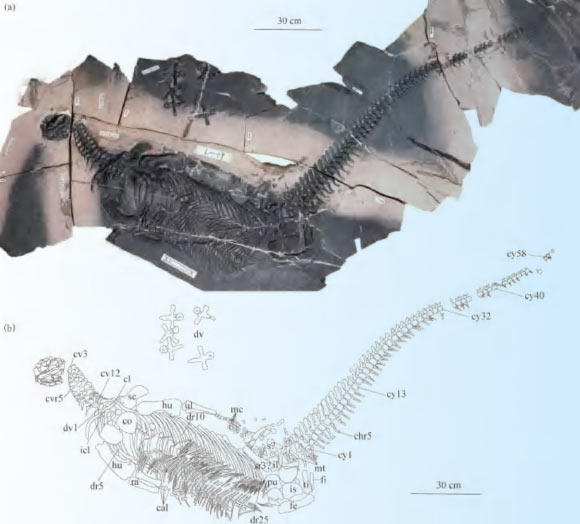
Partial skull of Shastasaurus pacificus (UCMP 9017) from the Late Triassic of California, USA, in (A) lateral, (B) dorsal, and (C) anterolateral view.

Based on this skull, Shastasaurus has repeatedly been reconstructed with a long, tooth-bearing rostrum. However, note the slenderness of the lower jaw (B, C) and the strong anterior taper of the snout (B), both of which are more consistent with the abbreviated and toothless snout of Shastasaurus liangae comb. nov. than with the traditional long-snouted reconstruction of this skull (as, e.g., in references [22] and [23]).
Taxons Shastasaurus

Partial skull of Shastasaurus pacificus (UCMP 9017) from the Late Triassic of California, USA, in (A) lateral, (B) dorsal, and (C) anterolateral view. Based on this skull, Shastasaurus has repeatedly been reconstructed with a long, tooth-bearing rostrum. However, note the slenderness of the lower jaw (B, C) and the strong anterior taper of the snout (B), both of which are more consistent with the abbreviated and toothless snout of Shastasaurus liangae comb. nov. than with the traditional long-snouted reconstruction of this skull (as, e.g., in references [22] and [23]).

dent États-Unis Trias supérieur Trias +5
Partial skull of Shastasaurus pacificus (UCMP 9017) from the Late Triassic of California, USA, in (A) lateral, (B) dorsal, and (C) anterolateral view.

Based on this skull, Shastasaurus has repeatedly been reconstructed with a long, tooth-bearing rostrum. However, note the slenderness of the lower jaw (B, C) and the strong anterior taper of the snout (B), both of which are more consistent with the abbreviated and toothless snout of Shastasaurus liangae comb. nov. than with the traditional long-snouted reconstruction of this skull (as, e.g., in references [22] and [23]).
Taxons Merriamosauria

Partial skull of Shastasaurus pacificus (UCMP 9017) from the Late Triassic of California, USA, in (A) lateral, (B) dorsal, and (C) anterolateral view. Based on this skull, Shastasaurus has repeatedly been reconstructed with a long, tooth-bearing rostrum. However, note the slenderness of the lower jaw (B, C) and the strong anterior taper of the snout (B), both of which are more consistent with the abbreviated and toothless snout of Shastasaurus liangae comb. nov. than with the traditional long-snouted reconstruction of this skull (as, e.g., in references [22] and [23]).

dent États-Unis Trias supérieur Trias +5
1 2 3 4

Actualités

Paleontologists Find Lost Ice Age World in Flooded Texas Cave
Des paléontologues découvrent un monde perdu de la période glaciaire dans une grotte inondée du Texas
dent fossile
Les fossiles d'une tortue géante, d'un paresseux terrestre, d'un tatou de la taille d'un lion appelé pampathere, de chats à dents de cimeterre, de chevaux, de chameaux et de mastodontes trouvés dans la grotte de Bender sur le plateau d'Edwards au Texas pourraient révéler une période chaude jusqu'alors inconnue dans la région il y a environ 100 000 ans. L'article Des paléontologues trouvent le monde perdu de la période glaciaire dans une grotte inondée du Texas apparaît en premier sur Sci.News : Breaking Science News.
14/05/2026 sci-news ⚙ Traduction automatique
Une nouvelle étude suggère que le jeune Maiasaura mangeait des aliments différents de ceux des adultes
dent alimentation fossile juvénile Hadrosauria Maiasaura étude
Un article scientifique récemment publié a fourni de nouvelles informations sur les habitudes alimentaires du célèbre hadrosaure Maiasaura peeblesorum. L'analyse de l'usure des dents chez les Maiasaura juvéniles par rapport aux hadrosaures adultes suggère que les jeunes Maiasaura se nourrissaient différemment des animaux adultes. Les chercheurs ont examiné l’usure dentaire associée aux dents fossiles de Maiasaura peeblesorum.  Des informations sur l'alimentation peuvent aider à
13/05/2026 everythingdinosaur ⚙ Traduction automatique
Dinosaurs May Have Fed Their Young a Special Diet, Study Suggests
Les dinosaures auraient pu nourrir leurs petits avec un régime spécial, selon une étude
dent juvénile Dinosauria Hadrosauria Maiasaura étude
Une analyse de l'usure des dents fossilisées du dinosaure hadrosaure Maiasaura peeblesorum indique que leurs juvéniles pourraient avoir mangé des aliments plus mous et plus nutritifs que les adultes, ce qui fait allusion à des soins parentaux avancés chez les dinosaures. L'article Les dinosaures pourraient avoir nourri leurs petits avec un régime spécial, suggère une étude, apparaît en premier sur Sci.News : Breaking Science News.
11/05/2026 sci-news ⚙ Traduction automatique
Une « plante grimpante des sables » géante vieille de 240 millions d’années découverte cachée dans un mur de soutènement
dent prédateur Australie fossile découverte squelette
Un fossile oublié caché dans un mur de jardin s’est avéré être l’une des découvertes préhistoriques les plus remarquables d’Australie. Les scientifiques ont maintenant identifié l'amphibien Arenaerpeton supinatus, vieux de 240 millions d'années, révélant un squelette presque parfaitement conservé, avec de rares traces de peau. Cet ancien prédateur de rivière, mesurant environ 1,2 mètre de long, ressemblait un peu à une salamandre géante, mais il était plus volumineux et armé de redoutables dents en forme de crocs.
06/05/2026 sciencedaily ⚙ Traduction automatique
Early Platypuses Had Strong Teeth and Powerful Jaws, Fossils Show
Les premiers ornithorynques avaient des dents solides et des mâchoires puissantes, selon des fossiles
mâchoire dent Australie fossile formation
De nouveaux fossiles de la Formation de Namba, en Australie méridionale, révèlent qu'il y a 25 millions d'années, Obdurodon insignis prospérait dans les lacs intérieurs luxuriants aux côtés de dauphins d'eau douce et d'autres espèces aujourd'hui disparues. L'article Les premiers ornithorynques avaient des dents solides et des mâchoires puissantes, Fossils Show est apparu en premier sur Sci.News : Breaking Science News.
28/04/2026 sci-news ⚙ Traduction automatique
1 2 3 4 5