Galerie d'images
Toutes les images de la base — taxons, formations et intervalles géologiques.
⚠ La fonctionnalité de récupération des images est en cours de test, des images non pertinentes peuvent apparaître.
4,826 image(s)

Acrioceras (Aspinoceras) dilatatum (d'Orbigny) Upper Hauterivian, Belimel, Montana Province, (Coll. G. Mandov) at the Sofia University 'St. Kliment Ohridski' Museum of Paleontology and Historical Geology

Acanthodiscus vaceki (Neumayr & Uhlig) Lower Hauterivian, Dragoman, Bulgaria, Cr1 976X1 (Coll. G. Mandov) at the Sofia University 'St. Kliment Ohridski' Museum of Paleontology and Historical Geology

Life reconstruction of two species of Protonympha in the Devonian Catskill delta of New York

Monte San Nicola in Sicily, Italy, south of Butera in the province of Caltanissetta. The red line below the '5' on the rock marks the basis of the Gelasian (Lower Pleistocene) 2.58 million years ago. The Gelasian is a geologic age named after the nearby city of Gela in southern Sicily.

Monte San Nicola in Sicily, Italy, south of Butera in the province of Caltanissetta. The rocks seen here are of marine origin and date from the late Pliocene and Pleistocene.

Monte San Nicola in Sicily, Italy, south of Butera in the province of Caltanissetta. The red line below the '5' on the rock marks the basis of the Gelasian (Lower Pleistocene) 2.58 million years ago. The Gelasian is a geologic age named after the nearby city of Gela in southern Sicily. A geologist is seen at work at the red line.

Monte San Nicola in Sicily, Italy, south of Butera in the province of Caltanissetta. The red line below the '5' on the rock marks the basis of the Gelasian (Lower Pleistocene), 2.58 million years ago. The Gelasian is a geologic age named after the nearby city of Gela in southern Sicily. Two geologists are seen at work at the red line.

Monte San Nicola in Sicily, Italy, south of Butera in the province of Caltanissetta. The red line below the '5' on the rock marks the basis of the Gelasian (Lower Pleistocene), 2.58 million years ago. The Gelasian is a geologic age named after the nearby city of Gela in southern Sicily.

Monte San Nicola in Sicily, Italy, south of Butera in the province of Caltanissetta. The red line below the '5' on the rock marks the basis of the Gelasian (Lower Pleistocene), 2.58 million years ago. The Gelasian is a geologic age named after the nearby city of Gela in southern Sicily.

Monte San Nicola in Sicily, Italy, south of Butera in the province of Caltanissetta. The red line below the '5' on the rock marks the basis of the Gelasian (Lower Pleistocene), 2.58 million years ago. The Gelasian is a geologic age named after the nearby city of Gela in southern Sicily.

Kalksandskalk fra København kalk Fm med omlejrede bryozoer (netmønster) og skalstumper

Koralkalk fra Faxe kalkbrud

Main floristic types from the earliest Danian: Cheirolepidiaceae, shrubs and other low–diversity flora. doi:10.1371/journal.pone.0052455.g007


Glacialt forstyrret koralkalk, Faxe

Eekaulostomus cuevasae gen. and sp. nov. from the Danian marine deposits of the Belisario Domínguez quarry, near Palenque, Chiapas, southeastern Mexico. 1, General view of IGM 4716, holotype and single specimen known. 2, Idealized line drawing of the same specimen.


Bryozobanker i Stevns klint, set fra stranden ved Boesdal kalkbrud (i let diset vejr)

Grå flint med fossiler af søpindsvin, Krauseparken i København


“Sternberger Kuchen” (“Sternberg cake”), a large late Pleistocene glaciofluvial pebble of a highly fossiliferous, shallow marine sandstone of the North German Paleogene (Sülstorf beds, formerly known as “Sternberg rock”, Chattian, Oligocene, about 25 million years old). The fossil content is mainly made up of mollusks (pelecypods, gastropods, scaphopods). Provenance: Sternberg, Mecklenburg-Vorpommern, Northeast Germany.


4 Tonnen schwerer Findling mit Muscheln einer Art der Gattung Pectunculus, der wohl ungefähr 25 Millionen Jahre alt ist

Stein aus Sandstein aus dem Cenoman im Alpengarten in Pfronten-Steinach, Obere Kreide, Herkunft Pfronten-Röfleuten

Quarry called “Ratssteinbruch” at Plauenscher Grund (gorge-like valley of the river Weißeritz nearby/in the city of Dresden, Saxony, Germany), Upper Carboniferous Monzonite (historically identified as Syenite) of the Meißen Massif (Paleozoic basement) unconformably overlain by Upper Cenomanian beds of the Dölzschen Formation, yellowish basal conglomerate and overlying bluish silty clay-marlstone (“plenus-Pläner”) of the Saxo-Bohemian Cretaceous Basin (Mesozoic platform).[1]
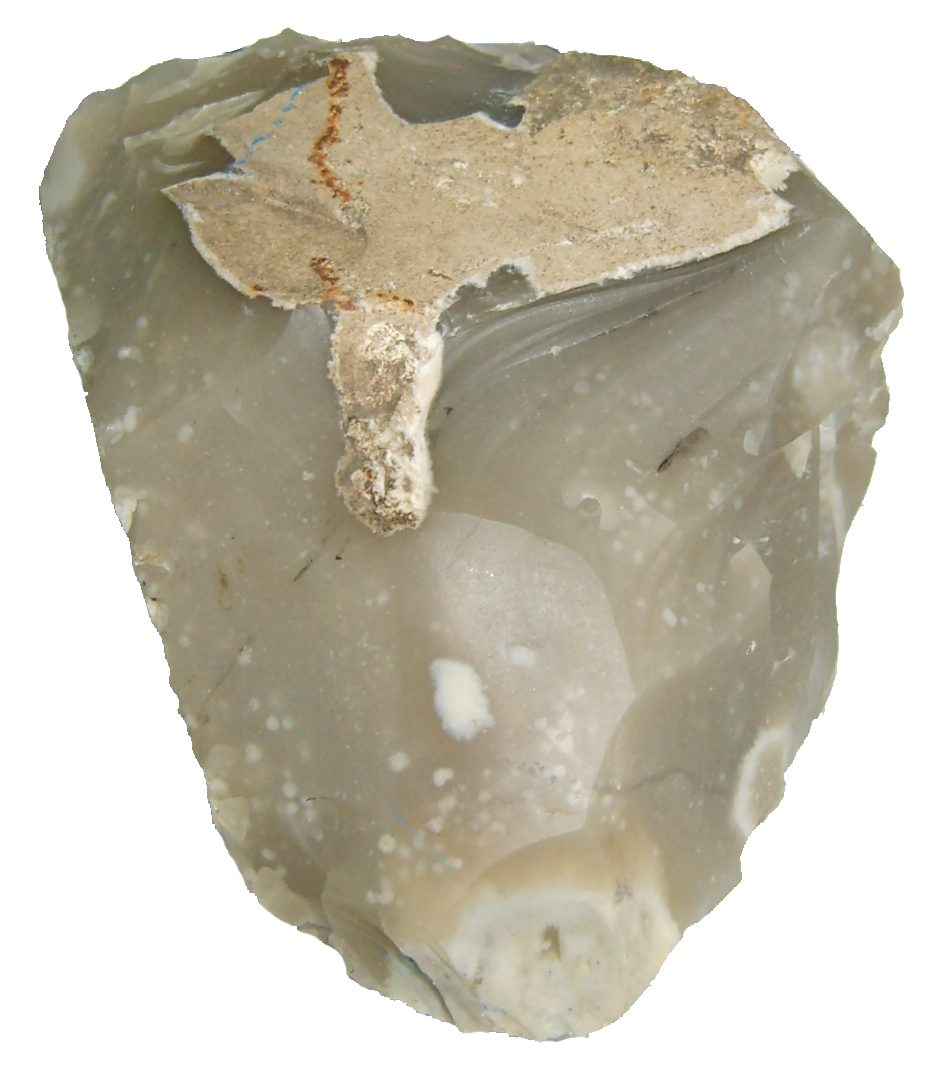
A light coloured sample of Miorcani flint from the Cenomanian chalky marl layer of the Moldavian Plateau. This sample came from the flint mine near Rădăuţi-Prut. (ca. 7.5 cm wide)

Pilares de Los Gigantes, provincia de Río Negro, correspondientes la la Formación Candeleros.


Typical landscape of the hills around Montmoreau. Saint-Amant, Charente, France.

Typical landscape of the hills around Montmoreau. Saint-Amant, Charente, France.


Chalky hillside with its characteristic vegetation (dry lawn, juniper, orchids, pines on the top). Juignac, Charente, France.


Holotype skull of the centrosaurine ceratopsian dinosaur Diabloceratops eatoni from the Late Cretaceous (Campanian) of the Wahweap Formation, Grand Staircase-Escalante National Monument, Utah. Photograph by Nick Longrich, 2023.

Outcrops of the Late Cretaceous (Campanian) aged Aguja Formation, Big Bend National Park, Texas, USA

Restoration of the sturgeon "Acipenser" gigantissimus, from Campanian marine strata in Saratov

It is the southern flank of a syncline Campanian, Maastrichtian and Eocene age(35-55 million ys)flakes represented by conglomerates overlying gypsum marls in the syncline; but also an undeveloped alabaster deposit giving way to a beautiful landscape

Osgodby Formation (Middle Jurassic) exposed on the shore of Cayton Bay, North Yorkshire.

Matmor Formation (Jurassic, Callovian) exposed in Makhtesh Gadol, Israel. (Electricity pylon for scale).


Tripneustes parkinsoni . Stage : Burdigalian between 20.43 ± 0.05 Ma and 15.97 ± 0.05 Ma (million years ago).

Ein Stein aus sand-/ kalkhaltigen Ablagerungen aus dem Hemmorium (vor 17 Mio Jahren)

Glyptostrobus europaeus fossil leaves of Burdigalian stage in the early Miocene epoch, from a brown coal mine in Bilina, Czech Republic.


A l'intérieur d'une vitrine à ciel ouvert, on voit des milliers de turritelles, gastéropode typique du Burdigalien local

Boules de Buoux

Boules de Buoux

Talus de route entaillant des grèzes litées

Falaises marneuses à l'ouest de Port en Bessin à marée haute. (coefficent 80)

Falaises marneuses à l'est de Port-en-Bessin-Huppain (Calvados, France).

Acrosalenia_hemicidaroides Stage : Bathonian 167.7 Ma to around 164.7 Ma (million years ago) .