Galerie d'images
Toutes les images de la base — taxons, formations et intervalles géologiques.
⚠ La fonctionnalité de récupération des images est en cours de test, des images non pertinentes peuvent apparaître.
4,826 image(s)

Chert & phosphorite in the Permian of Wyoming, USA. The Permian-aged Phosphoria Formation has a significant component of phosphorite, a scarce, phosphate-rich sedimentary rock. This material is mined in southern Idaho as a source of phosphorus for the fertilizer industry, the fireworks industry, and other uses. Phosphorites are generally considered to have >15-20% phosphate content. Texturally, phosphorites can be obviously granular, with fossil fragments or oolites or peloids or lithic fragments, or they can be composed of extremely fine-grained, phosphate-rich mud. Compositionally, the phosphate component in phosphorites is principally a mix of apatite minerals: chlorapatite (Ca5(PO4)3Cl), fluorapatite (Ca5(PO4)3F), hydroxyapatite (Ca5(PO4)3OH)), and carbonate fluorapatite (Ca10(PO4,CO3)6F2-3). Phosphorites are generally marine sedimentary rocks. They range in age from Precambrian to Holocene. In modern oceans, they tend to occur along the eastern margins of some ocean basins where deep-water upwelling occurs under areas of high biologic productivity. Stratigraphy: Rex Chert Member over Meade Peak Member, Phosphoria Formation, Roadian Stage to Wordian Stage, lower Guadalupian Series, mid-Permian Locality: roadcut on the northern side of Route 26/Route 89 at the town of Astoria Hot Springs, Snake River Canyon, southern Teton County, northwestern Wyoming, USA

Hadrocheilus aff. fragilis (Pictet & Loriol) Upper Valanginian, Komshitsa, Sofia Province, (Coll. G. Mandov) at the Sofia University 'St. Kliment Ohridski' Museum of Paleontology and Historical Geology

Hadrocheilus (Dentatobecus) gibber Till. Valanginian, Borima, Lovech Province, (Coll. G. Mandov) at the Sofia University 'St. Kliment Ohridski' Museum of Paleontology and Historical Geology

Elasmobranchs teeth from the Thanetian phosphatic serie of Jebel Dyr (Algerian-Tunisian border area); 14. Nebrius bequaerti; 15. Archaeomanta priemi; 16. Burnhamia daviesi; 17. Ginglymostoma subafricanum; 18. Myliobatis sulcidens; 21. Hemiscyllium daimeriesi; 23. Squatiscyllium nigeriensis. a: labial; b: lingual; c: lateral; d: occlusal; e: oral; f: basilar views.

Elasmobranchs teeth from the Thanetian phosphatic serie of Jebel Dyr (Algerian-Tunisian border area); 7. Brachycarcharias lerichei; 8. Anomotodon novus; 9. Mustelus biddlei 10. Brachycarcharias lerichei; 11. Mennerotodus sp; 12. Abdounia beaugei; 13. Galeorhinus mesetaensis. a: labial; b: lingual; c: lateral views.

Elasmobranchs teeth from the Thanetian phosphatic serie of Jebel Dyr (Algerian-Tunisian border area); 1. Abdounia beaugei; 2. Palaoegaleus vincenti; 3. Galeorhinus mesetaensis. a: labial; b: lingual; c: lateral; d: occlusal views.

Elasmobranchs teeth from the Thanetian phosphatic serie of Jebel Dyr (Algerian-Tunisian border area); 1. Abdounia beaugei; 2. Palaoegaleus vincenti; 3. Galeorhinus mesetaensis; 4. Delpitoscyllium africanum; 5. Squatina prima; 6. Brachycarcharias lerichei. a: labial; b: lingual; c: lateral; d: occlusal views.

Tongnanlong is a large mamenchisaurid sauropod dinosaur that lived in the Late Jurassic period of what is now China. Typical of mamenchisaurids, it had an extremely long neck, even by sauropod standards. Tongnanlong grew to approximately 25 m in length and weighed 20-30 t, making it one of the largest mamenchisaurids.


Solitary tooth of a sauropod from Angeac-Charente in France. Based on its morphology, it is not from an unnamed titanosaur like other material from this site, but from an unnamed titanosauriform similar to Ligabuesaurus or Veneosaurus.

Kol ghuva restored as feeding from a termite mound, based on related animals.

Known skull material of Kuru kulla (gen. et sp. nov. Napoli et al. 2022) - premaxilla, dentary, surangular, lacrimal, and teeth - shown with a speculative restoration of the remainder of the skull based on the related taxon Velociraptor mongoliensis. Known skull material is shown in light grey and labeled; unknown parts of the skull are shown in dark grey.


Skeletal reconstruction of Siamraptor suwati. Cranial elements were scaled to fit in with the holotype (surangular). Human size = 1.8 m. Scale bar = 1 m. Human silhouette has been added to the original image.

Skeletal reconstruction of Ahshislepelta minor, a small ankylosaur from the Late Cretaceous Kirtland Formation of New Mexico. While originally recovered as an ankylosaurid related to Gastonia, later analyses favored a nodosaurid position which this is based on. Based on the holotype SMP VP-1930, consisting of fragmentary shoulder, forelimb, and vertebral elements as well as several osteoderms. Unknown material filled in using Niobrarasaurus, Pawpawsaurus, Silvisaurus, Sauropelta, and Borealopelta. Total length is approximately 4.9 m through the centra. Notes: Osteoderm placement somewhat speculative, not all osteoderms and vertebral fragments are figured. References: Burns & Sullivan, 2011.


Strict reduced consensus at the genus level of the most parsimonious trees recovered following the phylogenetic analysis. The original dataset is based on the matrix and scorings of Zhang et al. 2019 (except for Irisosaurus) and includes 62 taxa for 364 characters. This reduced consensus displays 39 taxa. It is based on 2 MPTs of 1,300 steps each (CI = 0.33, RI = 0.69). Dashed lines mean that the exact age of the genus is uncertain. Clades: 1, Sauropodomorpha; 2, Plateosauridae; 3, Massopoda; 4, Massospondylidae; 5, Riojasauridae; 6, Sauropodiformes; 7, Lessemsauridae. Squares represent stem-based definitions, ellipses represent node-based definitions.


Wudingloong is the earliest diverging, and oldest sauropodomorph dinosaur known from East Asia. Typical of basal sauropodomorphs, or "prosauropods," it was a bipedal herbivore with a long neck. Wudingloong was a fairly small prosauropod at approximately 4 m in length, and weighing around 400 kg.

Restoration of Analong chuanjieensis, a sauropod dinosaur from the Middle Jurassic of China

(ESP_063206_1780) Iani Chaos - Mariagat modified image: NASA/JPL/University of Arizona - We ♥ Mars

Figuras de abelisaurio y Lohuecotitan. Museo Paleontológico de Castilla-La Mancha (Cuenca)

Skeletal composite of the chilean titanosaur Atacamatitan chilensis. A fragmented sauropod known from the holotype SGO-PV-961, found in the Atacama Desert. The preserved elements consist of:[1] Right femur, the proximal end of a humerus, two dorsal vertebrae, posterior caudal vertebrae, dorsal ribs and a possibly fragmentary element of the sternum, other fragmented caudal vertebrae and indeterminate bones.[1] Due to the fragmented nature of the holotype, most cladistic analyzes exclude Atacamatitan. Nevertheless, in 2012, Rubilar-Rogers and Gutstein conducted a preliminary cladistic analysis which placed Atacamatitan within the Lithostrotia.[2] The original description lacks a lateral view for the humerus and femur, the lateral view for the humerus was based on Alamosaurus and Opisthocoelicaudia, since it shows resemblance with them. The lateral view of the femur is based on Mendozasaurus for the same reason. Color Key Known Unknown


Vitosaura is an abelisaurid theropod dinosaur that lived in what is now Argentina. It was a medium sized bipedal carnivore reaching around 6 m in total body length. Though only known from the pelvic girdle, Vitosaura likely had a blunt rugose snout, and extremely short arms, as these are typical traits of abelisaurs.

Rhamphinion with Dilophosaurus in the background. While the pterosaur was identified as Dimorphodon by the artist, that genus is not known to have coexisted with Dilophosaurus, so the identity is here changed to its closest contemporary relative, which is possibly which was meant to begin with.

The hands of oviraptorosaurs, showing basal oviraptorosaurs (A-B), Caenagnathidae (C-G) and Oviraptoridae (H-R). Colors signify diagnostic attributes of each group, with blue representing caenagnathid features (1-7), red representing oviraptorid features (8-15), green representing “ingeniine” features (16-21), light orange representing other features (22-25) not evenly distributed among taxa, and violet representing features basal to or restricted to non-caenagnathoid oviraptorosaurs (26-31). See text for clarification. A, Protarchaeopteryx robusta, based on NGMC 2127; B, Caudipteryx sp., based on IVPP V12430; C, Anzu wyliei, based on CM 78000; D, Gigantoraptor erlianensis, based on LH V0011; E, Chirostenotes pergracilis, based on CMN 2367 and RTMP 1979.20.1; F, Hagryphus giganteus, based on UMNH VP 12765; G, Elmisaurus rarus, based on ZPAL MgD-I/98; H, Wulatelong gobiensis, based on IVPP V18409; I, Oviraptor philoceratops, based on AMNH FABR 6517; J, the Bayan Mandahu “oviraptorine,” IVPP V9608; K, the Zamyn Khondt “oviraptorid,” MPC-D 100/42; L, Citipati osmolskae, based on MPC-D 100/979; M, Conchoraptor gracilis, based on MPC-D 100/20; N, Khaan mckennai, based on MPC-D 100/1127; O, Machairasaurus leptonychus, based on IVPP V15979; P, Nemegtomaia barsboldi, based on MPC-D 107/15 and 107/16; Q, “Ingenia“ yanshini, based on MPC-D 100/30; R, Heyuannia huangi, based on HYMV1-2.


A skull reconstruction and cranial bones from Shaochilong maortuensis, a small-bodied mid Cretaceous (Turonian) carcharodontosauri-an theropod from Inner Mongolia, China. A, skull reconstruction (courtesy of Brett Booth); B, right maxilla in lateral view (IVPP V.2885.4); C, braincase and skull roof in dorsal view (IVPP V.2885.1-2). Scale bars equal 5 centimeters.

Skeletal cross-sections and ecological estimates for four cryptoclidid plesiosaurs: Tatenectes, Cryptoclidus, Muraenosaurus, and Abyssosaurus.


Spinosaurus aegyptiacus, a spinosaurid from the Middle Cretaceous of Egypt
Spinosaurus aegyptiacus, a spinosaurid from the Middle Cretaceous of Egypt

Terminación de réplicas de dinosaurios en el Museo Argentino Urquiza y Parque de Dinosaurios Rinconsaurus realizados por Fundación Nothos

Comptonatus is an iguanodontid ornithopod dinosaur that lived about 125 million years ago, in the Early Cretaceous of what is now Europe. It was a medium sized herbivore at about 7 m in length, and weighed around 1 t in body mass. Fossilized footprints found near the original specimen indicate that Comptonatus was likely a herding animal. Comparisons between Comptonatus and other iguanodontids that lived around the same time and region show a high rate of diversity. This indicates there may have been pressure for speedy evolutionary adaptation in the region, or perhaps a high volume of migration.


Dinosaur National Monument is a United States National Monument located on the southeast flank of the Uinta Mountains on the border between Colorado and Utah at the confluence of the Green and Yampa Rivers. Although most of the monument area is in Moffat County, Colorado, the Dinosaur Quarry is located in Utah just to the north of the town of Jensen, Utah. The nearest communities are Jensen, Utah, and Dinosaur, Colorado. The park contains over 800 paleontological sites and has fossils of dinosaurs including Allosaurus, Deinonychus, Abydosaurus (a nearly complete skull, lower jaws and first four neck vertebrae of the specimen DINO 16488 found here at the base of the Mussentuchit Member of the Cedar Mountain Formation is the holotype for the description) and various long-neck, long-tail sauropods. It was declared a National Monument on October 4, 1915. The rock layer enclosing the fossils is a sandstone and conglomerate bed of alluvial or river bed origin known as the Morrison Formation from the Jurassic Period some 150 million years old. The dinosaurs and other ancient animals were carried by the river system which eventually entombed their remains in Utah. The pile of sediments were later buried and lithified into solid rock. The layers of rock were later uplifted and tilted to their present angle by the mountain building forces that formed the Uintas during the Laramide orogeny. The relentless forces of erosion exposed the layers at the surface to be found by paleontologists. The dinosaur fossil beds (bone beds) were discovered in 1909 by Earl Douglass, a paleontologist working and collecting for the Carnegie Museum of Natural History. He and his crews excavated thousands of fossils and shipped them back to the museum in Pittsburgh, Pennsylvania for study and display. President Woodrow Wilson proclaimed the dinosaur beds as Dinosaur National Monument in 1915. The monument boundaries were expanded in 1938 from the original 80-acre (320,000 m2) tract surrounding the dinosaur quarry in Utah, to its present extent of over 200,000 acres (800 km²) in Utah and Colorado, encompassing the spectacular river canyons of the Green and Yampa. Though lesser-known than the fossil beds, the petroglyphs in Dinosaur National Monument are another treasure the monument holds. Due to problems with vandals, many of the sites are not listed on area maps. The "Wall of Bones" located within the Dinosaur Quarry building in the park consists of a steeply tilted (67° from horizontal) rock layer which contains hundreds of dinosaur fossils. The enclosing rock has been chipped away to reveal the fossil bones intact for public viewing. In July 2006, the Quarry Visitor Center was closed due to structural problems that since 1957 had plagued the building because it was built on unstable clay. The decision was made to build a new facility elsewhere in the monument to house the visitor center and administrative functions, making it easier to resolve the structural problems of the quarry building while still retaining a portion of the historic Mission 66 era exhibit hall. It was announced in April 2009 that Dinosaur National Monument would receive $13.1 million to refurbish and reopen the gallery as part of the Obama administration's $750 billion stimulus plan. The Park Service successfully rebuilt the Quarry Exhibit Hall, supporting its weight on 70-foot steel micropile columns that extend to the bedrock below the unstable clay. The Dinosaur Quarry was reopened in Fall 2011. en.wikipedia.org/wiki/Dinosaur_National_Monument en.wikipedia.org/wiki/Wikipedia:Text_of_Creative_Commons_...


Recreación de Aragosaurus, Lourinhasaurus y Galvesaurus, los tres macronarios hallados en la Península Ibérica


Life restoration of the Triassic ichthyosaur Callawayia neoscapularis. Three specimens of this ichthyosaur are known, the holotype, ROM 41993, and two referred specimens, TMP 94.380.11 and 94.382.2. The skull is primarily based on ROM 41993, cross-checked against TMP 94.380.11 and TMP 94.382.2. The vertebral column is based primarily on TMP 94.382.2 as it is the most complete of these specimens, while the ribs were based on ROM 41993. The forelimbs were mainly based on those of ROM 41993, with TMP 94.380.11 used to determine their breadth. The hindlimbs were based on TMP 94.380.11, especially the more complete right hindlimb. ROM 41993 was cross-scaled with TMP 94.380.11 by the dimensions of the forelimb epipodials, which produced similar vertebral dimensions. The two TMP specimens were cross-scaled based on femoral length, also producing similar vertebral dimensions. Nicholls & Manabe (2001) stated that no wedge-shaped caudal centra supporting a tailbend were found and that there was no evidence of a bend being present, though considered that they might have existed in the gap in the preserved caudals. Since various other Triassic ichthyosaurs have since been found to have tail bends, one was illustrated here. A modest downturn of roughly 15° was illustrated, comparable to that in Guanlingsaurus, and the location of the bend within the gap in the preserved vertebrae matches well with the location of the bend in Guizhouichthyosaurus. References McGowan, C. (1994). "A new species of Shastasaurus (Reptilia: Ichthyosauria) from the Triassic of British Columbia: The most complete exemplar of the genus". Journal of Vertebrate Paleontology 14 (2): 168–179. DOI:10.1080/02724634.1994.10011550. Nicholls, E. L.; Manabe, M. (2001). "A new genus of ichthyosaur from the Late Triassic Pardonet Formation of British Columbia: Bridging the Triassic-Jurassic gap". Canadian Journal of Earth Sciences 38 (6): 983–1002. Ji, C.; Jiang, D.Y.; Hao, W.; Sun, Y. (2011). "True tailbend occurred in the Late Triassic: Evidence from ichthyosaur skeletons of South China". Acta Scientiarum Naturalium Universitatis Pekinensis 47 (2): 309–314. Shang, Q. H.; Li, C. (2009). "On the occurrence of the ichthyosaur Shastasaurus in the Guanling biota (Late Triassic), Guizhou, China". Vertebrata PalAsiatica 47 (3): 178–193.
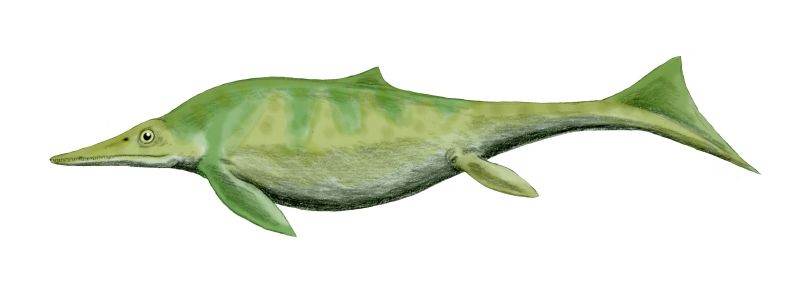
Californosaurus perrini, an ichthyosaur from the Late Triassic of North America, pencil drawing

Isasicursor santacrucensis, an elasmarian ornithopod dinosaur.


Megacephalosaurus eulerti reconstructed skull in the Rocky Mountain Dinosaur Resource Center, Woodland Park, Colorado.


Ichthyosaurus communis, Early Jurassic of England. Digital.

“Golden spike” at the GSSP of the Selandian stage (lower Upper Paleocene) at Zumaia section, Spanish Basque Country. The spike sits on the top plane of the uppermost limestone bed of the Aitzgorri Limestone Formation which is identical to the basal plane of the overlying red marls of the lowest part of the Itzurun Formation (right-hand outside the picture).[1]

Information sign for the GSSP of the Seelandian stage (lower Upper Paleocene) at Zumaia section, Spanish Basque Country. The sign is mounted near the “golden spike” on the top plane of the uppermost limestone bed of the Aitzgorri Limestone Formation which is identical to the basal plane of the overlying red marls of the lowest part of the Itzurun Formation (right-hand outside the picture).[1]


Shetwemys, Plastral remains of the podocnemidid turtle S. fajumensis (Erymnochelyini). (a–b) NHMUK R3435, anterior plastral lobe, in ventral (a) and dorsal (b) views. (c–d) NHMUK R8441, plaster cast of the specimen CGM C8509, anterior plastral lobe, in ventral (c) and dorsal (d) views. (e–f) AMNH 5093, articulated epiplastra and entoplastron, in ventral (e) and dorsal (f) views. (g–h) SMNS 11233/6, anterior plastral lobe, in ventral (g) and dorsal (h) views. (i–j) NHMUK R3103, partial anterior plastral lobe, in ventral (i) and dorsal (j) views. (k–l) SMNS 11233/5, right hypoplastron, in ventral (k) and dorsal (l) views. (m–n) SMNS 11233/3, articulated left hypoplastron and xiphiplastron, in dorsal (m) and ventral (n) views, and detail of the outer ornamental pattern (o). Gebel Quatrani Formation, Fayum depression, Egypt, Lower Oligocene (Rupelian)

Shetwemys, Shell remains of the podocnemidid turtle S. fajumensis (Erymnochelyini). (a–c) SMNS 11233/2, partial carapace, in dorsal (a), ventral (b), and left lateral (c) views. (d) Ventral view of the anterior lobe the holotype of the species, currently lost, based on the fig. 2C in plate 8 of Andrews (1903). (e–g) SMNS 12647, plastron, in ventral (e), dorsal (f), and left lateral (g) views. (g’) corresponds to an enlarged photograph of the posterior plastral lobe, in left lateral view, in which the thickness in the regions close to the hypo-xiphiplastral suture (in blue), between the pelvic scars (in green), and at the level of the anal notch (in red), have been represented by arrows (h–i), SMNS 12646, plastron, in ventral (h) and dorsal (i) views. Gebel Quatrani Formation, Fayum depression, Egypt, Lower Oligocene (Rupelian)