Galerie d'images
Toutes les images de la base — taxons, formations et intervalles géologiques.
⚠ La fonctionnalité de récupération des images est en cours de test, des images non pertinentes peuvent apparaître.
4,826 image(s)

Fossil of Coloborhynchus, an extinct pterosaur- Took the photo at Naturalis museum, Leiden

Coelurus fragilis, a coelurosaur from the Late Jurassic of North America, pencil drawing, digital coloring
Coelurus fragilis, a coelurosaur from the Late Jurassic of North America, pencil drawing, digital coloring


Figure 1: Geographic distribution of Early Cretaceous iguanodontians in North America. Taxa found at each locality are as follows: (A) Dakotadon lakotaensis; (B) Osmakasaurus depressus; (C) Tenontosaurus tilletti, Tenontosaurus dossi; (D) Tenontosaurus tilletti; (E) Theiophytalia kerri; (F) Cedrorestes crichtoni, Planicoxa venenica; (G) Hippodraco scutodens; (H) Iguanacolossus fortis; (I) Tenontosaurus sp; (J) Tenontosaurus tilletti.
Figure 1: Geographic distribution of Early Cretaceous iguanodontians in North America. Taxa found at each locality are as follows: (A) Dakotadon lakotaensis; (B) Osmakasaurus depressus; (C) Tenontosaurus tilletti, Tenontosaurus dossi; (D) Tenontosaurus tilletti; (E) Theiophytalia kerri; (F) Cedrorestes crichtoni, Planicoxa venenica; (G) Hippodraco scutodens; (H) Iguanacolossus fortis; (I) Tenontosaurus sp; (J) Tenontosaurus tilletti.

Numbers above nodes represent bootstrap values, whereas those beneath nodes represent Bremer decay values. Bootstrap values lower than 20 and Bremer decay values less than 2 are not shown.
Numbers above nodes represent bootstrap values, whereas those beneath nodes represent Bremer decay values. Bootstrap values lower than 20 and Bremer decay values less than 2 are not shown.

Central Museum of Mongolian Dinosaurs, Ulaanbaatar. Complete indexed photo collection at WorldHistoryPics.com.

Map of the localities in the Bauru Basin where the sauropod dinosaurs were collected.

'Saturnalia' Skulpturengruppe von Ernesto Biondi in Buenos Aires ( im Botanischen Garten)

(A) A phylogenetic principal-component analysis (PCA) represents the projection of the Dinosauria supertree (STAR Methods) into a PCA of climatic variables. PC1 axis shows strong positive correlation with maximum temperature ([temp max), low positive correlation with precipitation seasonality ( precip season), strong negative correlation with minimum temperature (Ytemp min), and strong negative correlation with minimum precipitation (Yprecip min). PC2 axis shows strong positive correlation with minimum temperature ([temp min) and negative correlation with precipitation seasonality (Yprecip season). Shadows around points highlight the relative density in the principal compo- nent space of non-dinosaurian Dinosauromorpha (gray), Ornithischia (blue), Sauropodomorpha (green), and Theropoda (red). (B) Lower left plot shows 95% confidence interval convex hulls for each dinosauromorph subclade. Blue thermometer (top left corner) symbolizes the direction of the vector in the PC space region for cold temper- atures; yellow thermometer (top right corner) indicates the direction of the vector in PC space for warm tem- peratures; brown shrub (top right corner) depicts dry conditions, while the same with a gray, rainy cloud (mid, lower side of the graph) illustrates seasonal conditions. Silhouettes represent the following taxa (clockwise from the higher left corner): Minmi, Edmontosaurus, Pachyrhinosaurus, Tyrannosaurus, Asilisaurus, Graci- liceratops, Harpymimus, Altirhinus, Gobititan, Suz- housaurus, Marasuchus, Pampadromaeus, Herrer- asaurus, Vulcanodon, Diplodocus, Giraffatitan, Coelophysis, Dromomeron, Gondwanatitan, Tapuiasaurus, Anchisaurus, Siamotyrannus, Diodorus, Suchomimus, Phuwiangosaurus, Ouranosaurus, Irritator, Tangvayosaurus, Nanshiungosaurus, Aeolosaurus, Rebbachisaurus, Chuxiongosaurus, Tethyshadros, Koreanosaurus. Genyodectes, Mapusaurus, Vegavis, Goyocephale, and Rhoetosaurus.

Reconstruction of Mochlodon suessi from the Late Cretaceous of Austria. Based on Zalmoxes by Scott Hartman

Numbers above nodes represent bootstrap values, whereas those beneath nodes represent Bremer decay values. Bootstrap values lower than 20 and Bremer decay values less than 2 are not shown.


Life restoration of the German Jurassic ichthyosaur Suevoleviathan disinteger. The dorsal and caudal fins are loosely based on those of Stenopterygius. References Maisch, M.W. (2020). "The best-preserved skeleton of Suevoleviathan integer (Bronn, 1844)(Reptilia: Ichthyosauria) from the lower Jurassic of south-western Germany, with a discussion of the genus". Neues Jahrbuch für Geologie und Paläontologie, Abhandlungen 297 (2): 153–172. Maisch, M.W. (1998). "A new ichthyosaur genus from the Posidonia Shale (Lower Toarcian, Jurassic) of Holzmaden, SW-Germany with comments on the phylogeny of post-Triassic ichthyosaurs". Neues Jahrbuch für Geologie und Paläontologie-Abhandlungen 209 (1): 47–78.

Tuarangisaurus cabazai skeleton restoration, Copenhagen

Muraenosaurus? Reedii, Sp. Nov. and Tricleidus? Laramiensis Knight, American Jurassic Plesiosaurs

Restored skeleton of Anzu wyliei (previously labelled as a specimen of Chirostenotes)

Life restoration of the mosasaurine mosasaurid Eremiasaurus, with unknown portions and soft tissues based primarily on Prognathodon and supplemented with Mosasaurus where needed. References Leblanc, A.R.H.; Caldwell, M.W.; Bardet, N. (2012). "A new mosasaurine from the Maastrichtian (Upper Cretaceous) phosphates of Morocco and its implications for mosasaurine systematics". Journal of Vertebrate Paleontology 32 (1): 82–104. Lindgren, J.; Kaddumi, H.; Polcyn, M. (2013). "Soft tissue preservation in a fossil marine lizard with a bilobed tail fin". Nature Communications 4: 2423. DOI:10.1038/ncomms3423. Konishi, T.; Brinkman, D.; Massare, J.A.; Caldwell, M.W. (2011). "New exceptional specimens of Prognathodon overtoni (Squamata, Mosasauridae) from the upper Campanian of Alberta, Canada, and the systematics and ecology of the genus". Journal of Vertebrate Paleontology 31 (5): 1026–1046. Russell, D.A. (1967). "Systematics and morphology of American mosasaurs". Bulletin of the Peabody Museum of Natural History 23: 1–241.

Fossil samples – e.g. ‘primitive’ bony fish (1, 2), a skull of a temnospondyl ‘amphibian’ (probably a metoposauroid) in dorsal view (3), a skull of an archosaur of the crocodile lineage (probably a phytosaur) in palatal view (4), holotype of the “gliding reptile” Icarosaurus siefkeri [1] (5) and Atreipus-Grallator-type dinosaur tracks (bottom right) – from the Newark Supergroup, i.e. a series of mainly Late Triassic to Early Jurassic sedimentary rocks of eastern North America ↑ Edwin H. Colbert: A gliding reptile from the Triassic of New Jersey. American Museum Novitates, 2230. American Museum of Natural History, New York 1966, digitallibrary.amnh.org, cf. fig. 3 therein.

Photo montage of different specimens of mosasaurs: Opetiosaurus Vallecillosaurus Halisaurus Plotosaurus Platecarpus Tylosaurus

Eonatator sternbergi, a mosasaur from the Late Cretaceous of Kansas. Digital.

Leptorhynchos, a small caenagnathid from the Campanian of Western North America. Original work in pencil and charcoal by Nick Longrich. Additional digital editing in Adobe Photoshop by Nick Longrich.

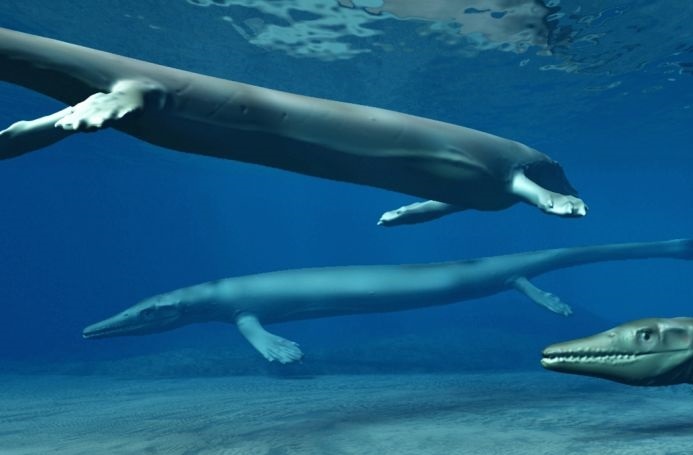
Paddle of the British Jurassic pliosaurid plesiosaur Eardasaurus housed at the Oxford University Natural History Museum.

Title: A descriptive catalogue of the marine reptiles of the Oxford clay. Based on the Leeds Collection in the British Museum (Natural History), London .. Identifier: descriptivecatal02brit (find matches) Year: 1910 (1910s) Authors: British Museum (Natural History). Dept. of Geology; Andrews, Charles William, 1866-1924 Subjects: Reptiles, Fossil Publisher: London, Printed by order of the Trustees Contributing Library: Smithsonian Libraries Digitizing Sponsor: Biodiversity Heritage Library View Book Page: Book Viewer About This Book: Catalog Entry View All Images: All Images From Book Click here to view book online to see this illustration in context in a browseable online version of this book. Text Appearing Before Image: CATAL.MARINE KEPT. OXFORD CLAY. PART II. PLATE I. pmcc. Text Appearing After Image: >p77ia:. G.M.Woodward del. etlibh. West, Newman imp. PLIOSAURUS FEROX. Note About Images Please note that these images are extracted from scanned page images that may have been digitally enhanced for readability - coloration and appearance of these illustrations may not perfectly resemble the original work.

Phylogenetic relationships, chronostratigraphic, and paleoecological implications of M. intrepidus. a Graphic illustrating temporal range of North American tyrannosauroids including species-level range prior to the discovery of M. intrepidus, extension of current range, and hypothesized range based on isolated teeth12. The current gap in the North American tyrannosauroid record spans from the Tithonian to the Aptian. Faunal composition of Late Cretaceous ecosystems was established between the Albian and Turonian, as recognized by the stratigraphic appearance of major clades (see refs. 7,12 and references therein). b generalized phylogenetic relationships of Tyrannosauroidea, showing the appearance of select traits related to cursoriality in tyrannosaurs that are newly optimized as a result of the discovery of M. intrepidus. Tree topology follows this study using the modified dataset of Carr and colleagues27. Coelurus and Tanycolagreus are grafted as basal tyrannosauroids following Brusatte and colleagues5. c Stratigraphic distribution of Allosauria in North America (incl. Megaraptora but see ref. 70 for alternative hypotheses regarding this clade) documents overlap with M. intrepidus in early Late Cretaceous ecosystems leading to (d) refined calibration on the origin of late diverging tyrannosauroids and clade-level faunal turnover within apex predator roles throughout the Late Jurassic–Late Cretaceous of North America. Colored polygons are stylized call-outs and are not intended to reflect two-dimensional data. Temporal data corresponding to this figure are available in Supplementary Table 5

Réplica expuesta en CaixaForum Sevilla. Neuquensaurus australis último de los titanosaurios. Encontrado en Cinco Saltos, Neuquén por Santiago Roth. Ocho metros de longitud y tres mil kilos de peso.

Rhomaleosaurus cramptoni fossil, Natural History Museum, London

Carinodens acrodon holotype left maxilla (MHNM.KHG.1510) (A) compared to Xenodens calminechari holotype left maxilla (MHNM.KHG.331) (B), in lateral view; both from Sidi Chennane, Oulad Abdoun Basin, Morocco; Phosphates, Upper Couche III, uppermost Maastrichtian [9,24]. Scales = 50 mm.

Holotype of Rexarthuria or "Palaeornis" clifti, PV OR 2353. Proximal extremity of left humerus.


Phylogenetic position of Akainacephalus johnsoni in (A), a strict consensus of 21 equally most parsimonious trees, including the wildcard taxon Ahshislepelta minor, placing A. johnsoni within a large polytomy, consisting of crown group taxa that include Asian and all Laramidian ankylosaurids; and (B), the resulting strict consensus of six equally most phylogenetic trees, from which the wildcard taxon Ahshislepelta minor has been pruned. The crown group taxa are slightly better resolved in the pruned analysis, in which Akainacephalus johnsoni forms a clade with its sister taxon Nodocephalosaurus kirtlandensis, nested within the clade that also includes the Asian taxa Minotaurasaurus ramachandrani, Tarchia kilanae, and Shanxia tianzhenensis, suggesting a close taxonomic relationship with Nodocephalosaurus kirtlandensis and Asian taxa.
Phylogenetic position of Akainacephalus johnsoni in (A), a strict consensus of 21 equally most parsimonious trees, including the wildcard taxon Ahshislepelta minor, placing A. johnsoni within a large polytomy, consisting of crown group taxa that include Asian and all Laramidian ankylosaurids; and (B), the resulting strict consensus of six equally most phylogenetic trees, from which the wildcard taxon Ahshislepelta minor has been pruned. The crown group taxa are slightly better resolved in the pruned analysis, in which Akainacephalus johnsoni forms a clade with its sister taxon Nodocephalosaurus kirtlandensis, nested within the clade that also includes the Asian taxa Minotaurasaurus ramachandrani, Tarchia kilanae, and Shanxia tianzhenensis, suggesting a close taxonomic relationship with Nodocephalosaurus kirtlandensis and Asian taxa.
Phylogenetic position of Akainacephalus johnsoni in (A), a strict consensus of 21 equally most parsimonious trees, including the wildcard taxon Ahshislepelta minor, placing A. johnsoni within a large polytomy, consisting of crown group taxa that include Asian and all Laramidian ankylosaurids; and (B), the resulting strict consensus of six equally most phylogenetic trees, from which the wildcard taxon Ahshislepelta minor has been pruned. The crown group taxa are slightly better resolved in the pruned analysis, in which Akainacephalus johnsoni forms a clade with its sister taxon Nodocephalosaurus kirtlandensis, nested within the clade that also includes the Asian taxa Minotaurasaurus ramachandrani, Tarchia kilanae, and Shanxia tianzhenensis, suggesting a close taxonomic relationship with Nodocephalosaurus kirtlandensis and Asian taxa.

IdentificatieTitel(s): Pootafdruk en een spoor van een staart. Brontozoum Sillimanium and B. Minisculum (titel op object). Caudal Trail? (titel op object)Objecttype: foto bladzijde Objectnummer: RP-F-2001-7-1066-4Opschriften / Merken: nummer, recto, gedrukt: ‘Plate XVI. Fig. 1. Fig. 2.’Omschrijving: Links de pootafdruk van een Brontozoum Sillimanium en Brontozoum Minisculum, rechts (vermoedelijk) een spoor van de staart van een Platypterna.VervaardigingVervaardiger: fotograaf: J.L. Lovell (vermeld op object)Plaats vervaardiging: AmherstDatering: ca. 1858 - in of voor 1863Materiaal: fotopapier Techniek: albuminedrukAfmetingen: pagina: h 313 mm × b 232 mmOnderwerpWat: foot-print, trackVerwerving en rechtenCredit line: Aankoop met steun van de Mondriaan Stichting, het Prins Bernhard Cultuurfonds, het VSBfonds, het Paul Huf Fonds/Rijksmuseum Fonds en het Egbert KunstfondsVerwerving: aankoop 2001Copyright: Publiek domein
Clidastes propython, a mosasaur from the Late Cretaceous of Kansas, digital.

Protoceratops andrewsi skeleton at Carnegie Museum of Natural History.

A, Akmechetosauropus makhkamovi (redrawn from [56]); B, Amblydactylus gethingi (redrawn from [8]); C, Amblydactylus kortmeyeri (redrawn from [57]); D, Apulosauripus federicianus (redrawn from [62]); E, Babatagosauropus bulini (redrawn from [56]); F, Bonaparteichnium tali (redrawn from [66]); G, Brachyguanodonipus prejanensis (redrawn from [68]); H, Camptosaurichnus fasolae (redrawn from [70]); I, Camptosauropus vialovi (redrawn from [74]); J, Caririchnium magnificum (redrawn from [11]); K, Caririchnium leonardii (redrawn from [76]); L-M, Caririchnium protohadrosaurichnos (redrawn from [78]); N, Caririchnium lotus (redrawn from [81]); O, Caririchnium kyoungsookimi (redrawn from [80]); P, Gigantoshiraminesauropus matsuoi (redrawn from [82]); Q, Gypsichnites pacensis (redrawn from [8]); R, Hadrosaurichnoides igeensis (redrawn from [92]); S, Hadrosaurichnus australis (redrawn from [93]); T, Hadrosaurichnus titicaensis (redrawn from [96]); U, Hadrosauripeda hauboldi (redrawn from [98]); V, Hadrosauropodus langstoni (redrawn from [24]); W, Hadrosauropodus nanxiongensis (redrawn from [99]); X, Iguanodonichnus frenkii (redrawn from [70]); Y, Iguanodonipus cuadrupedae (redrawn from [68]).
A, Akmechetosauropus makhkamovi (redrawn from [56]); B, Amblydactylus gethingi (redrawn from [8]); C, Amblydactylus kortmeyeri (redrawn from [57]); D, Apulosauripus federicianus (redrawn from [62]); E, Babatagosauropus bulini (redrawn from [56]); F, Bonaparteichnium tali (redrawn from [66]); G, Brachyguanodonipus prejanensis (redrawn from [68]); H, Camptosaurichnus fasolae (redrawn from [70]); I, Camptosauropus vialovi (redrawn from [74]); J, Caririchnium magnificum (redrawn from [11]); K, Caririchnium leonardii (redrawn from [76]); L-M, Caririchnium protohadrosaurichnos (redrawn from [78]); N, Caririchnium lotus (redrawn from [81]); O, Caririchnium kyoungsookimi (redrawn from [80]); P, Gigantoshiraminesauropus matsuoi (redrawn from [82]); Q, Gypsichnites pacensis (redrawn from [8]); R, Hadrosaurichnoides igeensis (redrawn from [92]); S, Hadrosaurichnus australis (redrawn from [93]); T, Hadrosaurichnus titicaensis (redrawn from [96]); U, Hadrosauripeda hauboldi (redrawn from [98]); V, Hadrosauropodus langstoni (redrawn from [24]); W, Hadrosauropodus nanxiongensis (redrawn from [99]); X, Iguanodonichnus frenkii (redrawn from [70]); Y, Iguanodonipus cuadrupedae (redrawn from [68]).
A, Akmechetosauropus makhkamovi (redrawn from [56]); B, Amblydactylus gethingi (redrawn from [8]); C, Amblydactylus kortmeyeri (redrawn from [57]); D, Apulosauripus federicianus (redrawn from [62]); E, Babatagosauropus bulini (redrawn from [56]); F, Bonaparteichnium tali (redrawn from [66]); G, Brachyguanodonipus prejanensis (redrawn from [68]); H, Camptosaurichnus fasolae (redrawn from [70]); I, Camptosauropus vialovi (redrawn from [74]); J, Caririchnium magnificum (redrawn from [11]); K, Caririchnium leonardii (redrawn from [76]); L-M, Caririchnium protohadrosaurichnos (redrawn from [78]); N, Caririchnium lotus (redrawn from [81]); O, Caririchnium kyoungsookimi (redrawn from [80]); P, Gigantoshiraminesauropus matsuoi (redrawn from [82]); Q, Gypsichnites pacensis (redrawn from [8]); R, Hadrosaurichnoides igeensis (redrawn from [92]); S, Hadrosaurichnus australis (redrawn from [93]); T, Hadrosaurichnus titicaensis (redrawn from [96]); U, Hadrosauripeda hauboldi (redrawn from [98]); V, Hadrosauropodus langstoni (redrawn from [24]); W, Hadrosauropodus nanxiongensis (redrawn from [99]); X, Iguanodonichnus frenkii (redrawn from [70]); Y, Iguanodonipus cuadrupedae (redrawn from [68]).


Diversity of Marginocephalians. Psittacosaurus, Pachycephalosaurus, Protoceratops, Triceratops, Stegoceras and Prenoceratops.

A map showing the distribution of paraves in Late Jurassic with the respective paleogeographic setting.

A map showing the distribution of paraves in Late Cretaceous with the respective paleogeographic setting.

A map showing the distribution of paraves in Early Cretaceous with respective paleogeographic setting.

Foto und Schema von Schädel und Zahnverteilung, Chromeornis funkyi (Bildausschnitt)


Diaorama of various paravians, including taxidermied emu and cockatiels, plus Deinonychus reconstruction

A diagram showing the diversification of avialans before and after the K-Pg boundary.

Computertomographische verschluckter Steinchen durch Chromeornis funkyi (Bildausschnitt)

The "dromaeo-avemorphs", as they are informally known (Paul, 2002), represent a group of early paravian theropods with asymmetrical feathers and an Archaeopteryx-like body. According to Hartman et al. (2019), the animals shown in this image might, together, form a clade (monophyletic group) without modern birds.

Diuqin is an unenlagiine dinosaur from the Late Cretaceous of what is now Argentina. Unenlagiines, known exclusively from South America, are usually classified as dromaeosaurs though this is sometimes debated. Like dromaeosaurs, they were covered in feathers, carnivorous, and had the large sickle-like claw on the inner toe of each foot. Unique to unenlagiines is their elongated snout, suggesting a piscivorous diet. Diuqin was a medium-sized unenlagiine, at about 4 m in length.

Figure 1. Evolution of macroecological traits in Dinosauria. Large scale event in dinosaur evolution (a); the origin of dinosaurs (star), hyperthermals (volcano), the earliest fossil Avialae (bird), the earliest fossil angiosperm (flower), the Cretaceous/Palaeogene mass extinction (asteroid). Phylogeny of dinosaurs (b) redrawn from Sereno and adapted to the current consensus and upon which an ancestral state reconstruction of temperature niche (mean annual temperature) after Chiarenza et al. is plotted; Mesozoic palaeogeographies (c) for Triassic (T), Jurassic (J) and Cretaceous (K). Silhouette colours symbolize body mass for each of the taxa represented; information on dietary habits are plotted after Barrett and Zanno & Makovicky; numbers represent clades discussed through this study: 1, Ornithischia; 2, Thyreophora; 3, Ornithopoda; 4, Hadrosauroidea; 5, Marginocephalia; 6, Ceratopsia; 7, Saurischia; 8, Sauropodomorpha; 9, Sauropoda; 10, Theropoda; 11, Ceratosauria; 12, Tetanurae; 13, Coelurosauria; 14, Maniraptoriformes; 15, Maniraptora; 16, Deinonychosauria; 17, Avialae; 18, Ornithothoraces. Palaeogeographies modified from original plots via R package ‘mapast’ using plate models by Scotese.

Representative taxa from the Santonian Iharkút fauna from the Csehbánya Formation, Bakony Mountains, western Hungary. A Pannoniasaurus inexpectatus (Squamata, Mosasauroidea), dorsal vertebra (MTM uncatalogued) in dorsal view (photo by Réka Kalmár) B Foxemys trabanti (Pleurodira, Bothremydidae), skull (MTM V 2010.215.1.) in dorsal view (photo by Márton Rabi). C Bicuspidon aff. hatzegiensis (Squamata, Borioteiioidea), left dentary (MTM 2006.112.1.) in medial view (photo by László Makádi) D Basal tetanuran (Theropoda, Tetanurae), tooth (MTM V.01.54) in ?lingual view E Indeterminate abelisaurid (Theropoda, Abelisauridae), pedal ungual phalanx (MTM V 2008.43.1.) in lateral view F Pneumatoraptor fodori (Theropoda, Paraves), left scapulocoracoid (holotype, MTM V 2008.38.1.) in lateral view G Mochlodon vorosi (Ornithopoda, Rhabdodontidae), left dentary (holotype, MTM V 2010.105.1) in lateral view H Bakonydraco galaczi (Pterosauria, Azhdarchidae), mandible (holotype, MTM 2007.110.1) in dorsal view I Iharkutosuchus makadii (Eusuchia, Hylaeochampsidae), skull (holotype, MTM 2006.52.1) in dorsal view J Hungarosaurus tormai (Ankylosauria, Nodosauridae), right dentary (MTM 2007.25.2) in lateral view K Bauxitornis mindszentyae (Aves, Enantiornithes), left tarsometatarsus (holotype, MTM V 2009.38.1) in anterior view L Ajkaceratops kozmai (Ceratopsia), fused rostral and premaxillae (holotype, MTM V 2009.192.1) in lateral view. Scale bars: 2 cm in A, V, G, H, I, J; 1 cm in D, E, F, K, L; 1 mm in C.
