Galerie d'images
Toutes les images de la base — taxons, formations et intervalles géologiques.
⚠ La fonctionnalité de récupération des images est en cours de test, des images non pertinentes peuvent apparaître.
4,826 image(s)


Majungasaurus crenatissimus, Royal Ontario Museum, Toronto, Ontario, Museum

Mounted skeleton (cast) of Majungasaurus crenatissimus, Stony Brook University.

Comparison between the tails of for different Ichthyosauria specimens, captions present and in German, from Abel, O. (1919). Die Stämme der Wirbeltiere.

Figure description from paper: "Figure 23: Early and Middle Triassic ichthyopterygian heads possessing longirostry. Simplified outlines of four different Early and Middle Triassic ichthyopterygian heads possessing a long and slender rostrum. Specimens are at the same scale. (A) Utatsusaurus hataii (UHR 30691, Motani, Minoura & Ando, 1998); (B) Grippia longirostris (PMU R445, Motani, 2000); (C) Mixosaurus cornalianus (BES SC 1000, Renesto et al., 2020); (D) Besanosaurus leptorhynchus (PIMUZ T 4847, this paper); (E) Cymbospondylus buchseri (PIMUZ T 4351, Sander, 1989). Scale bar represents 10 cm." References: Bindellini, G.; Wolniewicz, A.S.; Miedema, F.; Scheyer, T.M.; Dal Sasso, C. (2021). "Cranial anatomy of Besanosaurus leptorhynchus Dal Sasso & Pinna, 1996 (Reptilia: Ichthyosauria) from the Middle Triassic Besano Formation of Monte San Giorgio, Italy/Switzerland: Taxonomic and palaeobiological implications". PeerJ 9: e11179. DOI:10.7717/peerj.11179.

Reconstruction of a paleoecological environment, showing a Cymbospondylus petrinus swimming next to a group of Phalarodon fraasi (formerly identified as Mixosaurus nordenskioeldii as depicted by Sander & Bucher (1990) and Schmitz (2005)).


Besanosaurus leptorhynchus referred specimen PIMUZ T 4376, preserved on the same slab as a specimen of the smaller Mixosaurus. Scale bar represents 50 cm (1.6 ft). Figure 3C of Bindellini et al. (2021). References: Bindellini, G.; Wolniewicz, A.S.; Miedema, F.; Scheyer, T.M.; Dal Sasso, C. (2021). "Cranial anatomy of Besanosaurus leptorhynchus Dal Sasso & Pinna, 1996 (Reptilia: Ichthyosauria) from the Middle Triassic Besano Formation of Monte San Giorgio, Italy/Switzerland: Taxonomic and palaeobiological implications". PeerJ 9: e11179. DOI:10.7717/peerj.11179.

Modified version of figure 23 of Bindellini et al. (2021) showing just the ichthyosaurs from the Besano Formation: Besanosaurus leptorhynchus (A), Mixosaurus cornalianus (B), and Cymbospondylus buchseri (C). The original figure was uploaded unmodified here: File:Early to Middle Triassic Longirostrine Ichthyopterygians.png References: Bindellini, G.; Wolniewicz, A.S.; Miedema, F.; Scheyer, T.M.; Dal Sasso, C. (2021). "Cranial anatomy of Besanosaurus leptorhynchus Dal Sasso & Pinna, 1996 (Reptilia: Ichthyosauria) from the Middle Triassic Besano Formation of Monte San Giorgio, Italy/Switzerland: Taxonomic and palaeobiological implications". PeerJ 9: e11179. DOI:10.7717/peerj.11179.

Barracudasauroides panxianensis, skull. Stage : Anisian from 247.2 million years ago until ~242 million years ago. Size and weight : 118x62x545 cm – 79.4 Kg

Barracudasauroides panxianensis Stage : Anisian from 247.2 million years ago until ~242 million years ago Size and weight : 118x62x545 cm – 79.4 Kg

Life restoration of Barracudasauroides panxiensis

Plioplatecarpus, autor - Bogdanov,2006
Plioplatecarpus, autor - Bogdanov,2006

Plesioplatecarpus planifrons mounted skeleton in the Rocky Mountain Dinosaur Resource Center in Woodland Park, Colorado

This is a photograph from my own collection. I am the photographer. Taken 12/6/01, Atlanta, Georgia.
This is a photograph from my own collection. I am the photographer. Taken 12/6/01, Atlanta, Georgia.

A hypothetical life restoration of Oneirosaurus caballeroi, a basal plioplatecarpine mosasaur from the Coniacian beds of Lebrija, Santander of Central Colombia. Body proportions are based off of other related mosasaurs such as Angolasaurus and Yaguarasaurus.
A hypothetical life restoration of Oneirosaurus caballeroi, a basal plioplatecarpine mosasaur from the Coniacian beds of Lebrija, Santander of Central Colombia. Body proportions are based off of other related mosasaurs such as Angolasaurus and Yaguarasaurus.

Plioplatecarpus primaevus skull, Oxford University Museum of Natural History .
Plioplatecarpus primaevus skull, Oxford University Museum of Natural History .

Reconstructed skeleton of the indeterminate Moroccan Cretaceous plioplatecarpine (Mosasauridae: Plioplatecarpinae) NMNS005676 F043103, possibly Gavialimimus almaghribensis or an unnamed species (according to Yang, 2022). A collection of the National Museum of Natural Science (Taichung, Taiwan), the specimen was on display in the National Taiwan Museum during a special exhibition.
Reconstructed skeleton of the indeterminate Moroccan Cretaceous plioplatecarpine (Mosasauridae: Plioplatecarpinae) NMNS005676 F043103, possibly Gavialimimus almaghribensis or an unnamed species (according to Yang, 2022). A collection of the National Museum of Natural Science (Taichung, Taiwan), the specimen was on display in the National Taiwan Museum during a special exhibition.

Latoplatecarpus willistoni (TMP 1984.162.0001), Royal Tyrrell Museum, Drumheller, Alberta, 2025-07-13; cast, Campanian, from the Pierre Shale


Diagram of the skull of Taniwhasaurus antarcticus, the areas in black being the known fossil material. Reference source: Álvarez–Herrera, Agnolin & Novas (2020) "A rostral neurovascular system in the mosasaur Taniwhasaurus antarcticus"

Taxonomic Name : Chordata vertebrata reptilia lacertilia mosasauridae Accession Number : LH1530 Part of the reptiles and amphibians/land vertebrates collection For more details visit <a href="https://www.aucklandmuseum.com/collections-research/collections/record/am_naturalsciences-object-126470" rel="noreferrer nofollow">www.aucklandmuseum.com/collections</a> Images released under a CC-BY licence. Auckland Museum 2019

Taxonomic Name : Chordata vertebrata reptilia lacertilia mosasauridae Accession Number : LH1516 Part of the reptiles and amphibians/land vertebrates collection For more details visit <a href="https://www.aucklandmuseum.com/collections-research/collections/record/am_naturalsciences-object-122721" rel="noreferrer nofollow">www.aucklandmuseum.com/collections</a> Images released under a CC-BY licence. Auckland Museum 2019

Taxonomic Name : Chordata vertebrata reptilia lacertilia mosasauridae Accession Number : LH1516 Part of the reptiles and amphibians/land vertebrates collection For more details visit <a href="https://www.aucklandmuseum.com/collections-research/collections/record/am_naturalsciences-object-122721" rel="noreferrer nofollow">www.aucklandmuseum.com/collections</a> Images released under a CC-BY licence. Auckland Museum 2019

Taxonomic Name : Chordata vertebrata reptilia lacertilia mosasauridae Accession Number : LH1556 Part of the reptiles and amphibians/land vertebrates collection For more details visit <a href="https://www.aucklandmuseum.com/collections-research/collections/record/am_naturalsciences-object-132419" rel="noreferrer nofollow">www.aucklandmuseum.com/collections</a> Images released under a CC-BY licence. Auckland Museum 2019

Taxonomic Name : Chordata vertebrata reptilia lacertilia mosasauridae Accession Number : LH1546 Part of the reptiles and amphibians/land vertebrates collection For more details visit <a href="https://www.aucklandmuseum.com/collections-research/collections/record/am_naturalsciences-object-134128" rel="noreferrer nofollow">www.aucklandmuseum.com/collections</a> Images released under a CC-BY licence. Auckland Museum 2019

Taxonomic Name : Chordata vertebrata reptilia lacertilia mosasauridae Accession Number : LH1530 Part of the reptiles and amphibians/land vertebrates collection For more details visit <a href="https://www.aucklandmuseum.com/collections-research/collections/record/am_naturalsciences-object-126470" rel="noreferrer nofollow">www.aucklandmuseum.com/collections</a> Images released under a CC-BY licence. Auckland Museum 2019

Taxonomic Name : Chordata vertebrata reptilia lacertilia mosasauridae Accession Number : LH1516 Part of the reptiles and amphibians/land vertebrates collection For more details visit <a href="https://www.aucklandmuseum.com/collections-research/collections/record/am_naturalsciences-object-122721" rel="noreferrer nofollow">www.aucklandmuseum.com/collections</a> Images released under a CC-BY licence. Auckland Museum 2019

A life reconstruction of the plioplatecarpine Angolasaurus bocagei, alongside the turtle Angolachelys mbaxi. Digital painting.


Eudimorphodon ranzii - photo taken in museums of natural science in Bergamo
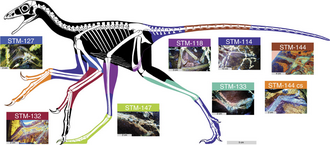
Skeletal restoration of Anchiornis huxleyi by Scott Hartman (2017), incorporating the soft tissue outlines revealed by laser fluorescence studies.

Brontosaurus excelsus in the Yale Peabody Museum of Natural History. Brontosaurus excelsus Inv no. YPM 1980 (holotype specimen of the species) Discoverer William H. Reed 1879 Locality Como Bluff, Wyoming Age Morrison Formatian, Jurassic period, 150 million years ago

Tastavinsaurus, pencil drawing, digital coloring

Identifier: waterreptilesofp1914will Title: Water reptiles of the past and present Year: 1914 (1910s) Authors: Williston, Samuel Wendell, 1851-1918 Subjects: Aquatic reptiles Publisher: Chicago, Ill., The University of Chicago Press Contributing Library: Boston Public Library Digitizing Sponsor: Boston Public Library View Book Page: Book Viewer About This Book: Catalog Entry View All Images: All Images From Book Click here to view book online to see this illustration in context in a browseable online version of this book. Text Appearing Before Image: served and very complete skeletons ofdifferent species of ichthyosaurs from the Jurassic deposits ofWiirtemberg, in which remains of these animals occur in great 112 WATER REPTILES OF THE PAST AND PRESENT profusion. His researches, and those of several authors since then,supplementing and confirming or disproving those of the manyobservers made during the preceding seventy years, have finallydetermined almost perfectly the complete structure of the moretypical ichthyosaurs, enabling us to infer not a little as to theirhabits and distribution in the old Jurassic oceans. Within thepast few years the discoveries of Professor J. C. Merriam of Cali-fornia have likewise added greatly to our knowledge of the earlierichthyosaurs. It may now truthfully be said that of no group ofextinct reptiles do we have a more complete and satisfactory knowl-edge than of the ichthyosaurs. Nevertheless we have yet very much more to learn about theorder Ichthyosauria as a whole—whence they came and how they Text Appearing After Image: Fig. 52.—Ichthyosaurus quadricissus.museum, from Dr. Dreverman. Photograph of specimen in Senckenberg originated; what their nearest kin were among other reptiles; andespecially, more about the connecting links between them andterrestrial reptiles. They have, as an order, so isolated a position,are so widely separated from all other reptiles in structure, that theyhave long been a puzzle to paleontologists. Like the whales andother cetaceans among mammals, we know the ichthyosaurs wellin the plenitude of their power and the fulness of their development,but have yet only an imperfect knowledge of their earlier history,and none whatever of their earliest. However, as will be seenfarther on, the recent discoveries by Merriam have shed much lighton some of the stages of their evolution. So nearly perfectly wereall the later ichthyosaurs adapted to their life in the water that itwas believed by nearly all paleontologists until about a score of years ICHTHYOSAURIA 3 ago that they had desc Note About Images Please note that these images are extracted from scanned page images that may have been digitally enhanced for readability - coloration and appearance of these illustrations may not perfectly resemble the original work.


Skeletal restoration of Preondactylus bufarini.

Jeholornis prima skeleton (IVPP V13350) on display at the Paleozoological Museum of China.

Model of vulcanodon in JuraPark, Solec Kujawski, Poland


Alioramus altai skull in the exhibit, T. rex, The Ultimate Predator, in the American Museum of Natural History (with permission by Ben Miller).


Unaysaurus tolentinoi restored as eating a cycad, based on skeletal diagrams and related animals.


Fossil skeleton of Guaibasaurus, a basal Saurischian dinosaur genus


Life reconstruction of Sinomacrops bondei

Life reconstruction of Saturnalia tupiniquim


Mounted skeleton of Allosaurus fragilis, on display at the Carnegie Museum of Natural History, Pittsburgh, Pennsylvania, USA
