skeleton

View type

294 image(s) · 23 News

Image gallery

Holotype specimen of Linheraptor exquisitus, the blocks including nearly the entire skeleton.

Holotype specimen of Linheraptor exquisitus, the blocks including nearly the entire skeleton.

Japan holotype specimen Linheraptor +1
Hypnovenator matsubaraetoheorum gen. et sp. nov. Blocks including the forelimb, knee (A), and heel (B). (C) Reconstructed skeleton. Red and yellow colors show the confirmed and probable positions of the recovered elements, respectively (Courtesy of Genya Masukawa). (D) Left manus in medial view. (E) Left manual phalanx I-1 in dorsal view. (F) Removed fragmentary left manual phalanx II-3 (manual ungual phalanx II) for preparing the left manus. (G) Cross-section of the bent right ankle. (H) Left metatarsus in posterior view. Abbreviations: as, astragalus; dp, depression; fe, femur; fi, fibula; hu, humerus; mc I, metacarpal I; mc II, metacarpal II; mc III, metacarpal III; mp I-1, manual phalanx I-1; mp I-2, manual phalanx I-2 (manual ungual phalanx I); mp II-1, manual phalanx II-1; mp II-3, manual phalanx II-3 (manual ungual phalanx II); mp III-3, manual phalanx III-3; mp III-4, manual phalanx III-4 (manual ungual phalanx III); mr, medial ridge; mt II, metatarsal II; mt III, metatarsal III; mt IV, metatarsal IV; mt V, metatarsal V; ra, radius; ti, tibia; ul, ulna. Almost all elements are from the left side. Abbreviations for elements from the right side added ‘(r)’ at the end. This figure was created using Adobe Photoshop 25.5.1 and Adobe Illustrator 28.3 (https://www.adobe.com/).

Hypnovenator matsubaraetoheorum gen. et sp. nov. Blocks including the forelimb, knee (A), and heel (B). (C) Reconstructed skeleton. Red and yellow colors show the confirmed and probable positions of the recovered elements, respectively (Courtesy of Genya Masukawa). (D) Left manus in medial view. (E) Left manual phalanx I-1 in dorsal view. (F) Removed fragmentary left manual phalanx II-3 (manual ungual phalanx II) for preparing the left manus. (G) Cross-section of the bent right ankle. (H) Left metatarsus in posterior view. Abbreviations: as, astragalus; dp, depression; fe, femur; fi, fibula; hu, humerus; mc I, metacarpal I; mc II, metacarpal II; mc III, metacarpal III; mp I-1, manual phalanx I-1; mp I-2, manual phalanx I-2 (manual ungual phalanx I); mp II-1, manual phalanx II-1; mp II-3, manual phalanx II-3 (manual ungual phalanx II); mp III-3, manual phalanx III-3; mp III-4, manual phalanx III-4 (manual ungual phalanx III); mr, medial ridge; mt II, metatarsal II; mt III, metatarsal III; mt IV, metatarsal IV; mt V, metatarsal V; ra, radius; ti, tibia; ul, ulna. Almost all elements are from the left side. Abbreviations for elements from the right side added ‘(r)’ at the end. This figure was created using Adobe Photoshop 25.5.1 and Adobe Illustrator 28.3 (https://www.adobe.com/).

humerus Hypnovenator skeleton
(a) Photograph. (b) Highly schematic outline shows general layout of the skeleton (illustrated by Zhaochuang). Scale bar, 5 cm. d, dentary; f, femur; fi, fibula; fr, frontal; lj, lower jaw; or, orbit; ti, tibia.

(a) Photograph. (b) Highly schematic outline shows general layout of the skeleton (illustrated by Zhaochuang). Scale bar, 5 cm. d, dentary; f, femur; fi, fibula; fr, frontal; lj, lower jaw; or, orbit; ti, tibia.

scale Beibeilong skeleton
The whole skeleton of the holotype Tongtianlong limosus gen. et sp. nov. in dorsal view (a) and lateral view (b). Scale bar = 10 cm.

The whole skeleton of the holotype Tongtianlong limosus gen. et sp. nov. in dorsal view (a) and lateral view (b). Scale bar = 10 cm.

scale holotype Tongtianlong skeleton
A photograph of the skeleton of Jianchangosaurus yixianensis gen. et sp. nov. (41HIII-0308A) (A) and line drawing (B).

Abbreviations: at, atlas; ax, axis; cav, caudal vertebra; cv, cervical vertebra; co, coracoid; dc, distal carpal; dv, dorsal vertebra; l., left; f, femur; fi, fibula; fur, furcula; hu, humerus; il, ilium; is, ischium; pu, pubis; ra, radius; sc, scapula; ti, tibia; ul, ulna; mc, metacarpal; mt, metatarsal; mxf, maxillary fenestra; pat, proatlas; r., right; sr, sacral rib; sv, sacral vertebra; ung, ungual. All elements of the skeleton are preserved except the distal half of the caudal vertebrae. Dashed lines of metatarsals indicate areas that have been reconstructed. The middle portion of the neck, from the fourth to ninth cervical vertebrae, and the pedal phalanges have been repositioned. The rest of elements of this specimen are in the original position.

A photograph of the skeleton of Jianchangosaurus yixianensis gen. et sp. nov. (41HIII-0308A) (A) and line drawing (B). Abbreviations: at, atlas; ax, axis; cav, caudal vertebra; cv, cervical vertebra; co, coracoid; dc, distal carpal; dv, dorsal vertebra; l., left; f, femur; fi, fibula; fur, furcula; hu, humerus; il, ilium; is, ischium; pu, pubis; ra, radius; sc, scapula; ti, tibia; ul, ulna; mc, metacarpal; mt, metatarsal; mxf, maxillary fenestra; pat, proatlas; r., right; sr, sacral rib; sv, sacral vertebra; ung, ungual. All elements of the skeleton are preserved except the distal half of the caudal vertebrae. Dashed lines of metatarsals indicate areas that have been reconstructed. The middle portion of the neck, from the fourth to ninth cervical vertebrae, and the pedal phalanges have been repositioned. The rest of elements of this specimen are in the original position.

humerus vertebra drawing specimen +2
Squelette partiel de Wulatesaurus.

Squelette partiel de Wulatesaurus.

Japan Bannykus partial skeleton
Alvarezsaurus skeleton restoration, Copenhagen.

Alvarezsaurus skeleton restoration, Copenhagen.

Alvarezsauria skeleton
Skeleton outline of Dracoraptor hanigani.

Bones highlighted green for present, orange for external moulds and blue for tentatively identified bones. Many unidentified or uncertain elements have been omitted.

Skeleton outline of Dracoraptor hanigani. Bones highlighted green for present, orange for external moulds and blue for tentatively identified bones. Many unidentified or uncertain elements have been omitted.

bone Dracoraptor skeleton
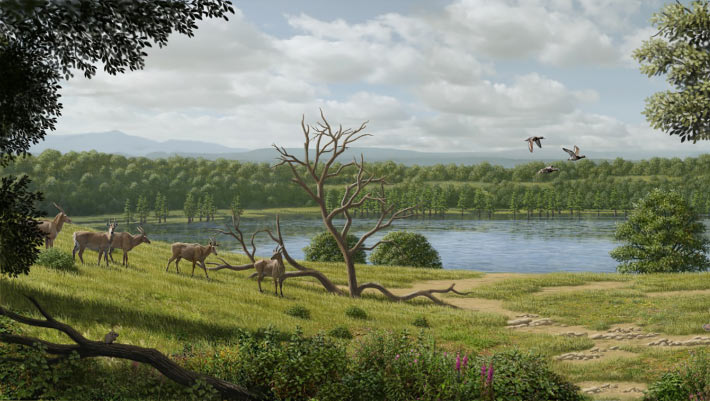
Reconstruction of the terrestrial paleoenvironmental setting of the Sao Khua Formation by Renata Cunha.
In the center, a generalized spinosaurid feeds on a sauropod. This trophic relationship is hypothesized based on isolated tooth crowns found in association with a sauropod skeleton [67]. In the background, a small pack of the ornithomimosaur theropod Kinnareemimus. Both sauropods and ornithomimosaurs (as part of the “herbivorous” theropods) were found to be positively associated with terrestrial paleoenvironments by Butler and Barrett [15].

(cropped from File:Spinosaurid and Kinnareemimus.PNG)

Reconstruction of the terrestrial paleoenvironmental setting of the Sao Khua Formation by Renata Cunha. In the center, a generalized spinosaurid feeds on a sauropod. This trophic relationship is hypothesized based on isolated tooth crowns found in association with a sauropod skeleton [67]. In the background, a small pack of the ornithomimosaur theropod Kinnareemimus. Both sauropods and ornithomimosaurs (as part of the “herbivorous” theropods) were found to be positively associated with terrestrial paleoenvironments by Butler and Barrett [15]. (cropped from File:Spinosaurid and Kinnareemimus.PNG)

tooth Sao Khua Kinnareemimus Ornithomimosauria +3
Photo of the partial holotype skeleton of the ornithomimosaur Garudimimus brevipes, as mounted in the Mongolian Natural History Museum. Scan of physical photograph.

Photo of the partial holotype skeleton of the ornithomimosaur Garudimimus brevipes, as mounted in the Mongolian Natural History Museum. Scan of physical photograph.

museum holotype Garudimimus Ornithomimosauria +2
Reconstruction of the Bravoceratops skeleton with known bones marked in white. Specimen: TMM 46015-1 (holotype). Scale bar=2 m. Total length along centra=6.97 m.

Reconstruction of the Bravoceratops skeleton with known bones marked in white. Specimen: TMM 46015-1 (holotype). Scale bar=2 m. Total length along centra=6.97 m.

bone scale holotype specimen +2
Ornithischian dinosaur Stenopelix valdensis Meyer, 1857, holotype (GZG 741/2, formerly GPI Gö 741−2), from the Obernkirchen Sandstone (Early
Cretaceous: Berriasian), near Bückeburg, Niedersachsen, Germany. A. Large sandstone slab. B. Interpretative outline drawing of large latex cast (prepared
from large sandstone slab), showing majority of postcranial skeleton in dorsal view. C. Small sandstone slab. D. Interpretative outline drawing of small la−
tex cast (prepared from small sandstone slab), showing sacrum and caudals, pelvic region and partial hindlimbs in ventral view. For clarity elements in and
around the sacral region have not been labelled—these areas are shown in greater detail in Fig. 3. Roman numerals II–IV correspond to respective digits.

Abbreviations: mt, metatarsals; f, femur; ?, unidentified element.

Ornithischian dinosaur Stenopelix valdensis Meyer, 1857, holotype (GZG 741/2, formerly GPI Gö 741−2), from the Obernkirchen Sandstone (Early Cretaceous: Berriasian), near Bückeburg, Niedersachsen, Germany. A. Large sandstone slab. B. Interpretative outline drawing of large latex cast (prepared from large sandstone slab), showing majority of postcranial skeleton in dorsal view. C. Small sandstone slab. D. Interpretative outline drawing of small la− tex cast (prepared from small sandstone slab), showing sacrum and caudals, pelvic region and partial hindlimbs in ventral view. For clarity elements in and around the sacral region have not been labelled—these areas are shown in greater detail in Fig. 3. Roman numerals II–IV correspond to respective digits. Abbreviations: mt, metatarsals; f, femur; ?, unidentified element.

drawing Germany Berriasian Cretaceous +8
Composite skeleton on display at the Perot Museum of Nature and Science. Scale bar equals 10 cm.

Composite skeleton on display at the Perot Museum of Nature and Science. Scale bar equals 10 cm.

scale museum Convolosaurus skeleton
The holotype skeleton of Kamuysaurus japonicus gen. et sp. nov. (b) Reconstructed skeleton, showing recovered elements. Selected postcranial elements: cervical vertebrae (atlas, axis, and fourth and twelfth cervicals) in left lateral view (c), dorsal vertebrae (first, seventh, and sixteenth dorsals) in left lateral view (d), caudal vertebrae (anterior, middle, and posterior caudals) in left lateral view (e), left scapula (f) and coracoid (g) in lateral view, right sternum in ventral view (h), left humerus in anterior view (i), right ulna and radius in medial view (j), right manus in dorsal view (k), right pelvis in lateral view (l), right femur in anterior view (m), right tibia in anterior view (n), right fibula in lateral view (o), right astragalus and calcaneum, articulated positioned with tibia (p), and right pes in dorsal view (q). All scales are 10 cm except 1 m scale for (b). Abbreviations; ac, acromion process; ast, astragalus; cal, calcaneum; dpc, deltopectoral crest; fi, fibula; icg, intercondylar groove; il, ilium; is, ischium; ltr, lesser trochanter; mc2, metacarpal II; mc5, metacarpal V; mt2, metatarsal II; mt4, metatarsal IV; nc, neurocentrum; od, odontoid; olp, olecranon process; pc, pleurocentrum; pu, pubis; ra, radius; ti, tibia; ul, ulna; vp, ventral process.

The holotype skeleton of Kamuysaurus japonicus gen. et sp. nov. (b) Reconstructed skeleton, showing recovered elements. Selected postcranial elements: cervical vertebrae (atlas, axis, and fourth and twelfth cervicals) in left lateral view (c), dorsal vertebrae (first, seventh, and sixteenth dorsals) in left lateral view (d), caudal vertebrae (anterior, middle, and posterior caudals) in left lateral view (e), left scapula (f) and coracoid (g) in lateral view, right sternum in ventral view (h), left humerus in anterior view (i), right ulna and radius in medial view (j), right manus in dorsal view (k), right pelvis in lateral view (l), right femur in anterior view (m), right tibia in anterior view (n), right fibula in lateral view (o), right astragalus and calcaneum, articulated positioned with tibia (p), and right pes in dorsal view (q). All scales are 10 cm except 1 m scale for (b). Abbreviations; ac, acromion process; ast, astragalus; cal, calcaneum; dpc, deltopectoral crest; fi, fibula; icg, intercondylar groove; il, ilium; is, ischium; ltr, lesser trochanter; mc2, metacarpal II; mc5, metacarpal V; mt2, metatarsal II; mt4, metatarsal IV; nc, neurocentrum; od, odontoid; olp, olecranon process; pc, pleurocentrum; pu, pubis; ra, radius; ti, tibia; ul, ulna; vp, ventral process.

crest humerus pelvis scale +3
Incomplete skeleton of Camptosaurus prestwichii, now referred to as Cumnoria, Oxford University Museum of Natural History.

Incomplete skeleton of Camptosaurus prestwichii, now referred to as Cumnoria, Oxford University Museum of Natural History.

museum Camptosaurus Cumnoria skeleton
Yueosaurus tiantaiensis, reconstructed skeletons, Zhejiang Geological Museum

Yueosaurus tiantaiensis, reconstructed skeletons, Zhejiang Geological Museum

museum Yueosaurus skeleton
1 2 3 4 5 6 7 8 9 10 11 12 13 14 15 16 17 18 19

News

Half-Ton Cattle Relatives Roamed Europe 4 Million Years Ago
Spain Pliocene mammals skeleton
Near-complete bovine skeletons unearthed the Early Pliocene site of Camp dels Ninots in northeastern Spain reveal that the ancestors of today’s buffalo and cattle were already growing to impressive sizes long before humans arrived on the continent. The post Half-Ton Cattle Relatives Roamed Europe 4 Million Years Ago appeared first on Sci.News: Breaking Science News.
05/06/2026 sci-news
New Jurassic Pterosaur Unearthed in Germany
Germany Jurassic fossil Monofenestrata Pterosauria new species skeleton
Paleontologists have described a new genus and species of early monofenestratan pterosaur based on a nearly complete and well-preserved fossil skeleton discovered in Bavaria, Germany. The post New Jurassic Pterosaur Unearthed in Germany appeared first on Sci.News: Breaking Science News.
19/05/2026 sci-news
Beautiful Eryops Fossil Skeleton on Display
predator museum Permian fossil skeleton
As a child, one of my favourite prehistoric animals was the giant temnospondyl Eryops.  It always brings me pleasure when I come across fossils of this Early Permian predator.  Indeed, just viewing a reconstructed skeleton makes me smile.  When at the London Natural History Museum, I try to make time to see the Eryops megacephalus
06/05/2026 everythingdinosaur
240-million-year-old giant “sand creeper” found hidden in retaining wall
tooth predator Australia fossil discovery skeleton
A forgotten fossil hidden inside a garden wall has turned out to be one of Australia’s most remarkable prehistoric discoveries. Scientists have now identified the 240-million-year-old amphibian, Arenaerpeton supinatus, revealing an almost perfectly preserved skeleton—complete with rare traces of skin. This ancient river predator, about 1.2 meters long, looked somewhat like a giant salamander but was bulkier and armed with fearsome fang-like teeth.
06/05/2026 sciencedaily
Early Sauropodomorph Dinosaur Unearthed in China
China Early Jurassic Jurassic Dinosauria Massopoda new species partial skeleton
A new genus and species of massopodan sauropodomorph that lived during the Early Jurassic epoch has been identified from a partial skeleton unearthed in southwestern China. The post Early Sauropodomorph Dinosaur Unearthed in China appeared first on Sci.News: Breaking Science News.
04/05/2026 sci-news
1 2 3 4 5