squelette

Type de vue

155 image(s) · 12 Actualités

Galerie d'images

The holotype skeleton of Kamuysaurus japonicus gen. et sp. nov. (b) Reconstructed skeleton, showing recovered elements. Selected postcranial elements: cervical vertebrae (atlas, axis, and fourth and twelfth cervicals) in left lateral view (c), dorsal vertebrae (first, seventh, and sixteenth dorsals) in left lateral view (d), caudal vertebrae (anterior, middle, and posterior caudals) in left lateral view (e), left scapula (f) and coracoid (g) in lateral view, right sternum in ventral view (h), left humerus in anterior view (i), right ulna and radius in medial view (j), right manus in dorsal view (k), right pelvis in lateral view (l), right femur in anterior view (m), right tibia in anterior view (n), right fibula in lateral view (o), right astragalus and calcaneum, articulated positioned with tibia (p), and right pes in dorsal view (q). All scales are 10 cm except 1 m scale for (b). Abbreviations; ac, acromion process; ast, astragalus; cal, calcaneum; dpc, deltopectoral crest; fi, fibula; icg, intercondylar groove; il, ilium; is, ischium; ltr, lesser trochanter; mc2, metacarpal II; mc5, metacarpal V; mt2, metatarsal II; mt4, metatarsal IV; nc, neurocentrum; od, odontoid; olp, olecranon process; pc, pleurocentrum; pu, pubis; ra, radius; ti, tibia; ul, ulna; vp, ventral process.
Taxons Kamuysaurus

The holotype skeleton of Kamuysaurus japonicus gen. et sp. nov. (b) Reconstructed skeleton, showing recovered elements. Selected postcranial elements: cervical vertebrae (atlas, axis, and fourth and twelfth cervicals) in left lateral view (c), dorsal vertebrae (first, seventh, and sixteenth dorsals) in left lateral view (d), caudal vertebrae (anterior, middle, and posterior caudals) in left lateral view (e), left scapula (f) and coracoid (g) in lateral view, right sternum in ventral view (h), left humerus in anterior view (i), right ulna and radius in medial view (j), right manus in dorsal view (k), right pelvis in lateral view (l), right femur in anterior view (m), right tibia in anterior view (n), right fibula in lateral view (o), right astragalus and calcaneum, articulated positioned with tibia (p), and right pes in dorsal view (q). All scales are 10 cm except 1 m scale for (b). Abbreviations; ac, acromion process; ast, astragalus; cal, calcaneum; dpc, deltopectoral crest; fi, fibula; icg, intercondylar groove; il, ilium; is, ischium; ltr, lesser trochanter; mc2, metacarpal II; mc5, metacarpal V; mt2, metatarsal II; mt4, metatarsal IV; nc, neurocentrum; od, odontoid; olp, olecranon process; pc, pleurocentrum; pu, pubis; ra, radius; ti, tibia; ul, ulna; vp, ventral process.

crête humérus bassin écaille +3
Incomplete skeleton of Camptosaurus prestwichii, now referred to as Cumnoria, Oxford University Museum of Natural History.
Taxons Cumnoria

Incomplete skeleton of Camptosaurus prestwichii, now referred to as Cumnoria, Oxford University Museum of Natural History.

musée Camptosaurus Cumnoria squelette
Yueosaurus tiantaiensis, reconstructed skeletons, Zhejiang Geological Museum
Taxons Yueosaurus

Yueosaurus tiantaiensis, reconstructed skeletons, Zhejiang Geological Museum

musée Yueosaurus squelette
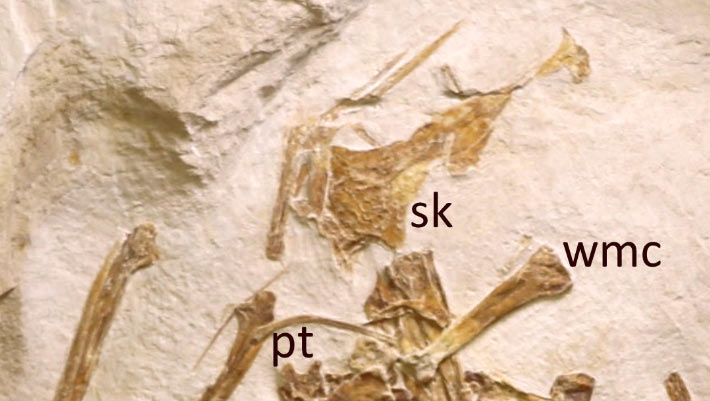
Partial skeleton of the heterodontosaurid Tianyulong confuciusi from the Lower Cretaceous Jehol Group of China. Partial skeleton mainly in right lateral view (IVPP V17090). Enlargements of subsequent figures are shown in red. Scale bar equals 10 cm.
Taxons Tianyulong

Partial skeleton of the heterodontosaurid Tianyulong confuciusi from the Lower Cretaceous Jehol Group of China. Partial skeleton mainly in right lateral view (IVPP V17090). Enlargements of subsequent figures are shown in red. Scale bar equals 10 cm.

écaille Chine Crétacé Heterodontosauridae +3
Photograph and outline drawing of the skeleton of Chuanqilong chaoyangensis.

A, photograph; B, outline drawing. Abbreviations: ca, caudal vertebrae; cb, cervical band; da, dermal armor; dr, dorsal rib; lfe, left femur; lfi, left fibula; lhu, left humerus; lil, left ilium; lis, left ischium; lma, left maxilla; lmd, left mandible; lmt, left metatarsal; lra, left radius; lsc, left scapula; lti, left tibia; lul, left ulna; mc, metacarpals; orb, orbital; pl, plates; q, quadrate; rfe, right femur; rfi, right fibula; rhu, right humerus; ril, right ilium; rma, right maxilla; rmd, right mandible; rmt, right metatarsals; rra, right radius; rsc, right scapula; rti, right tibia; rul, right ulna; sar, sacral rib; te, tendons. [planned for page width].
Taxons Chuanqilong

Photograph and outline drawing of the skeleton of Chuanqilong chaoyangensis. A, photograph; B, outline drawing. Abbreviations: ca, caudal vertebrae; cb, cervical band; da, dermal armor; dr, dorsal rib; lfe, left femur; lfi, left fibula; lhu, left humerus; lil, left ilium; lis, left ischium; lma, left maxilla; lmd, left mandible; lmt, left metatarsal; lra, left radius; lsc, left scapula; lti, left tibia; lul, left ulna; mc, metacarpals; orb, orbital; pl, plates; q, quadrate; rfe, right femur; rfi, right fibula; rhu, right humerus; ril, right ilium; rma, right maxilla; rmd, right mandible; rmt, right metatarsals; rra, right radius; rsc, right scapula; rti, right tibia; rul, right ulna; sar, sacral rib; te, tendons. [planned for page width].

armure humérus dessin Chuanqilong +1
Reconstructed skeleton of Zuul
Taxons Zuul

Reconstructed skeleton of Zuul

Zuul squelette
Fossil skeleton of Gargoyleosaurus parkpinorum taken in 2007 at the Denver Museum of Nature and Science.
Taxons Gargoyleosaurus

Fossil skeleton of Gargoyleosaurus parkpinorum taken in 2007 at the Denver Museum of Nature and Science.

musée Denver fossile Gargoyleosaurus +1
Copy of a skeleton of a Lessemsaurus in the exhibition "Gigasaurier - Die Riesen Argentiniens" in Frankfurt am Main 2010
Taxons Lessemsaurus

Copy of a skeleton of a Lessemsaurus in the exhibition "Gigasaurier - Die Riesen Argentiniens" in Frankfurt am Main 2010

Lessemsauridae Lessemsaurus squelette
Copy of a skeleton of a Lessemsaurus in the exhibition "Gigasaurier - Die Riesen Argentiniens" in Frankfurt am Main 2010
Taxons Lessemsauridae

Copy of a skeleton of a Lessemsaurus in the exhibition "Gigasaurier - Die Riesen Argentiniens" in Frankfurt am Main 2010

Lessemsauridae Lessemsaurus squelette
The incomplete skeleton of Cetiosauriscus stewarti (BMNH R3078) mounted prior to display in around
1903. Photographed in the BMNH, and reproduced courtesy of the Leeds family, with layout by J. J. Liston. Note

the similarity of this photograph to the drawing of the skeleton in Woodward (1905); previously figured in Anon. (1924) and Naish & Martill (2008).[1][2]
Taxons Cetiosauriscus

The incomplete skeleton of Cetiosauriscus stewarti (BMNH R3078) mounted prior to display in around 1903. Photographed in the BMNH, and reproduced courtesy of the Leeds family, with layout by J. J. Liston. Note the similarity of this photograph to the drawing of the skeleton in Woodward (1905); previously figured in Anon. (1924) and Naish & Martill (2008).[1][2]

dessin Cetiosauriscus squelette
Xianshanosaurus skeleton
Taxons Xianshanosaurus

Xianshanosaurus skeleton

Xianshanosaurus squelette
Reconstructed skeleton of Daxiatitan binglingi.
Taxons Daxiatitan

Reconstructed skeleton of Daxiatitan binglingi.

Daxiatitan squelette
Skeletons of Bonatitan and Austroraptor at the Museo Argentino de Ciencias Naturales Bernardino Rivadavia
Taxons Bonatitan

Skeletons of Bonatitan and Austroraptor at the Museo Argentino de Ciencias Naturales Bernardino Rivadavia

Austroraptor Bonatitan squelette
Herbivorous dinosaur found in the Al-khoudh area.  This dinosaur is similar to the Zalmoxes and Rhabdodon dinosaurs.  The skeleton in the Bait Al Baranda Museum was assembled from bones borrowed from several museums.

Herbivorous dinosaur found in the Al-khoudh area. This dinosaur is similar to the Zalmoxes and Rhabdodon dinosaurs. The skeleton in the Bait Al Baranda Museum was assembled from bones borrowed from several museums.

os musée Dinosauria Mochlodon +3
Rates of skeletal character evolution in the skull and postcranial skeleton of hadrosauroids. Cladograms illustrate the results from branch likelihood tests for two morphological partitions: skull (cranium and mandible) (A) and postcranial skeleton (B). In both cladograms, results from the branch likelihood tests are summarized on a strict consensus tree derived from four separately analyzed MPTs, each with 100 dating replicates (a total of 400 Hedman-dated phylogenies). Pie charts on branches illustrate the proportion of dating replicates that showed significantly high rates (red), slow rates (blue), or nonsignificant average rates (white). No pie charts are plotted on branches that showed nonsignificant rates in 100% of dating replicates. Branches that showed high rates (red) in more than 50% of dating replicates are doubled in length. See the Supplementary Material for Hedman-based results plotted separately for each MPT (Supplementary Fig. S2) and for results using the MBL dating method (Supplementary Fig. S3). Silhouettes were created by Scott Hartman and were downloaded from http://phylopic.org (Creative Commons license CC BY 3.0).

Rates of skeletal character evolution in the skull and postcranial skeleton of hadrosauroids. Cladograms illustrate the results from branch likelihood tests for two morphological partitions: skull (cranium and mandible) (A) and postcranial skeleton (B). In both cladograms, results from the branch likelihood tests are summarized on a strict consensus tree derived from four separately analyzed MPTs, each with 100 dating replicates (a total of 400 Hedman-dated phylogenies). Pie charts on branches illustrate the proportion of dating replicates that showed significantly high rates (red), slow rates (blue), or nonsignificant average rates (white). No pie charts are plotted on branches that showed nonsignificant rates in 100% of dating replicates. Branches that showed high rates (red) in more than 50% of dating replicates are doubled in length. See the Supplementary Material for Hedman-based results plotted separately for each MPT (Supplementary Fig. S2) and for results using the MBL dating method (Supplementary Fig. S3). Silhouettes were created by Scott Hartman and were downloaded from http://phylopic.org (Creative Commons license CC BY 3.0).

Protohadros datation évolution squelette +1
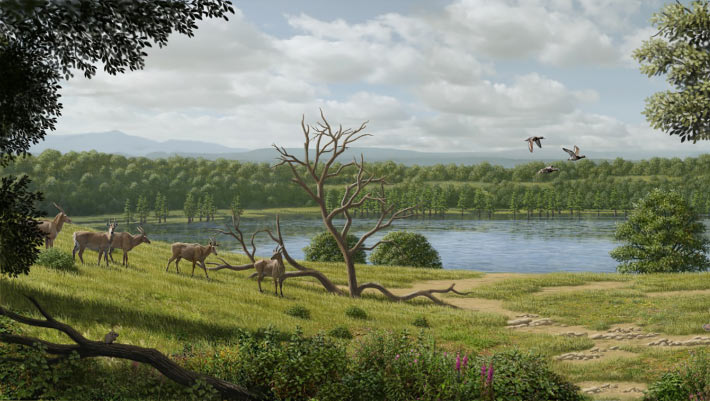
Restoration of the spinosaurid dinosaur Siamosaurus in the Sao Khua Formation palaeoenvironment, with Sunosuchus in the middle left and a herd of Phuwiangosaurus in the background.
References:
Siamosaurus based on tooth specimens [1] and the neural spine of a possibly referable skeleton[2], with other missing elements filled in with relatives (Suchomimus[3], Baryonyx[4], IchthyovenatorFile:Ichthyovenator_laosensis_skeletal_reconstruction_by_PaleoGeek.png).
Phuwiangosaurus based on skeletal by Suteethorn et al. (2009)[5] and missing elements of skull of EuhelopusFile:Euhelopus.png.

Sunosuchus based on Suteethorn and Ingavat (1983)[6] and missing elements based on Goniopholis[7].
Formations Sao Khua

Restoration of the spinosaurid dinosaur Siamosaurus in the Sao Khua Formation palaeoenvironment, with Sunosuchus in the middle left and a herd of Phuwiangosaurus in the background. References: Siamosaurus based on tooth specimens [1] and the neural spine of a possibly referable skeleton[2], with other missing elements filled in with relatives (Suchomimus[3], Baryonyx[4], IchthyovenatorFile:Ichthyovenator_laosensis_skeletal_reconstruction_by_PaleoGeek.png). Phuwiangosaurus based on skeletal by Suteethorn et al. (2009)[5] and missing elements of skull of EuhelopusFile:Euhelopus.png. Sunosuchus based on Suteethorn and Ingavat (1983)[6] and missing elements based on Goniopholis[7].

dent dessin Sao Khua spécimen +11
1 2 3 4 5 6 7 8 9 10

Actualités

Des os de dinosaures découverts presque les uns sur les autres en Transylvanie
os bassin Roumanie fossile Dinosauria Titanosauria squelette
Des scientifiques explorant le bassin de Hațeg en Roumanie ont découvert l’un des sites de fossiles de dinosaures les plus denses jamais découverts, avec des os presque les uns sur les autres. Le site K2 préserve des milliers de vestiges d’un lac préhistorique alimenté en crue qui agissait comme un piège osseux naturel il y a 72 millions d’années. Aux côtés de dinosaures locaux communs, les chercheurs ont découvert les premiers squelettes de titanosaures bien conservés jamais découverts dans la région. Le site révèle comment les anciens écosystèmes européens de dinosaures se sont formés et ont évolué au cours de cette période.
23/12/2025 sciencedaily ⚙ Traduction automatique
Un squelette vieux de 140 000 ans montre les premiers croisements entre humains et Néandertaliens
Israël fossile datation découverte Homo sapiens squelette
Les scientifiques ont découvert le premier fossile au monde présentant à la fois des caractéristiques de Néandertal et d'Homo sapiens : un enfant de cinq ans de la grotte de Skhul en Israël, datant de 140 000 ans. Cette découverte repousse la chronologie du métissage humain, prouvant que les Néandertaliens et les humains modernes se mélangeaient déjà bien avant les rencontres ultérieures de l'Europe.
21/08/2025 sciencedaily-human-evo ⚙ Traduction automatique
1 2 3