←

os

Partie anatomique

76 image(s) · 55 Actualités

Galerie d'images

Line drawings of the holotype skull of Spatulidentatus breviceps (GMG10) as preserved in its flattened and distorted state. At left is a grayscale version indicating general regions and anatomy (skull [upper jaw, skull roof, mandible], teeth, palate, and cervical bones), with the external nares (ext. nares) and orbit labeled. At right is a color-coded version distinguishing each skull bone with a different color. Both skulls are to the same scale; scale bar=5 cm.

Line drawings of the holotype skull of Spatulidentatus breviceps (GMG10) as preserved in its flattened and distorted state. At left is a grayscale version indicating general regions and anatomy (skull [upper jaw, skull roof, mandible], teeth, palate, and cervical bones), with the external nares (ext. nares) and orbit labeled. At right is a color-coded version distinguishing each skull bone with a different color. Both skulls are to the same scale; scale bar=5 cm.

os écaille dessin holotype +3
Muttaburrasaurus
The plants, animals and climate of the Australian continent have changed dramatically over long periods of time. Imagine this giant creature roaming the luxuriant wet forests that covered parts of the continent in the Cretaceous period, about 100-110 million years ago. The Muttaburrasaurus ambled along on all four legs or stood on its hind legs. Its large teeth were well adapted to eat tough vegetation such as the leathery foliage of the evergreen forests of Araucaria trees, ancient relatives of the bunya pine of south-eastern Queensland.
In 1963, grazier Doug Langdon discovered the fossilised bones of a dinosaur on his property near Muttaburra in central-west Queensland. It was one of the most complete dinosaur skeletons found in Australia. The bones belonged to a new species of ornithopod and palaeontologists named it Muttaburrasaurus langdoni.

Cast of Muttaburresaurus langdoni 1987 made by Queensland Museum, Brisbane National Museum of Australia
Taxons Muttaburrasaurus

Muttaburrasaurus The plants, animals and climate of the Australian continent have changed dramatically over long periods of time. Imagine this giant creature roaming the luxuriant wet forests that covered parts of the continent in the Cretaceous period, about 100-110 million years ago. The Muttaburrasaurus ambled along on all four legs or stood on its hind legs. Its large teeth were well adapted to eat tough vegetation such as the leathery foliage of the evergreen forests of Araucaria trees, ancient relatives of the bunya pine of south-eastern Queensland. In 1963, grazier Doug Langdon discovered the fossilised bones of a dinosaur on his property near Muttaburra in central-west Queensland. It was one of the most complete dinosaur skeletons found in Australia. The bones belonged to a new species of ornithopod and palaeontologists named it Muttaburrasaurus langdoni. Cast of Muttaburresaurus langdoni 1987 made by Queensland Museum, Brisbane National Museum of Australia

os musée Australie Crétacé +5
Montanoceratops cerorhynchus (Brown & Schlaikjer, 1942) - fossil ceratopsian dinosaur skeleton from the Cretaceous of Montana, USA. (MOR 542, Museum of the Rockies, Bozeman, Montana, USA)
The species name is sometimes incorrectly spelled "cerorhynchos".  The original publication spells it "cerorhynchus".  The genus name is sometimes incorrectly spelled "Montanaceratops".
Ceratopsians are the "horned dinosaurs".  They were large, quadrupedal, herbivorous dinosaurs having a beaked skull and a frill - an extension of bone behind the skull that partially covered the neck.  Ceratopsian dinosaurs are known from the Jurassic and Cretaceous.  The last members of the group died out at the Cretaceous-Tertiary boundary, 65 million years ago.
This is a partial skeleton of a juvenile Montanoceratops, a ceratopsian from the near-latest Cretaceous of western North America.  This type of ceratopsian lacked facial horns.


From exhibit signage:
Sixty-eight million years ago, when the horned dinosaurs Triceratops and Torosaurus inhabited the coastal plain near the inland ocean, primitive "horned" dinosaurs named Montanoceratops lived in uplands near the young Rocky Mountains.  These little protoceratopsians fed on plants with slicing teeth and narrow beaks similar to their giant three-horned relatives.


Classification: Animalia, Chordata, Vertebrata, Reptilia, Archosauria, Dinosauria, Ornithischia, Marginocephalia, Ceratopsia, Leptoceratopsidae
Stratigraphy: St. Mary River Formation, Maastrichtian Stage, Upper Cretaceous
Locality: Little Rocky Coulee, north of the town of Cut Bank, eastern Glacier County, northwestern Montana, USA


Info. at:

en.wikipedia.org/wiki/Montanoceratops
Taxons Montanoceratops

Montanoceratops cerorhynchus (Brown & Schlaikjer, 1942) - fossil ceratopsian dinosaur skeleton from the Cretaceous of Montana, USA. (MOR 542, Museum of the Rockies, Bozeman, Montana, USA) The species name is sometimes incorrectly spelled "cerorhynchos". The original publication spells it "cerorhynchus". The genus name is sometimes incorrectly spelled "Montanaceratops". Ceratopsians are the "horned dinosaurs". They were large, quadrupedal, herbivorous dinosaurs having a beaked skull and a frill - an extension of bone behind the skull that partially covered the neck. Ceratopsian dinosaurs are known from the Jurassic and Cretaceous. The last members of the group died out at the Cretaceous-Tertiary boundary, 65 million years ago. This is a partial skeleton of a juvenile Montanoceratops, a ceratopsian from the near-latest Cretaceous of western North America. This type of ceratopsian lacked facial horns. From exhibit signage: Sixty-eight million years ago, when the horned dinosaurs Triceratops and Torosaurus inhabited the coastal plain near the inland ocean, primitive "horned" dinosaurs named Montanoceratops lived in uplands near the young Rocky Mountains. These little protoceratopsians fed on plants with slicing teeth and narrow beaks similar to their giant three-horned relatives. Classification: Animalia, Chordata, Vertebrata, Reptilia, Archosauria, Dinosauria, Ornithischia, Marginocephalia, Ceratopsia, Leptoceratopsidae Stratigraphy: St. Mary River Formation, Maastrichtian Stage, Upper Cretaceous Locality: Little Rocky Coulee, north of the town of Cut Bank, eastern Glacier County, northwestern Montana, USA Info. at: en.wikipedia.org/wiki/Montanoceratops

os musée États-Unis Crétacé +17
Lower jaw, arm bone, and leg bone (LACM 128258 and LACM 120478) of Fruitadens haagarorum on display at the Natural History Museum of Los Angeles County.
Taxons Fruitadens

Lower jaw, arm bone, and leg bone (LACM 128258 and LACM 120478) of Fruitadens haagarorum on display at the Natural History Museum of Los Angeles County.

os musée Fruitadens
Illustration of the holotype frontal bone of Albertavenator curriei TMP 1993.105.0001 in dorsal view. Scale bar is 5mm.
Taxons Albertavenator

Illustration of the holotype frontal bone of Albertavenator curriei TMP 1993.105.0001 in dorsal view. Scale bar is 5mm.

os écaille holotype Albertavenator
Diamantinasaurus matildae gen. et sp. nov. (AODF 603)
A. Right side
B. Left side
(both silhouettes with sketched in bone parts of the material currently known at publishing date; scale bars: 5 x 5 = 25 m; complemented with height data here)
Taxons Diamantinasaurus

Diamantinasaurus matildae gen. et sp. nov. (AODF 603) A. Right side B. Left side (both silhouettes with sketched in bone parts of the material currently known at publishing date; scale bars: 5 x 5 = 25 m; complemented with height data here)

os écaille musée Diamantinasauria +1
* Wintonotitan wattsi gen. et sp. nov. (QMF 7292)
(Silhouette with sketched in bone parts of the material currently known at publishing date; scale bar: size unknown — not mentioned in original source)
Taxons Wintonotitan

* Wintonotitan wattsi gen. et sp. nov. (QMF 7292) (Silhouette with sketched in bone parts of the material currently known at publishing date; scale bar: size unknown — not mentioned in original source)

os écaille musée Dinosauria +1
Reconstruction and restoration of the skull of Eolambia.

(A) Skull reconstruction of Eolambia in left lateral view by the lead author. Bones in white are unknown, bones in dark grey are based primarily upon the adult holotype (CEUM 9758) or paratype (CEUM 5212), and bones in light grey are based primarily upon juvenile elements from the Eo2 and WS8 bonebeds. Sutures and points of contact between bones are marked in black. Scale bar equals 10 cm; scale is calibrated with the dentary of CEUM 9758. (B) Life restoration of the head of Eolambia by Lukas Panzarin. Abbreviations: an, angular; d, dentary; f, frontal; j, jugal; l, lacrimal; mx, maxilla; na, nasal; pd, predentary; pmx, premaxilla; po, postorbital; prf, prefrontal; q, quadrate; qj, quadratojugal; sa, surangular; sq, squamosal.
Taxons Eolambia

Reconstruction and restoration of the skull of Eolambia. (A) Skull reconstruction of Eolambia in left lateral view by the lead author. Bones in white are unknown, bones in dark grey are based primarily upon the adult holotype (CEUM 9758) or paratype (CEUM 5212), and bones in light grey are based primarily upon juvenile elements from the Eo2 and WS8 bonebeds. Sutures and points of contact between bones are marked in black. Scale bar equals 10 cm; scale is calibrated with the dentary of CEUM 9758. (B) Life restoration of the head of Eolambia by Lukas Panzarin. Abbreviations: an, angular; d, dentary; f, frontal; j, jugal; l, lacrimal; mx, maxilla; na, nasal; pd, predentary; pmx, premaxilla; po, postorbital; prf, prefrontal; q, quadrate; qj, quadratojugal; sa, surangular; sq, squamosal.

os écaille holotype juvénile +2
Magnoavipes sp. - dinosaur track from the Cretaceous of Colorado, USA. (replica; public display, Red Rocks Amphitheater visitor center, west of Denver, Colorado, USA)
Dinosaur Ridge, Colorado has numerous dinosaur fossils, including bones and tracks.  The most common track type at the site is Caririchnium leonardii, which was made by an iguanodontid dinosaur.  A less common track is this - a slender, three-toed print called Magnoavipes, which was made by a theropod dinosaur.
Stratigraphy: Dakota Sandstone, upper Lower Cretaceous

Provenance: eastern side of Dinosaur Ridge, Dakota Hogback, west of Denver, north-central Colorado, USA
Taxons Magnoavipes

Magnoavipes sp. - dinosaur track from the Cretaceous of Colorado, USA. (replica; public display, Red Rocks Amphitheater visitor center, west of Denver, Colorado, USA) Dinosaur Ridge, Colorado has numerous dinosaur fossils, including bones and tracks. The most common track type at the site is Caririchnium leonardii, which was made by an iguanodontid dinosaur. A less common track is this - a slender, three-toed print called Magnoavipes, which was made by a theropod dinosaur. Stratigraphy: Dakota Sandstone, upper Lower Cretaceous Provenance: eastern side of Dinosaur Ridge, Dakota Hogback, west of Denver, north-central Colorado, USA

os États-Unis Denver Crétacé +7
Fossil bone of Procerosaurus exogyrarum, possible dinosaur from the Czech Republic. National Museum, Prague (2007).
Taxons Ponerosteus

Fossil bone of Procerosaurus exogyrarum, possible dinosaur from the Czech Republic. National Museum, Prague (2007).

os musée Tchéquie fossile +3
Theiophytalia kerri Brill & Carpenter, 2006 - ornithopod dinosaur skull from the Cretaceous of Colorado, USA. (YPM 1887, public display, Garden of the Gods visitor center, Colorado Springs, Colorado, USA)
This skull is the holotype and only known specimen of an entire genus of ornithopod dinosaurs, Theiophytalia.  Ornithopods were herbivorous dinosaurs.


From exhibit signage:
A Brand New Dinosaur Species Theiophytalia kerri
What we know about the dinosaur fossil - so far:
It is the only Theiophytalia kerri fossil known to exist in the world.
It is a brand new genus and species of dinosaur.
Theiophytalia kerri means "belonging to the Garden of the Gods".  "Theios" is a Greek word that means "belonging to the gods" and "phytalia" means "garden".  "kerri" honors James Hutchinson Kerr (pronounced "Care"), who discovered the dinosaur fossil.
Theiophytalia was a medium-sized dinosaur, measuring about 30 feet from head to tail.
It was found in 1878 in the Garden of the Gods in the lower Lytle Member of the Purgatoire Rock Formation of the Dakota Group.
The dinosaur fossil skull is from the Aptian-Albian Age of the Cretaceous Ear, 125 - 100 million years old.
Look closely at the fossil skull.  Where are the teeth located?  You can see the teeth in the back of the jaw.  There are no teeth in the front of the dinosaur's beak-like mouth.  This is evidence that the Theiophytalia was a plant eater.  It could nip and tear plants, then grind them between its tightly-packed back teeth, similar to plant-eaters of today.
Timeline:
Dinosaur Fossil Discovered, then Forgotten
1878 - James Kerr, geology professor at Colorado College, finds a fossil skull "in one of the ridges east of the red rocks of the Garden of the Gods."
1886 - O.C. Marsh, famous 1800s dinosaur collector from Yale University, obtains the fossil skull from James Kerr, identifies it as a Camptosaurus dinosaur, and sends the fossil to the Yale Peabody Museum in New Haven, Connecticut.
1886 - 1995 - While the dinosaur fossil skull safely rests in the Yale Museum for many decades, knowledge of its existence is forgotten in Colorado Springs.
Rediscovery - 117 years later
1994 - Colorado Springs City park staff research new exhibits for the Garden of the Gods Visitor and Nature Center, set to open in 1995.  They meet with Doctor Kirk Johnson, curator of paleontology at the Denver Museum of Nature & Science.
1995 - Kirk Johnson refers the park staff to his museum colleague Doctor Ken Carpenter, expert dinosaur scientist.  Doctor Carpenter remembers seeing in his files "something about a dinosaur fossil found in Garden of the Gods" and mails the following article to park staff.
Camptosaurus amplus No. 1887, Yale Museum, consisting of portions of the skull and lower jaw.  It was collected from deposits in the Garden of the Gods, Colorado Springs, Colorado.  With this specimen was found the following note in Professor O.C. Marsh's handwriting, "Part of this animal and various Sauropoda bones were taken out by Professor Kerr in 1878."
A Case of Mistaken Identity Reveals a Brand New Dinosaur!
1996 - Kirk Johnson (a Yale alumnus) secures permission to hand-carry the Camptosaurus fossil from the Yale Peabody Museum to Denver so that Ken Carpenter can make a cast (a precise replica) of the fossil.
Doctor Carpenter notices irregularities in the Camptosaurus fossil and decides to re-examine the fossil when his schedule permits.
1997 - The Camptosaurus fossil replica is given to the City of Colorado Springs and is exhibited at the Garden of the Gods Visitor and Nature Center.
2006 - Doctor Carpenter and his associate Kathleen Brill reassess the fossil skull and note that it differs from other Camptosaurus skulls in several significant ways, such as the narrower mouth and snout, and the position of the nasal openings, and the bony structures over the eyes.
Also, microscopic identification of the rock matrix clinging to the fossil, and research of archival maps, reveal that the fossil skull was actually found in the lower Dakota Rock Formation, not the Morrison Formation as originally reported in the 1800s.  The skull is from a dinosaur that lived in the Cretaceous Ear and can't be a Jurassic Era Camptosaurus.
Doctor Carpenter's exacting research reveals that the dinosaur skull is a brand new genus and species of dinosaur!  He names it Theiophytalia kerri.
2008 - The Theiophytalia kerri is proudly re-exhibited at the Garden of the Gods Visitor and Nature Center.


Classification: Animalia, Chordata, Vertebrata, Dinosauria, Ornithischia, Ornithopoda
Stratigraphy: lower Lytle Member, Purgatoire Formation, Dakota Group, Aptian to Albian Stages, upper Lower Cretaceous
Locality: Garden of the Gods, Colorado Springs, Colorado, USA


See info. at:
en.wikipedia.org/wiki/Theiophytalia
and

en.wikipedia.org/wiki/Ornithopoda
Taxons Theiophytalia

Theiophytalia kerri Brill & Carpenter, 2006 - ornithopod dinosaur skull from the Cretaceous of Colorado, USA. (YPM 1887, public display, Garden of the Gods visitor center, Colorado Springs, Colorado, USA) This skull is the holotype and only known specimen of an entire genus of ornithopod dinosaurs, Theiophytalia. Ornithopods were herbivorous dinosaurs. From exhibit signage: A Brand New Dinosaur Species Theiophytalia kerri What we know about the dinosaur fossil - so far: It is the only Theiophytalia kerri fossil known to exist in the world. It is a brand new genus and species of dinosaur. Theiophytalia kerri means "belonging to the Garden of the Gods". "Theios" is a Greek word that means "belonging to the gods" and "phytalia" means "garden". "kerri" honors James Hutchinson Kerr (pronounced "Care"), who discovered the dinosaur fossil. Theiophytalia was a medium-sized dinosaur, measuring about 30 feet from head to tail. It was found in 1878 in the Garden of the Gods in the lower Lytle Member of the Purgatoire Rock Formation of the Dakota Group. The dinosaur fossil skull is from the Aptian-Albian Age of the Cretaceous Ear, 125 - 100 million years old. Look closely at the fossil skull. Where are the teeth located? You can see the teeth in the back of the jaw. There are no teeth in the front of the dinosaur's beak-like mouth. This is evidence that the Theiophytalia was a plant eater. It could nip and tear plants, then grind them between its tightly-packed back teeth, similar to plant-eaters of today. Timeline: Dinosaur Fossil Discovered, then Forgotten 1878 - James Kerr, geology professor at Colorado College, finds a fossil skull "in one of the ridges east of the red rocks of the Garden of the Gods." 1886 - O.C. Marsh, famous 1800s dinosaur collector from Yale University, obtains the fossil skull from James Kerr, identifies it as a Camptosaurus dinosaur, and sends the fossil to the Yale Peabody Museum in New Haven, Connecticut. 1886 - 1995 - While the dinosaur fossil skull safely rests in the Yale Museum for many decades, knowledge of its existence is forgotten in Colorado Springs. Rediscovery - 117 years later 1994 - Colorado Springs City park staff research new exhibits for the Garden of the Gods Visitor and Nature Center, set to open in 1995. They meet with Doctor Kirk Johnson, curator of paleontology at the Denver Museum of Nature & Science. 1995 - Kirk Johnson refers the park staff to his museum colleague Doctor Ken Carpenter, expert dinosaur scientist. Doctor Carpenter remembers seeing in his files "something about a dinosaur fossil found in Garden of the Gods" and mails the following article to park staff. Camptosaurus amplus No. 1887, Yale Museum, consisting of portions of the skull and lower jaw. It was collected from deposits in the Garden of the Gods, Colorado Springs, Colorado. With this specimen was found the following note in Professor O.C. Marsh's handwriting, "Part of this animal and various Sauropoda bones were taken out by Professor Kerr in 1878." A Case of Mistaken Identity Reveals a Brand New Dinosaur! 1996 - Kirk Johnson (a Yale alumnus) secures permission to hand-carry the Camptosaurus fossil from the Yale Peabody Museum to Denver so that Ken Carpenter can make a cast (a precise replica) of the fossil. Doctor Carpenter notices irregularities in the Camptosaurus fossil and decides to re-examine the fossil when his schedule permits. 1997 - The Camptosaurus fossil replica is given to the City of Colorado Springs and is exhibited at the Garden of the Gods Visitor and Nature Center. 2006 - Doctor Carpenter and his associate Kathleen Brill reassess the fossil skull and note that it differs from other Camptosaurus skulls in several significant ways, such as the narrower mouth and snout, and the position of the nasal openings, and the bony structures over the eyes. Also, microscopic identification of the rock matrix clinging to the fossil, and research of archival maps, reveal that the fossil skull was actually found in the lower Dakota Rock Formation, not the Morrison Formation as originally reported in the 1800s. The skull is from a dinosaur that lived in the Cretaceous Ear and can't be a Jurassic Era Camptosaurus. Doctor Carpenter's exacting research reveals that the dinosaur skull is a brand new genus and species of dinosaur! He names it Theiophytalia kerri. 2008 - The Theiophytalia kerri is proudly re-exhibited at the Garden of the Gods Visitor and Nature Center. Classification: Animalia, Chordata, Vertebrata, Dinosauria, Ornithischia, Ornithopoda Stratigraphy: lower Lytle Member, Purgatoire Formation, Dakota Group, Aptian to Albian Stages, upper Lower Cretaceous Locality: Garden of the Gods, Colorado Springs, Colorado, USA See info. at: en.wikipedia.org/wiki/Theiophytalia and en.wikipedia.org/wiki/Ornithopoda

os musée États-Unis Denver +19
Reconstruction of the Abelisaurus skull with original bones of the holotype. Museo Provincial Carlos Ameghino, Cipolletti, Argentina. Scale = 10 cm
Taxons Abelisaurus

Reconstruction of the Abelisaurus skull with original bones of the holotype. Museo Provincial Carlos Ameghino, Cipolletti, Argentina. Scale = 10 cm

os écaille Argentine holotype +3
Comparison of the holotype (BRSMG Cg3178, A and C right surangular, BAS specimen) and referred specimen (BRSMG Cg2488, B and D left surangular, Lilstock specimen) of Ichthyotitan severnensis gen. et sp. nov. To ease comparison, A and C have been reversed. A-B. Lateral view of both surangulars showing same unique shape; note the upturned, almost 90-degree angle bend and the spatulate-shaped posterior end. C-D. Medial view of both surangulars displaying same morphology posteriorly; anteriorly the Lilstock specimen (D) has been heavily eroded and distorted along its length. Note the position of an elongated foramen on the lateral surface (A-B), identified as part of the fossa surangularis that passes through the bone into the Meckelian canal. See also the damaged (?)angular that is articulated with the surangular and defined by a continuous groove (?suture) as seen in Fig 2H.
Taxons Ichthyotitan

Comparison of the holotype (BRSMG Cg3178, A and C right surangular, BAS specimen) and referred specimen (BRSMG Cg2488, B and D left surangular, Lilstock specimen) of Ichthyotitan severnensis gen. et sp. nov. To ease comparison, A and C have been reversed. A-B. Lateral view of both surangulars showing same unique shape; note the upturned, almost 90-degree angle bend and the spatulate-shaped posterior end. C-D. Medial view of both surangulars displaying same morphology posteriorly; anteriorly the Lilstock specimen (D) has been heavily eroded and distorted along its length. Note the position of an elongated foramen on the lateral surface (A-B), identified as part of the fossa surangularis that passes through the bone into the Meckelian canal. See also the damaged (?)angular that is articulated with the surangular and defined by a continuous groove (?suture) as seen in Fig 2H.

os holotype spécimen Ichthyotitan
Manual bones of Martharaptor greenriverensis (UMNH VP 21400). (A)–Presumed metacarpal I. (B)–Presumed phalanx I-1. (C)–Penultimate phalanx. (D) Penultimate phalanx. (E)–Unidentified phalanx. (F)–Unidentified phalanx. (G)–Ungual of digit I. (H)–Ungual of digit I. (I)–Ungual of digit II. (J)–Ungual of digit II. (K)–Ungual of digit III. (L)–Ungual of digit III. Scale bar = 50 mm. Numbers on sub-figures refer to proximal (1), distal (2), dorsal (3), palmar (4), and side (5) views; for side views, whether the side is medial or lateral cannot be determined.
Taxons Martharaptor

Manual bones of Martharaptor greenriverensis (UMNH VP 21400). (A)–Presumed metacarpal I. (B)–Presumed phalanx I-1. (C)–Penultimate phalanx. (D) Penultimate phalanx. (E)–Unidentified phalanx. (F)–Unidentified phalanx. (G)–Ungual of digit I. (H)–Ungual of digit I. (I)–Ungual of digit II. (J)–Ungual of digit II. (K)–Ungual of digit III. (L)–Ungual of digit III. Scale bar = 50 mm. Numbers on sub-figures refer to proximal (1), distal (2), dorsal (3), palmar (4), and side (5) views; for side views, whether the side is medial or lateral cannot be determined.

os écaille Martharaptor
Astigmasaura is a medium-sized rebbachisaurid sauropod dinosaur from the Late Cretaceous period of what is now Argentina. Rebbachisaurids had highly pneumatized bones that helped them to hold their weight on their four pillar-like legs, and extremely long tails. Astigmasaura was likely a ground-level browsing herbivore.
Taxons Astigmasaura

Astigmasaura is a medium-sized rebbachisaurid sauropod dinosaur from the Late Cretaceous period of what is now Argentina. Rebbachisaurids had highly pneumatized bones that helped them to hold their weight on their four pillar-like legs, and extremely long tails. Astigmasaura was likely a ground-level browsing herbivore.

os Argentine Crétacé Crétacé supérieur +3
Rebbachisaurids are the latest known sauropod dinosaurs outside the titanosaur lineage. Cienciargentina is a rebbachisaurid from the Late Cretaceous, making it among the most recent. It had many hollow bones, and likely had batteries of teeth used for chewing, a rebbachisaurid feature unique among sauropods.
Taxons Cienciargentina

Rebbachisaurids are the latest known sauropod dinosaurs outside the titanosaur lineage. Cienciargentina is a rebbachisaurid from the Late Cretaceous, making it among the most recent. It had many hollow bones, and likely had batteries of teeth used for chewing, a rebbachisaurid feature unique among sauropods.

os Crétacé Crétacé supérieur Cienciargentina +3
1 2 3 4 5

Actualités

Un fossile vieux de 30 ans cachait les os d'un mystérieux monstre marin ancien
os mâchoire Crétacé fossile Mosasaurus nouvelle espèce crâne
Des fossiles collectés à Osaka il y a plus de 30 ans ont révélé une surprise cachée à la vue de tous : quatre os jusqu'alors méconnus provenant d'un mosasaure géant du Crétacé. Parmi eux se trouve le premier prémaxillaire confirmé – l’os le plus en avant de la mâchoire supérieure – jamais identifié dans un fossile de mosasaure japonais. Plus intrigant encore, certaines parties du crâne présentent des caractéristiques anatomiques inhabituelles qui ne correspondent pas aux mosasaures connus, ce qui laisse penser que les restes appartiennent à une espèce entièrement nouvelle.
15/08/2026 sciencedaily ⚙ Traduction automatique
La paléontologie est ébranlée par des molécules organiques découvertes dans des os de dinosaures vieux de 66 millions d'années
os collagène protéine fossile Dinosauria découverte évolution
Les chercheurs ont trouvé des preuves solides que le collagène original peut survivre à l’intérieur des fossiles de dinosaures pendant des dizaines de millions d’années, renversant ainsi une hypothèse de longue date concernant la fossilisation. Cette découverte pourrait révéler des indices moléculaires cachés sur la biologie des dinosaures, leur évolution et la façon dont d’anciennes protéines ont réussi à survivre aussi longtemps.
14/08/2026 sciencedaily ⚙ Traduction automatique
Un nouveau genre de dinosaure troodontidé du Nouveau-Mexique
os Mexique Campanien Crétacé Crétacé supérieur fossile Dinevenator Dinosauria Troodontidae nouvelle espèce crâne
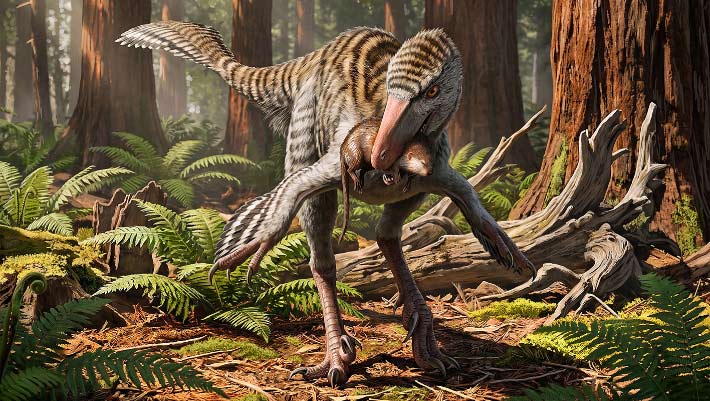
Les paléontologues ont nommé une nouvelle espèce de dinosaure théropode du Nouveau-Mexique. Le dinosaure, Dinevenator Robustus, vivait il y a environ 73 millions d'années (stade faunique campanien du Crétacé supérieur). Les chercheurs ont identifié le dinosaure à partir d’un os fossile du crâne (un frontal) trouvé dans le nord-ouest du Nouveau-Mexique. Il représente un nouveau genre et une nouvelle espèce de troodontidé. Troodontidés
13/08/2026 everythingdinosaur ⚙ Traduction automatique
New Troodontid Dinosaur Genus Identified from Fossil Bone Found Decades Ago in New Mexico
Un nouveau genre de dinosaure troodontidé identifié à partir d'un os fossile découvert il y a plusieurs décennies au Nouveau-Mexique
os Mexique fossile Dinevenator Dinosauria Troodontidae oiseau
Les paléontologues ont décrit un nouveau genre de petit dinosaure ressemblant à un oiseau qui vivait dans ce qui est aujourd'hui le Nouveau-Mexique il y a environ 73 millions d'années. L'article Nouveau genre de dinosaures troodontidés identifié à partir d'os fossiles trouvés il y a des décennies au Nouveau-Mexique est apparu en premier sur Sci.News : Breaking Science News.
07/08/2026 sci-news ⚙ Traduction automatique
Le T. rex a-t-il laissé ces marques de morsure vieilles de 66 millions d'années ?
os dent alimentation Dinosauria Tyrannosaurus comportement datation
Les os fossilisés de dinosaures du Wyoming offrent un rare aperçu du comportement alimentaire du Tyrannosaurus rex. Les chercheurs ont examiné plus de 3 000 os datant de 72 à 66 millions d’années et n’en ont trouvé que 12 avec d’éventuelles traces de dents, dont quatre avec des motifs qui correspondaient étroitement à la forme et à l’espacement des dents du T. rex.
05/08/2026 sciencedaily ⚙ Traduction automatique
1 2 3 4 5 6 7 8 9 10 11