skeleton

View type

294 image(s) · 23 News

Image gallery

Partial skeleton of the heterodontosaurid Tianyulong confuciusi from the Lower Cretaceous Jehol Group of China. Partial skeleton mainly in right lateral view (IVPP V17090). Enlargements of subsequent figures are shown in red. Scale bar equals 10 cm.

Partial skeleton of the heterodontosaurid Tianyulong confuciusi from the Lower Cretaceous Jehol Group of China. Partial skeleton mainly in right lateral view (IVPP V17090). Enlargements of subsequent figures are shown in red. Scale bar equals 10 cm.

scale China Cretaceous Heterodontosauridae +3
Photograph and outline drawing of the skeleton of Chuanqilong chaoyangensis.

A, photograph; B, outline drawing. Abbreviations: ca, caudal vertebrae; cb, cervical band; da, dermal armor; dr, dorsal rib; lfe, left femur; lfi, left fibula; lhu, left humerus; lil, left ilium; lis, left ischium; lma, left maxilla; lmd, left mandible; lmt, left metatarsal; lra, left radius; lsc, left scapula; lti, left tibia; lul, left ulna; mc, metacarpals; orb, orbital; pl, plates; q, quadrate; rfe, right femur; rfi, right fibula; rhu, right humerus; ril, right ilium; rma, right maxilla; rmd, right mandible; rmt, right metatarsals; rra, right radius; rsc, right scapula; rti, right tibia; rul, right ulna; sar, sacral rib; te, tendons. [planned for page width].

Photograph and outline drawing of the skeleton of Chuanqilong chaoyangensis. A, photograph; B, outline drawing. Abbreviations: ca, caudal vertebrae; cb, cervical band; da, dermal armor; dr, dorsal rib; lfe, left femur; lfi, left fibula; lhu, left humerus; lil, left ilium; lis, left ischium; lma, left maxilla; lmd, left mandible; lmt, left metatarsal; lra, left radius; lsc, left scapula; lti, left tibia; lul, left ulna; mc, metacarpals; orb, orbital; pl, plates; q, quadrate; rfe, right femur; rfi, right fibula; rhu, right humerus; ril, right ilium; rma, right maxilla; rmd, right mandible; rmt, right metatarsals; rra, right radius; rsc, right scapula; rti, right tibia; rul, right ulna; sar, sacral rib; te, tendons. [planned for page width].

armor humerus drawing Chuanqilong +1
Reconstructed skeleton of Zuul

Reconstructed skeleton of Zuul

Zuul skeleton
Fossil skeleton of Gargoyleosaurus parkpinorum taken in 2007 at the Denver Museum of Nature and Science.

Fossil skeleton of Gargoyleosaurus parkpinorum taken in 2007 at the Denver Museum of Nature and Science.

museum Denver fossil Gargoyleosaurus +1
Copy of a skeleton of a Lessemsaurus in the exhibition "Gigasaurier - Die Riesen Argentiniens" in Frankfurt am Main 2010

Copy of a skeleton of a Lessemsaurus in the exhibition "Gigasaurier - Die Riesen Argentiniens" in Frankfurt am Main 2010

Lessemsauridae Lessemsaurus skeleton
The incomplete skeleton of Cetiosauriscus stewarti (BMNH R3078) mounted prior to display in around
1903. Photographed in the BMNH, and reproduced courtesy of the Leeds family, with layout by J. J. Liston. Note

the similarity of this photograph to the drawing of the skeleton in Woodward (1905); previously figured in Anon. (1924) and Naish & Martill (2008).[1][2]

The incomplete skeleton of Cetiosauriscus stewarti (BMNH R3078) mounted prior to display in around 1903. Photographed in the BMNH, and reproduced courtesy of the Leeds family, with layout by J. J. Liston. Note the similarity of this photograph to the drawing of the skeleton in Woodward (1905); previously figured in Anon. (1924) and Naish & Martill (2008).[1][2]

drawing Cetiosauriscus skeleton
Xianshanosaurus skeleton

Xianshanosaurus skeleton

Xianshanosaurus skeleton
Reconstructed skeleton of Daxiatitan binglingi.

Reconstructed skeleton of Daxiatitan binglingi.

Daxiatitan skeleton
Skeletons of Bonatitan and Austroraptor at the Museo Argentino de Ciencias Naturales Bernardino Rivadavia

Skeletons of Bonatitan and Austroraptor at the Museo Argentino de Ciencias Naturales Bernardino Rivadavia

Austroraptor Bonatitan skeleton
Herbivorous dinosaur found in the Al-khoudh area.  This dinosaur is similar to the Zalmoxes and Rhabdodon dinosaurs.  The skeleton in the Bait Al Baranda Museum was assembled from bones borrowed from several museums.

Herbivorous dinosaur found in the Al-khoudh area. This dinosaur is similar to the Zalmoxes and Rhabdodon dinosaurs. The skeleton in the Bait Al Baranda Museum was assembled from bones borrowed from several museums.

bone museum Dinosauria Mochlodon +3
Rates of skeletal character evolution in the skull and postcranial skeleton of hadrosauroids. Cladograms illustrate the results from branch likelihood tests for two morphological partitions: skull (cranium and mandible) (A) and postcranial skeleton (B). In both cladograms, results from the branch likelihood tests are summarized on a strict consensus tree derived from four separately analyzed MPTs, each with 100 dating replicates (a total of 400 Hedman-dated phylogenies). Pie charts on branches illustrate the proportion of dating replicates that showed significantly high rates (red), slow rates (blue), or nonsignificant average rates (white). No pie charts are plotted on branches that showed nonsignificant rates in 100% of dating replicates. Branches that showed high rates (red) in more than 50% of dating replicates are doubled in length. See the Supplementary Material for Hedman-based results plotted separately for each MPT (Supplementary Fig. S2) and for results using the MBL dating method (Supplementary Fig. S3). Silhouettes were created by Scott Hartman and were downloaded from http://phylopic.org (Creative Commons license CC BY 3.0).

Rates of skeletal character evolution in the skull and postcranial skeleton of hadrosauroids. Cladograms illustrate the results from branch likelihood tests for two morphological partitions: skull (cranium and mandible) (A) and postcranial skeleton (B). In both cladograms, results from the branch likelihood tests are summarized on a strict consensus tree derived from four separately analyzed MPTs, each with 100 dating replicates (a total of 400 Hedman-dated phylogenies). Pie charts on branches illustrate the proportion of dating replicates that showed significantly high rates (red), slow rates (blue), or nonsignificant average rates (white). No pie charts are plotted on branches that showed nonsignificant rates in 100% of dating replicates. Branches that showed high rates (red) in more than 50% of dating replicates are doubled in length. See the Supplementary Material for Hedman-based results plotted separately for each MPT (Supplementary Fig. S2) and for results using the MBL dating method (Supplementary Fig. S3). Silhouettes were created by Scott Hartman and were downloaded from http://phylopic.org (Creative Commons license CC BY 3.0).

Protohadros dating evolution skeleton +1
Restoration of the spinosaurid dinosaur Siamosaurus in the Sao Khua Formation palaeoenvironment, with Sunosuchus in the middle left and a herd of Phuwiangosaurus in the background.
References:
Siamosaurus based on tooth specimens [1] and the neural spine of a possibly referable skeleton[2], with other missing elements filled in with relatives (Suchomimus[3], Baryonyx[4], IchthyovenatorFile:Ichthyovenator_laosensis_skeletal_reconstruction_by_PaleoGeek.png).
Phuwiangosaurus based on skeletal by Suteethorn et al. (2009)[5] and missing elements of skull of EuhelopusFile:Euhelopus.png.

Sunosuchus based on Suteethorn and Ingavat (1983)[6] and missing elements based on Goniopholis[7].

Restoration of the spinosaurid dinosaur Siamosaurus in the Sao Khua Formation palaeoenvironment, with Sunosuchus in the middle left and a herd of Phuwiangosaurus in the background. References: Siamosaurus based on tooth specimens [1] and the neural spine of a possibly referable skeleton[2], with other missing elements filled in with relatives (Suchomimus[3], Baryonyx[4], IchthyovenatorFile:Ichthyovenator_laosensis_skeletal_reconstruction_by_PaleoGeek.png). Phuwiangosaurus based on skeletal by Suteethorn et al. (2009)[5] and missing elements of skull of EuhelopusFile:Euhelopus.png. Sunosuchus based on Suteethorn and Ingavat (1983)[6] and missing elements based on Goniopholis[7].

tooth drawing Sao Khua specimen +11
Life restoration of the German Jurassic ichthyosaur Suevoleviathan disinteger. The dorsal and caudal fins are loosely based on those of Stenopterygius.
References
Maisch, M.W. (2020). "The best-preserved skeleton of Suevoleviathan integer (Bronn, 1844)(Reptilia: Ichthyosauria) from the lower Jurassic of south-western Germany, with a discussion of the genus". Neues Jahrbuch für Geologie und Paläontologie, Abhandlungen 297 (2): 153–172.
Maisch, M.W. (1998). "A new ichthyosaur genus from the Posidonia Shale (Lower Toarcian, Jurassic) of Holzmaden, SW-Germany with comments on the phylogeny of post-Triassic ichthyosaurs". Neues Jahrbuch für Geologie und Paläontologie-Abhandlungen 209 (1): 47–78.
Taxa Suevoleviathan

Life restoration of the German Jurassic ichthyosaur Suevoleviathan disinteger. The dorsal and caudal fins are loosely based on those of Stenopterygius. References Maisch, M.W. (2020). "The best-preserved skeleton of Suevoleviathan integer (Bronn, 1844)(Reptilia: Ichthyosauria) from the lower Jurassic of south-western Germany, with a discussion of the genus". Neues Jahrbuch für Geologie und Paläontologie, Abhandlungen 297 (2): 153–172. Maisch, M.W. (1998). "A new ichthyosaur genus from the Posidonia Shale (Lower Toarcian, Jurassic) of Holzmaden, SW-Germany with comments on the phylogeny of post-Triassic ichthyosaurs". Neues Jahrbuch für Geologie und Paläontologie-Abhandlungen 209 (1): 47–78.

Germany Posidonia Shale Jurassic Toarcian +6
Skeleton of Tuarangisaurus at the Museo Argentino de Ciencias Naturales Bernardino Rivadavia

Skeleton of Tuarangisaurus at the Museo Argentino de Ciencias Naturales Bernardino Rivadavia

Tuarangisaurus skeleton
Tuarangisaurus cabazai skeleton restoration, Copenhagen
Taxa Tuarangisaurus

Tuarangisaurus cabazai skeleton restoration, Copenhagen

Tuarangisaurus skeleton
MRF 319, a partial oviraptorosaurian skeleton referred to Anzu wyliei. 
(A) Skeletal reconstruction in left lateral view, with preserved bones in gray and bones represented in other Anzu specimens in white (hatching indicates heavily reconstructed portions of the ilia of CM 78001). Middle-posterior (ninth?) cervical vertebra in (B) anterior, (C) left lateral, and (D) dorsal views. Posterior (11th?) cervical vertebra in (E) anterior, (F) left lateral, and (G) dorsal views. Posterior (12th?) cervical vertebra in (H) anterior, (I) left lateral, and (J) dorsal views. Anteroposteriorly crushed left radius in lateral (K) and anterior (L) views. Mediolaterally crushed left ulna in lateral (M) and anterior (N) views. (O) Partial left scapulocoracoid in lateral view. Dorsal rib in anterior (P) and posterior (Q) views. Abbreviations: acr, acromial process; cr, cervical rib; dip, distal processes; pat, pathology; pf, pneumatic fossa. Scale bars = 50 cm in A; 1 cm in B–Q.

MRF 319, a partial oviraptorosaurian skeleton referred to Anzu wyliei. (A) Skeletal reconstruction in left lateral view, with preserved bones in gray and bones represented in other Anzu specimens in white (hatching indicates heavily reconstructed portions of the ilia of CM 78001). Middle-posterior (ninth?) cervical vertebra in (B) anterior, (C) left lateral, and (D) dorsal views. Posterior (11th?) cervical vertebra in (E) anterior, (F) left lateral, and (G) dorsal views. Posterior (12th?) cervical vertebra in (H) anterior, (I) left lateral, and (J) dorsal views. Anteroposteriorly crushed left radius in lateral (K) and anterior (L) views. Mediolaterally crushed left ulna in lateral (M) and anterior (N) views. (O) Partial left scapulocoracoid in lateral view. Dorsal rib in anterior (P) and posterior (Q) views. Abbreviations: acr, acromial process; cr, cervical rib; dip, distal processes; pat, pathology; pf, pneumatic fossa. Scale bars = 50 cm in A; 1 cm in B–Q.

bone scale vertebra pathology +5
1 2 3 4 5 6 7 8 9 10 11 12 13 14 15 16 17 18 19

News

This school-bus-sized “terror croc” ate dinosaurs. Now it’s back
museum fossil Dinosauria Georgia skeleton
A massive crocodilian capable of attacking dinosaurs has been brought back to life as the first scientifically accurate mounted skeleton of Deinosuchus schwimmeri. The 31-foot replica at Georgia’s Tellus Science Museum was built from detailed fossil scans and more than 40 years of research by paleontologist Dr. David Schwimmer, for whom the species was named.
05/08/2026 sciencedaily
Small Sauropod Dinosaur from Jurassic Period Discovered in India
pelvis India Jurassic Middle Jurassic Dinosauria partial skeleton
Paleontologists in India have unearthed a partial skeleton of a diminutive, previously unknown neosauropod dinosaur from the Middle Jurassic rocks of Gujarat’s Kachchh Basin. The post Small Sauropod Dinosaur from Jurassic Period Discovered in India appeared first on Sci.News: Breaking Science News.
21/07/2026 sci-news
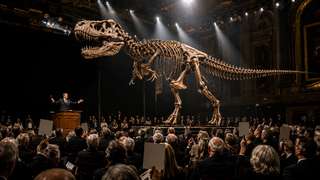
Il devient le dinosaure le plus cher du monde en 10 minutes : voici l’incroyable histoire de Gus
He becomes the most expensive dinosaur in the world in 10 minutes: here is Gus' incredible story
museum Dinosauria Tyrannosaurus skeleton
It spent 67 million years buried in the ground before shaking an auction house. The skeleton of Tyrannosaurus rex nicknamed “Gus” was sold for $50.13 million at Sotheby’s in New York. An absolute record for a dinosaur, which revives the debate on the privatization of...
15/07/2026 futura-terre ⚙ Auto-translated
Voici le mystérieux dragon marin qui pourrait résoudre une énigme vieille de presque 200 millions d'années
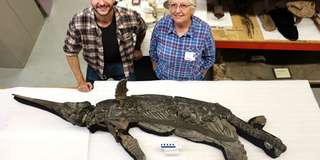
Meet the mysterious sea dragon that could solve a riddle almost 200 million years old
United Kingdom Xiphodracon skeleton
A three-metre skeleton has been lying dormant in Dorset chalk for 150 million years. Amateur excavators brought it out of obscurity in 2001, but it took more than twenty years for science to finally give it a name. This sea dragon shakes up what we thought we knew about...
21/06/2026 futura-terre ⚙ Auto-translated
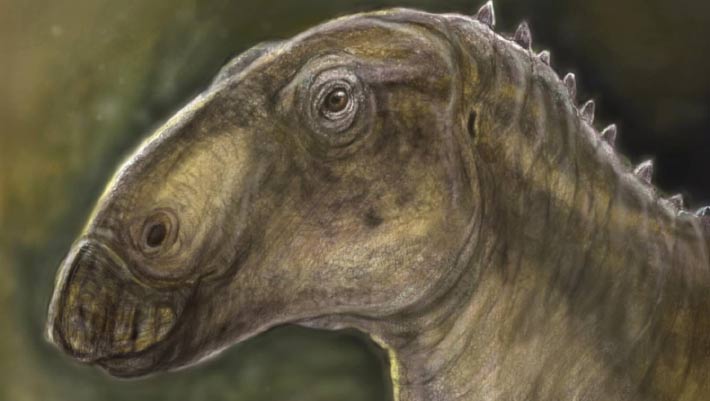
New Duck-Billed Dinosaur Unearthed in Romania
pelvis Hungary Italy Romania United Kingdom Maastrichtian Dinosauria Kryptohadros new species skeleton
An international team of paleontologists from Romania, Hungary and Italy has identified a new genus and species of herbivorous, duck-billed dinosaur from an incomplete skeleton unearthed in the Hațeg Basin, a bowl-shaped depression in the Carpathians of present-day Romania. The post New Duck-Billed Dinosaur Unearthed in Romania appeared first on Sci.News: Breaking Science News.
16/06/2026 sci-news
1 2 3 4 5