squelette

Type de vue

136 image(s) · 8 Actualités

Galerie d'images

Photo of the partial holotype skeleton of the ornithomimosaur Garudimimus brevipes, as mounted in the Mongolian Natural History Museum. Scan of physical photograph.
Taxons Garudimimus

Photo of the partial holotype skeleton of the ornithomimosaur Garudimimus brevipes, as mounted in the Mongolian Natural History Museum. Scan of physical photograph.

musée holotype Garudimimus partiel +1
Reconstruction of the Bravoceratops skeleton with known bones marked in white. Specimen: TMM 46015-1 (holotype). Scale bar=2 m. Total length along centra=6.97 m.
Taxons Bravoceratops

Reconstruction of the Bravoceratops skeleton with known bones marked in white. Specimen: TMM 46015-1 (holotype). Scale bar=2 m. Total length along centra=6.97 m.

écaille reconstitution holotype spécimen +2
Ornithischian dinosaur Stenopelix valdensis Meyer, 1857, holotype (GZG 741/2, formerly GPI Gö 741−2), from the Obernkirchen Sandstone (Early
Cretaceous: Berriasian), near Bückeburg, Niedersachsen, Germany. A. Large sandstone slab. B. Interpretative outline drawing of large latex cast (prepared
from large sandstone slab), showing majority of postcranial skeleton in dorsal view. C. Small sandstone slab. D. Interpretative outline drawing of small la−
tex cast (prepared from small sandstone slab), showing sacrum and caudals, pelvic region and partial hindlimbs in ventral view. For clarity elements in and
around the sacral region have not been labelled—these areas are shown in greater detail in Fig. 3. Roman numerals II–IV correspond to respective digits.

Abbreviations: mt, metatarsals; f, femur; ?, unidentified element.
Taxons Stenopelix

Ornithischian dinosaur Stenopelix valdensis Meyer, 1857, holotype (GZG 741/2, formerly GPI Gö 741−2), from the Obernkirchen Sandstone (Early Cretaceous: Berriasian), near Bückeburg, Niedersachsen, Germany. A. Large sandstone slab. B. Interpretative outline drawing of large latex cast (prepared from large sandstone slab), showing majority of postcranial skeleton in dorsal view. C. Small sandstone slab. D. Interpretative outline drawing of small la− tex cast (prepared from small sandstone slab), showing sacrum and caudals, pelvic region and partial hindlimbs in ventral view. For clarity elements in and around the sacral region have not been labelled—these areas are shown in greater detail in Fig. 3. Roman numerals II–IV correspond to respective digits. Abbreviations: mt, metatarsals; f, femur; ?, unidentified element.

dessin Allemagne Berriasien Crétacé +7
Composite skeleton on display at the Perot Museum of Nature and Science. Scale bar equals 10 cm.
Taxons Convolosaurus

Composite skeleton on display at the Perot Museum of Nature and Science. Scale bar equals 10 cm.

écaille musée Convolosaurus squelette
The holotype skeleton of Kamuysaurus japonicus gen. et sp. nov. (b) Reconstructed skeleton, showing recovered elements. Selected postcranial elements: cervical vertebrae (atlas, axis, and fourth and twelfth cervicals) in left lateral view (c), dorsal vertebrae (first, seventh, and sixteenth dorsals) in left lateral view (d), caudal vertebrae (anterior, middle, and posterior caudals) in left lateral view (e), left scapula (f) and coracoid (g) in lateral view, right sternum in ventral view (h), left humerus in anterior view (i), right ulna and radius in medial view (j), right manus in dorsal view (k), right pelvis in lateral view (l), right femur in anterior view (m), right tibia in anterior view (n), right fibula in lateral view (o), right astragalus and calcaneum, articulated positioned with tibia (p), and right pes in dorsal view (q). All scales are 10 cm except 1 m scale for (b). Abbreviations; ac, acromion process; ast, astragalus; cal, calcaneum; dpc, deltopectoral crest; fi, fibula; icg, intercondylar groove; il, ilium; is, ischium; ltr, lesser trochanter; mc2, metacarpal II; mc5, metacarpal V; mt2, metatarsal II; mt4, metatarsal IV; nc, neurocentrum; od, odontoid; olp, olecranon process; pc, pleurocentrum; pu, pubis; ra, radius; ti, tibia; ul, ulna; vp, ventral process.
Taxons Kamuysaurus

The holotype skeleton of Kamuysaurus japonicus gen. et sp. nov. (b) Reconstructed skeleton, showing recovered elements. Selected postcranial elements: cervical vertebrae (atlas, axis, and fourth and twelfth cervicals) in left lateral view (c), dorsal vertebrae (first, seventh, and sixteenth dorsals) in left lateral view (d), caudal vertebrae (anterior, middle, and posterior caudals) in left lateral view (e), left scapula (f) and coracoid (g) in lateral view, right sternum in ventral view (h), left humerus in anterior view (i), right ulna and radius in medial view (j), right manus in dorsal view (k), right pelvis in lateral view (l), right femur in anterior view (m), right tibia in anterior view (n), right fibula in lateral view (o), right astragalus and calcaneum, articulated positioned with tibia (p), and right pes in dorsal view (q). All scales are 10 cm except 1 m scale for (b). Abbreviations; ac, acromion process; ast, astragalus; cal, calcaneum; dpc, deltopectoral crest; fi, fibula; icg, intercondylar groove; il, ilium; is, ischium; ltr, lesser trochanter; mc2, metacarpal II; mc5, metacarpal V; mt2, metatarsal II; mt4, metatarsal IV; nc, neurocentrum; od, odontoid; olp, olecranon process; pc, pleurocentrum; pu, pubis; ra, radius; ti, tibia; ul, ulna; vp, ventral process.

crête humérus bassin écaille +3
Incomplete skeleton of Camptosaurus prestwichii, now referred to as Cumnoria, Oxford University Museum of Natural History.
Taxons Cumnoria

Incomplete skeleton of Camptosaurus prestwichii, now referred to as Cumnoria, Oxford University Museum of Natural History.

musée Camptosaurus Cumnoria squelette
Partial skeleton of the heterodontosaurid Tianyulong confuciusi from the Lower Cretaceous Jehol Group of China. Partial skeleton mainly in right lateral view (IVPP V17090). Enlargements of subsequent figures are shown in red. Scale bar equals 10 cm.
Taxons Tianyulong

Partial skeleton of the heterodontosaurid Tianyulong confuciusi from the Lower Cretaceous Jehol Group of China. Partial skeleton mainly in right lateral view (IVPP V17090). Enlargements of subsequent figures are shown in red. Scale bar equals 10 cm.

écaille Chine Crétacé Heterodontosauridae +3
Photograph and outline drawing of the skeleton of Chuanqilong chaoyangensis.

A, photograph; B, outline drawing. Abbreviations: ca, caudal vertebrae; cb, cervical band; da, dermal armor; dr, dorsal rib; lfe, left femur; lfi, left fibula; lhu, left humerus; lil, left ilium; lis, left ischium; lma, left maxilla; lmd, left mandible; lmt, left metatarsal; lra, left radius; lsc, left scapula; lti, left tibia; lul, left ulna; mc, metacarpals; orb, orbital; pl, plates; q, quadrate; rfe, right femur; rfi, right fibula; rhu, right humerus; ril, right ilium; rma, right maxilla; rmd, right mandible; rmt, right metatarsals; rra, right radius; rsc, right scapula; rti, right tibia; rul, right ulna; sar, sacral rib; te, tendons. [planned for page width].
Taxons Chuanqilong

Photograph and outline drawing of the skeleton of Chuanqilong chaoyangensis. A, photograph; B, outline drawing. Abbreviations: ca, caudal vertebrae; cb, cervical band; da, dermal armor; dr, dorsal rib; lfe, left femur; lfi, left fibula; lhu, left humerus; lil, left ilium; lis, left ischium; lma, left maxilla; lmd, left mandible; lmt, left metatarsal; lra, left radius; lsc, left scapula; lti, left tibia; lul, left ulna; mc, metacarpals; orb, orbital; pl, plates; q, quadrate; rfe, right femur; rfi, right fibula; rhu, right humerus; ril, right ilium; rma, right maxilla; rmd, right mandible; rmt, right metatarsals; rra, right radius; rsc, right scapula; rti, right tibia; rul, right ulna; sar, sacral rib; te, tendons. [planned for page width].

humérus dessin Chuanqilong squelette
Reconstructed skeleton of Zuul
Taxons Zuul

Reconstructed skeleton of Zuul

Zuul squelette
Fossil skeleton of Gargoyleosaurus parkpinorum taken in 2007 at the Denver Museum of Nature and Science.
Taxons Gargoyleosaurus

Fossil skeleton of Gargoyleosaurus parkpinorum taken in 2007 at the Denver Museum of Nature and Science.

musée Denver fossile Gargoyleosaurus +1
Copy of a skeleton of a Lessemsaurus in the exhibition "Gigasaurier - Die Riesen Argentiniens" in Frankfurt am Main 2010
Taxons Lessemsaurus

Copy of a skeleton of a Lessemsaurus in the exhibition "Gigasaurier - Die Riesen Argentiniens" in Frankfurt am Main 2010

Lessemsauridae Lessemsaurus squelette
Copy of a skeleton of a Lessemsaurus in the exhibition "Gigasaurier - Die Riesen Argentiniens" in Frankfurt am Main 2010
Taxons Lessemsauridae

Copy of a skeleton of a Lessemsaurus in the exhibition "Gigasaurier - Die Riesen Argentiniens" in Frankfurt am Main 2010

Lessemsauridae Lessemsaurus squelette
The incomplete skeleton of Cetiosauriscus stewarti (BMNH R3078) mounted prior to display in around
1903. Photographed in the BMNH, and reproduced courtesy of the Leeds family, with layout by J. J. Liston. Note

the similarity of this photograph to the drawing of the skeleton in Woodward (1905); previously figured in Anon. (1924) and Naish & Martill (2008).[1][2]
Taxons Cetiosauriscus

The incomplete skeleton of Cetiosauriscus stewarti (BMNH R3078) mounted prior to display in around 1903. Photographed in the BMNH, and reproduced courtesy of the Leeds family, with layout by J. J. Liston. Note the similarity of this photograph to the drawing of the skeleton in Woodward (1905); previously figured in Anon. (1924) and Naish & Martill (2008).[1][2]

dessin Cetiosauriscus squelette
Xianshanosaurus skeleton
Taxons Xianshanosaurus

Xianshanosaurus skeleton

Xianshanosaurus squelette
Reconstructed skeleton of Daxiatitan binglingi.
Taxons Daxiatitan

Reconstructed skeleton of Daxiatitan binglingi.

Daxiatitan squelette
Herbivorous dinosaur found in the Al-khoudh area.  This dinosaur is similar to the Zalmoxes and Rhabdodon dinosaurs.  The skeleton in the Bait Al Baranda Museum was assembled from bones borrowed from several museums.

Herbivorous dinosaur found in the Al-khoudh area. This dinosaur is similar to the Zalmoxes and Rhabdodon dinosaurs. The skeleton in the Bait Al Baranda Museum was assembled from bones borrowed from several museums.

musée Mochlodon Rhabdodon Zalmoxes +1
1 2 3 4 5 6 7 8 9

Actualités

Ce dinosaure de 2 livres réécrit ce que les scientifiques savent de l'évolution
fossile Alnashetri Alvarezsaurus Dinosaurus oiseau évolution squelette
Un squelette de dinosaure presque complet découvert en Patagonie aide les scientifiques à percer le mystère des alvarezsaures, un groupe étrange de dinosaures ressemblant à des oiseaux. Le fossile d'Alnashetri cerropoliciensis révèle que ces animaux sont devenus minuscules avant de développer leurs caractéristiques spécialisées ultérieures, telles que des bras tronqués et des adaptations mangeuses de fourmis. Pesant moins de deux livres, le dinosaure est l’un des plus petits connus d’Amérique du Sud.
10/03/2026 sciencedaily ⚙ Traduction automatique
Un fossile de « Sword Dragon » vieux de 190 millions d’années réécrit l’histoire des ichtyosaures
Royaume-Uni Jurassique fossile évolution squelette
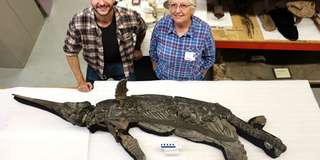
Un ichtyosaure nouvellement identifié de la côte jurassique du Royaume-Uni est en train de réécrire une partie du manuel préhistorique. Surnommé le « dragon-épée du Dorset », ce reptile marin de trois mètres de long a vécu pendant une période d’évolution mal comprise, au cours de laquelle les principaux groupes d’ichtyosaures disparaissaient et de nouveaux apparaissaient. Son squelette magnifiquement préservé – doté d’un museau en forme de lame et d’un éventuel dernier repas – permet de déterminer le moment où cette transition dramatique s’est produite.
24/02/2026 sciencedaily ⚙ Traduction automatique
Des os de dinosaures découverts presque les uns sur les autres en Transylvanie
os bassin Roumanie fossile Dinosaurus Titanosaurus squelette
Des scientifiques explorant le bassin de Hațeg en Roumanie ont découvert l’un des sites de fossiles de dinosaures les plus denses jamais découverts, avec des os presque les uns sur les autres. Le site K2 préserve des milliers de vestiges d’un lac préhistorique alimenté en crue qui agissait comme un piège osseux naturel il y a 72 millions d’années. Aux côtés de dinosaures locaux communs, les chercheurs ont découvert les premiers squelettes de titanosaures bien conservés jamais découverts dans la région. Le site révèle comment les anciens écosystèmes européens de dinosaures se sont formés et ont évolué au cours de cette période.
23/12/2025 sciencedaily ⚙ Traduction automatique
1 2